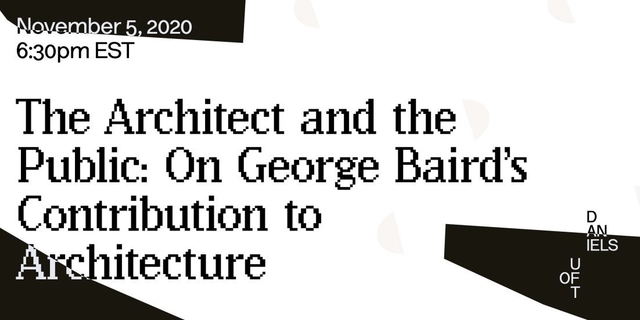
The event is the first of a series of conversations to launch the recently published book The Architect and the Public: On George Baird's Contribution to Architecture (Quodlibet, 2020). The first group of speakers moderated by Roberto Damiani, the book editor, includes Brigitte Shim as a discussant and the volume contributors Joan Ockman, Richard Sommer, Hans Ibelings, Michael Piper, and Andrew Choptiany.
Project Lari begins as an international design competition, that seeks innovative proposals for movable-urban devices in the Indian context. The pursue is to reimagine street carts, keeping in mind women as a target user group and explore the potentials of informal commerce as a legitimate economic resource, while reevaluating the possibilities it offers in the construction of public space. The objective of the competition is to select an outstanding entry in order to detail, construct and implement it in a collaboration with Chaal.Chaal.Agency, URBZ and SEWA.
Towards Half: Design for a Climate Positive Future. How can the built environment meet the 2030 target and halve the emissions of construction and operations this decade? MASS's Good, Clean, & Fair approach offers a language and approach to address this profound challenge - linking climate and socio-economic justice in the process.
Even as the COVID-19 pandemic rages on, the climate crisis continues to impact our cities, towns and regions around the world. Daring Cities is the global, action-oriented virtual forum, designed by ICLEI and the city of Bonn, to empower urban leaders - such as mayors, city councilors, administrators, and urban thought leaders, as well as national government representatives, researchers, technical staff, business leaders, civil society decision-makers and community organizers - to tackle the climate crisis, especially in light of the COVID-19 pandemic. Running from 7 to 28 October 2020, Daring Cities features ambitious global action in a variety of time zones, languages, and formats.
We are shaped by our context and histories. However, we also and critically shape our context and history to influence the future. While this appears so obvious, it took my leaving Kenya to study and work in the US, to discover my own deep-seated biases and discriminations that had influenced my design thinking. This lecture will reflect on how sketching can be utilised as a tool for introspection, with specific regard to breaking down deep-seated biases that are the basis for institutional discrimination. Through my sketches and the work of KDI I will explore the potential of Landscape Architecture, Architecture and Urban Design to shape our context and drive a more equitable future, in Kenyan Urban Space.