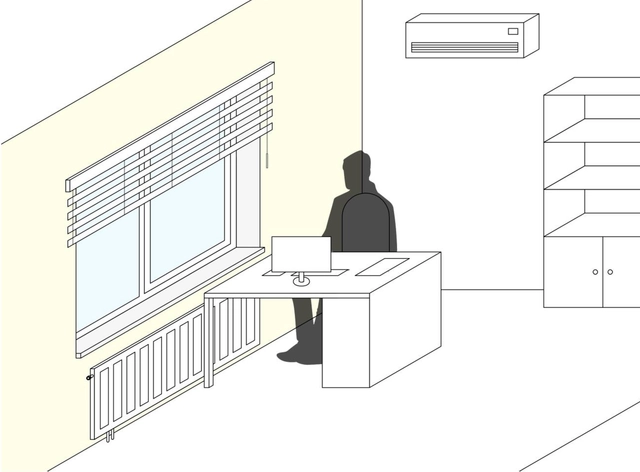
Many of us spend most of our days sitting behind a computer and working. In our working environments, not only indoor conditions, but also the daily interactions with building’s façade (i.e. opening a window, closing a window blind or simply looking out from a window) have a major impact on our experiences. In that respect, as a part of an ongoing Ph.D. research, this survey investigates users' experiences in their working environments, related to the building's façade.
After years of publishing projects and articles related to bamboo, we are strongly aware of its qualities as a construction material. But is it really an option that you would use into your next project? Despite widespread appreciation, bamboo seems to be a material that is rarely considered for use in everyday designs.
The team of Manasaram Architects and CGBMT asked themselves the same question. Together they are seeking to understand the current perceptions of bamboo and to discover its potential as a commonly-used material in the construction sector. To help in this pursuit, they have shared a survey with us which seeks to evaluate how often architects and building professionals use bamboo, the problems they face, and how informed they are about the material.
We would like to invite our readers to spare 10 minutes of their time to help us expand knowledge about the use of bamboo using the survey below. The results will be shared on ArchDaily once the study is complete.
https://www.archdaily.com/886269/is-it-possible-to-massify-the-bamboo-as-a-building-material-in-the-construction-sectorAD Editorial Team
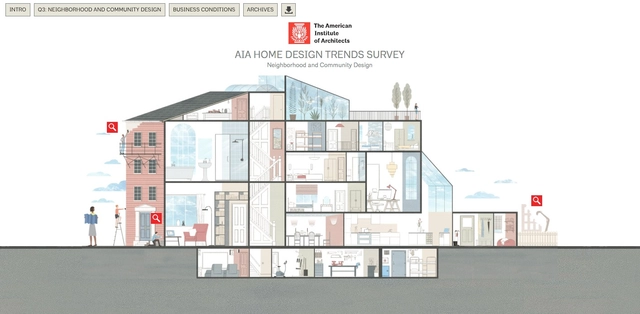
Courtesy of The American Institute of Architects (AIA)
The American Institute of Architects (AIA) has released its Home Design Trends Survey for the third quarter of 2016, which focuses on community and neighborhood design. According to the Survey, homeowners are generally expressing more interest in community development, as indicated by the popularity of thoughtful community design with access to amenities.
There is additionally, according to the Survey, a demand for walkable neighborhoods, access to public transportation, and multi-generational housing, as well as a demand for more and larger glass windows, driven by building technologies like smart glass windows.
The 2016 Venice Biennale has highlighted that dealing with natural disasters may become one of the main preoccupations of architecture in the future. But nature has its destructive ways, and volcanic eruptions are among the most extreme case in point. On the Island of Fogo (Cape Verde), the Natural Park Venue designed by OTO – and elected Best Building of the Year 2015 by Archdaily readers – was destroyed by molten lava flow only one year after its opening in 2013. The building, which combined a cultural center and administrative activities, helped to activate the economy in the island’s most remote area. Following the disaster, Adrian Kasperski, a student at Krakow University, devoted his master’s thesis to the redevelopment of this area, by proposing the expansion of the existing roads and hiking trails and designing facilities to improve alternative tourism offerings.
The Architectural Review has released the results of the fifth annualWomen in Architecture survey, providing insights into the experiences of over 1,000 women worldwide.
One out of five women responding to the survey said that they would not encourage a woman to start a career in architecture, and a similar proportion said they were unsure—only six out of ten overall would recommend an architectural career to another woman.
As a part of the Women in Architecture (WIA) program and its greater campaign, readers are invited to participate in a survey to help track the evolving status of women in the profession on a global level. The anonymous survey is “open to men and women working in the built environment and aims to track perceptions of equality, salary, and flexible working.”
With 1414 responses from 65 countries, the Architectural Record/Van Alen Institute Competition survey is one of the most comprehensive investigations of this question to date. Speaking to the Architectural Record in February, Van Alen Institute competitions director Jerome Chou said that the survey hoped to identify the pros and cons of the competitions process, and offer suggestions for its improvement. "[W]e're hoping to advance the dialogue about the future of competitions, develop new models, and reach new audience," Chou said.
Launched in February this year, the survey sought responses from international design professionals who had participated in a competition during their career.
Read a summary of the survey's key findings after the break.
UK universities are failing to properly equip graduates with the necessary skills required for practicing architecture, according to RIBA’s 2014 Skills Survey. Of the 149 employers and 580 architectural students or recent graduates who responded to the wide-spread survey, a large majority criticized architectural education for prioritizing “theoretical knowledge ahead of practical ability” and agreed that most graduates are ill-prepared for work after studying at the university.
“I can think of no other profession where new graduates must wait a decade or more to be given significant responsibility because they have not acquired basic skills in university,” says Yarema Ronish, RIBA client adviser and director at Richard Morton Architects.
Americans are indicating that they prefer higher-density, more walkable neighborhoods. Image Courtesy of AIA
The AIA just released its third quarter Design Trends Survey for 2013. Key findings have been made since the previous survey, specifically on neighborhood and community trends.
https://www.archdaily.com/459955/aia-focuses-on-neighborhood-and-community-growth-for-q3-2013Jose Luis Gabriel Cruz
The Women in Architecture Survey, which is sponsored by UK magazine Architect's Journal, is open to both men and women and aims to track the perceptions of gender equality in the workplace. It's already yielded significant results - the survey last year revealed large pay gaps between male and female architects, as well as interesting perceptions of work/life balance of the different genders. Research goes towards the Architect's Journal's Women in Architecture campaign, whose goal it is to promote the status of women in the industry. You can find the survey here.
https://www.archdaily.com/452835/fill-out-the-women-in-architecture-surveyKatherine Allen
A few weeks back, we at ArchDaily conducted a poll on Facebook to get a feel for what our readers think about their architectural educations. The question we asked: "Do employers put a lot of weight on what university you attended, or is it mostly about your portfolio?" had some promising results. There is a lot of cynisicm ciruclating in the professional world about what a degree from a particular university means. There are circles were some universities or some degrees are valued over others. Really though, we hope that it comes down to what each candidate can bring to a potential employer.






.jpg?1363809544)