
-
Architects: Architekton
- Year: 2009



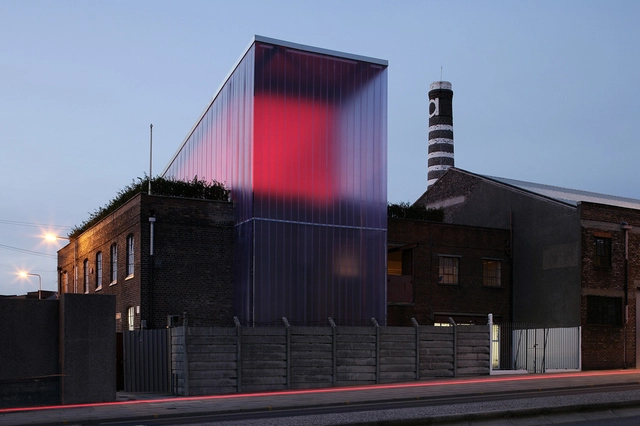
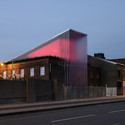
Eric Owen Moss Architects designed a multi-media tower which will sit at the primary entrance of the re-developed zone in Culver City, California. The objective of the tower is to distribute art and other relevant content to the local and in-transit audiences passing by the site.
Further project description and more images after the break.

Rafael López de Heredia Tondonia Winery is one of the oldest and more famous winery in the Spanish region of La Rioja. To celebrate their 125th anniversary they decided to rehabilitate a very old store that the winery founder took to Brussel’s World Fair in 1910 and had been disassembled ever since.
In 2002 current owners (direct descendants of the founder), discovered how beautiful the old store was and decided to built an exterior volume to house the old store. This would become the future wine store and a place where visitors could taste the great wines they produce. This pavillion is only part of all the project that will include three more tasting rooms and a cleaning room. More images and architect’s description after the break.

Los Angeles is often portrayed as the example of the car-friendly city. The traditional image of the town is an endless pattern of single family dwellings, interconnected by traffic-clogged freeways, where transit is undeveloped and the air is choked with smog.
However, Los Angeles is changing. The city’s Transport Authority has planned in the last years a series of measures aiming to improve quality of life through improving transit and walking and providing alternative to car commuting.
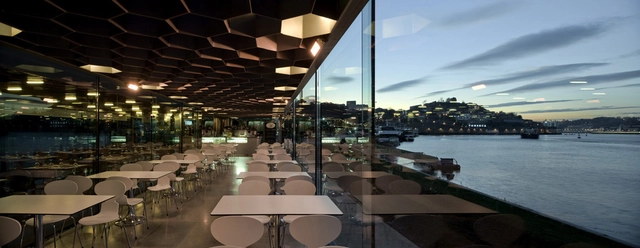

OMA sent us this new images for their latest AMO project, the Prada Transformer. More images after the break.

Our friends at Various Architects, authors of the innovative Mobile Performance Venue, just shared with us a new inflatable project, currently running up for the Yorkshire Renaissance Pavilion competition. From a total of 87 submissions, the jury selected 5 projects and then narrowed down to 3 finalists. Final results aren´t announced yet – we´ll keep you posted on that.
Their project, named “The Yorkshire Diamond“, has a very particular structure with inflatable tubes forming a diamond-lattice structure, forming a box with an excavated interior, which allows for different configurations.
The architect´s description:
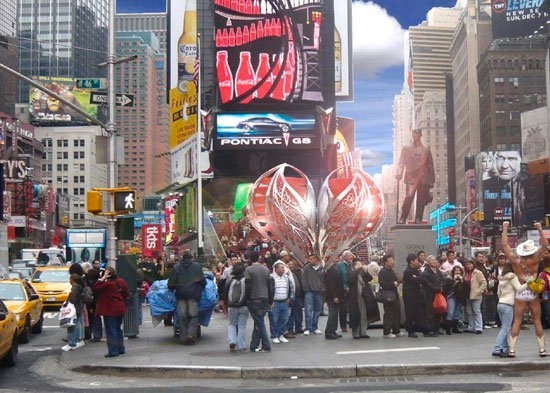
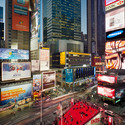
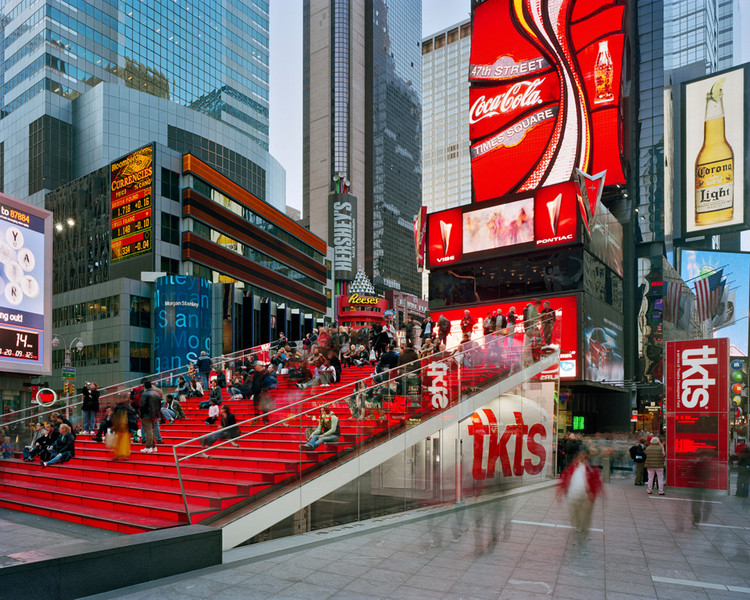
A heart-shaped sculpture by Gage Clemenceau Architects will land on Times Square today. It will stay on Duffy Square until March 1st. The sculpture is constructed with DuPontTM Corian® strawberry ice and welded steel tubes. The heart is lit from within using color-changing LED lighting.

We just got the news that MOS Architects won the competition to build a temporary installation at MoMA´s P.S.1 during this summer.
For this competition the P.S.1 invites each year a group of emerging architects to experiment with new shapes and materials, as Work AC did last year with their PF1 project.
MOS project is entitled Afterparty, a design that Micheal Meredith and Hilary Sample (MOS partners) say is meant to honor and reflect current economic realities, by using basic materials. The main structure is a lightweight aluminum frame using recyclable parts which require minimal assembly, which will become a landmark for the neigborhood – all this on a USD$70,000 budget.
I spoke with Michael a few minutes ago and he refered to the name of the project: One thing about the “Afterparty,” as we’re calling it, is the need to look for new promiscuities after the party of a sort of high-formalism which has dominated academic discourse, and in our case it’s with the basic structural arch geometries, rough almost singular materiality and the production and interaction of “environment,” (literally cooling down the courtyard through stack effect) looking towards a more primitive state of architecture. – (See afterparty definition on Wikipedia).
The project is still under development, and we´ll keep you posted on further updates. We´ll try to do a good coverage on this as we did last year.
You can see other works from MOS previously featured on AD: Floating House and their ORDOS 100 villa.
More images of Afterparty after the break.


Our friends at Inhabitat tipped us on this amazing project, the Folded Bamboo Houses + Paper House by Ming Tang. This structures were conceived as a response to the 7.9 earthquake that strucked China last May.
In order to relocate the people that lost their houses, the Chinese goverment decided to build 1.5 million temporary homes. For this, Ming Tang proposed a shelter that was easily produced, cheap and environmentally friendly, using bamboo. The concept utilizes a system of bamboo poles that are pre-assembled into rigid geometric shapes. The geometry of these forms provides each structure’s integrity, allowing a range of lightweight modular structures to be quickly assembled in factories and transported to their destination. Once constructed, the shelters are then covered by using post and pre-consumer recycled paper.
For this modular system, Tang also proposed a paper fibers, water, and cement envelope that allows for larger configurations.
This project was presented on the RE:Construct competition, a call for a ideas on temporary housing. This project was selected as a notable entry, but i think it should have been awarded since it address a on going problem with a local solution in an innovative way.
This are the kind of projects that I wish were being built right now! What do you think? Do you have more examples on innovative temporary housing?
More pictures after the break.
In my opinion Bjarke Ingels, founder of BIG, is one of the best architects when it comes to give shape to the interests of an “unspoken” client on public buildings,either representing the values of a country or a culture. All with exceptional syntax and presentation skills.
And BIG‘s latest project (in collaboration with Arup and 2+1), the Danish Pavilion for the Shanghai 2010 Expo, does it again, by taking the best of living in Copenhagen and placing it on China for visitors to experience.

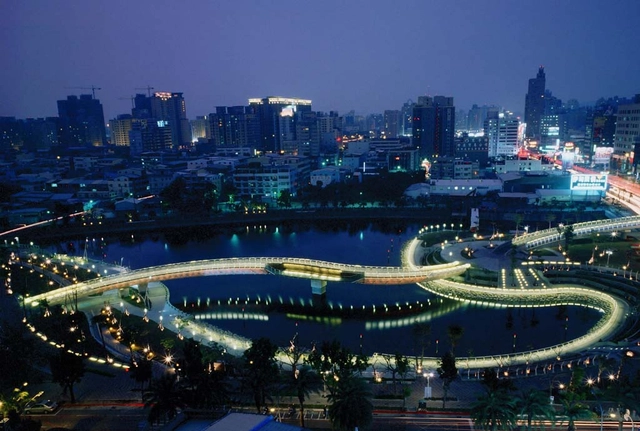
Basically, the pavilion is a big loop on which visitors ride around on one of the 1,500 bikes available at the entrance, a chance to experience the Danish urban way. At the center of the pavilion there’s a big pool with fresh water from Copenhagen’s harbor, on which visitors can even swim.