Floating House / MOS Architects

Architects: MOS – Michael Meredith, Hilary Sample
Location: Ontario, Canada
Design Team: Fred Holt, Chad Burke, Ryan Bollom, Forest Fulton, Temple Simpson, Martin Kredizor, Jimenez Lai
Project year: 2005
Constructed Area: 186 sqm
Engineering: David Bowick, Blackwell Engineering
Construction: Kropf Industries, Penfold Construction
Photographs: Florian Holzherr
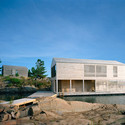
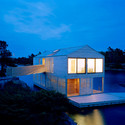
This project intersects a vernacular house typology with the site-specific conditions of this unique place: an island on Lake Huron. The location on the Great Lakes imposed complexities to the house’s fabrication and construction, as well as its relationship to site. Annual cyclical change related to the change of seasons, compounded with escalating global environmental trends, cause Lake Huron’s water levels to vary drastically from month-to-month, year-to-year. To adapt to this constant, dynamic change, the house floats atop a structure of steel pontoons, allowing it to fluctuate along with the lake.
Locating the house on a remote island posed another set of constraints. Using traditional construction processes would have been prohibitively expensive; the majority of costs would have been applied toward transporting building materials to the remote island. Instead, we worked with the contractor to devise a prefabrication and construction process that maximized the use of thee unique character of the site:
Lake Huron as a waterway. Construction materials were instead delivered to the contractor’s fabrication shop, located on t he lake shore. The steel platform structure with incorporated pontoons was built first and towed to the lake outside the workshop. On the frozen lake, near the shore, the fabricators constructed the house.
The structure was then towed to the site and anchored. In total, between the various construction stages, the house traveled a total distance of approximately 80 km on the lake.
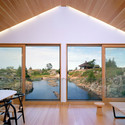
The formal envelope of the house experiments with the cedar siding of the vernacular home. This familiar form not only encloses the interior living space, but also enclosed exterior space as well as open voids for direct engagement with the lake. A “rainscreen” envelope of cedar strips condense to shelter interior space and expand to either filter light entering interior spaces or screen and enclose exterior spaces giving a modulated yet singular character to the house, while performing pragmatically in reducing win d load and heat gain.
- first floor plan
- second floor plan
- east elevation
- north elevation
- south elevation
- west elevation
- section
- model


37 comments »
This house was in Dwell I think. Very beautiful, obviously, but I wonder about the impact for the river and also for anyone else who might want to use it (or look at it). It’s a fairly aggressive gesture. Love the shots at night, though.
–
http://www.contemporaryartdaily.com
wonderful
Great architecture, i should start studying “watching architecture” that´ll be great!
Impressive, but will the steel pontoons survive the ice in the winter?
I was very interested in your float structure. I live in a floating cabin on Powell Lake in BC. My float is large cedar logs that are assisted by 55 gallon plastic barrels. Cedar logs are getting harder to come by to construct new floats. I invite you to take a look at my floating home. — Margy
[...]Thanks for sharing your work with us! Your theme is just awesome![...]
Do you think that special authorisation are required (in France) to build such an house? Or can it be considered as a boat?
Best regards
Hi,
I was just wondering if there were any exploded axometric views of this house to show how the major parts are assembled. Thanks.
-Steven
ВОТ БЫ ТАМ НА РЫБАЛКУ…и домик правильный!
Интересно, кто обьяснит девушке как добавить этот блог в избранное?
in a lecture, they mentioned that the house was constructed almost completely from the shown model. construction drawings were almost non existent.
I think it is pretty, but nothing special. House boats have been around for ages. These guys have basically made a modern zen houseboat, or extremely overbuilt zen party boat. If you like this check out a few of these: http://www.inhabitat.com/2006/08/27/living-the-life-aquatic-on-a-waterliving-houseboat/
the client should have just bought a cheesy house boat! instead of a house that responds to ingeniously to an expensive and beautiful site!
Links to this article »