
-
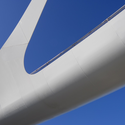
Architects: Ney & Partners
- Area: 110 m²
- Year: 2007



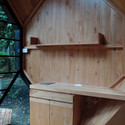
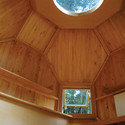
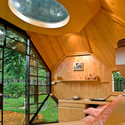
The MODULE ARK, by Sponge Architects, is a design for an autarkic (=self-sufficient) ark to live and/or work on. The design is modern, modular and sustainable. Surrounding the ark with glass facades ensures a maximal openness. Despite of these big glass surfaces, the MODULE ARK stays sustainable because of the low energy consumption, realized by means of a simple mechanical principle consisting of individual façade parts that can be closed and opened separately. These parts are utilized in extreme weather conditions against overheating and hypothermia. More after the break.


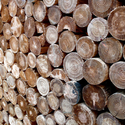
After our UN Studio’s Burnham Pavilion gallery, many of you wondered how it was built. This photo reveals the woodenstructure for this pavilion, which was later finished with a plastic-like material.

When the Jurmala City Council asked Substance to build a sports venue for the popular Latvian sea resort, the firm designed a structure that could be open all year long in any weather. Inspired by the amber – crystallised resin of pine typically washed up on the Baltic coast, the venue’s form incorporates translucent polycarbonate cladding inside a structural framework to accentuate the building’s varying height.
More about the sports venue after the break.

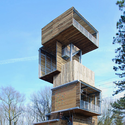
The Steel Structures Education Foundation organized a competition designed for students to fuse their conceptual ideas with the reality of physical structure. With the program and scale left to the discretion of the designer, the proposal had to emphasize the “essential relationship” between the exploration of form and material, with regards to surfaces, members and connections. As an academic project, students also had to use their details to communicate with the steel fabrication industry as a way to expose ”the opportunities and restraints inherent in realizing conceptual design.” “It is important for students of architecture to grasp the fact that structural design lies not just in the realm of the engineer, but can be a means for architects of arriving at a meaningful realization of architectural ideas,” explained the SSEF. The winner, student Matt Schmid from the University of Waterloo, designed a bird sanctuary in Niagara Gorge in Niagara Falls, Ontario, Canada.
More about the winning entry after the break.
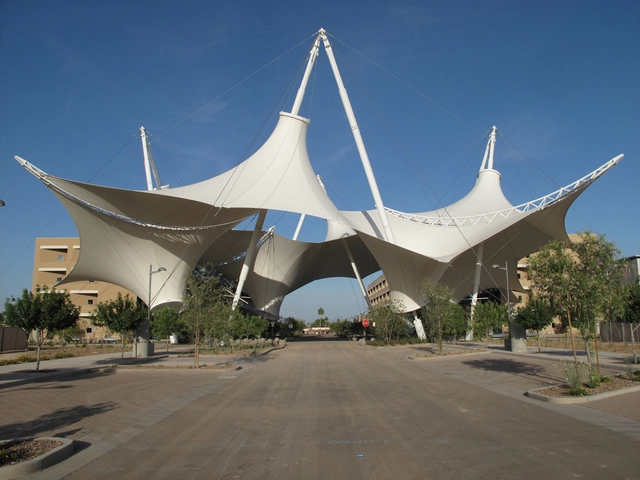

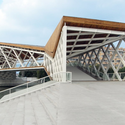
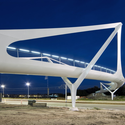
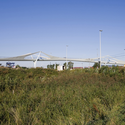
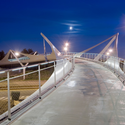
Last week, we featured the Quingpu Pedestrian Bridge designed by CA-DESIGN. The project received many good reviews from you, so they sent more images of the bridge, taken by Nacasa & Partners. See all the fantastic images of the project by day and night after the break.
Another building-related fail. We should make this a series.

Once again, our friend Architect Aristide Antonas surprises us with a wonderful project, this time in London. The design is really interesting but also the way he work the infographics, all in black and with, very sober and austere.
Hope you enjoy as much as I did looking at the project and understanding it!
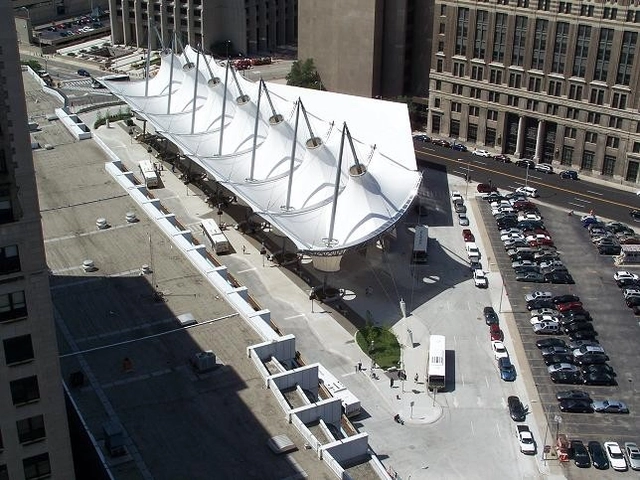


A few months ago we presented you the winning entry for this years YAP competition for the P.S.1 summer installation, awarded to MOS Architects (Michael Meredith, Hilary Sample) as we reported earlier.
This competition has been a field for experimentation on digital manufacturing, new materials and new construction techniques -all under a tight budget-, as we saw in 2008 with the P.F.1 by WORKac.
To keep the courtyard fresh, a series of “hut” like structures conformed by inverted catenaries (part of an on going research by the practice) acting as chimneys: The faux fur that covers them collects heat from the sun, transfering it to the air inside the huts creating a chimney effect that keeps air flowing to cool the lower level.

The resulting space corresponds to the after-party concept envisioned by MOS:
The main purpose of the afterparty is to provide a relaxing environment, as compared to the earlier venue, where the atmosphere is usually more frenetic. During an afterparty people often sit down, relax, and chat freely, meet new people in a more controlled setting. If the original party was one that continued until late at night, the afterparty will often include a morning snack, which usually counts as breakfast. …. Possibly in contrast to relaxation, the afterparty can provide a chance for people to get away from the eyes of people who were overseeing the main party. This tends to be more common in events such as school balls where alcohol consumption is not allowed, and provides a location where the partygoers will be allowed to drink. In this case, the afterparty may turn out to be more lively than the main party, as the people are freed from the restrictions that were placed on them during the main party.
All photos by Florian Holzherr. See more after the break:


Our friends from 100 Planos Arquitectura, a Portuguese firm, shared with us their latest project, Flower Power. Here’s the architect’s description:
The objective of this project was to create a structure model, multipliable, capable of creating ephemeral spaces or buildings. The need for a small pavilion at the Vila do Conde’s museum’s garden, where children and adults can have a rest and stop for some time during a visit to the museum, was the ideal starting point for exploring this idea of multiplication.
The basic module is a “flower” of 1.00 m diameter and 0.50 m high, with four petals, constructed of polycarbonate with plates of 5mm and pvc pipe ø 0,10 m. Assembling several modules with different heights we designed a waving horizontal surface, which suspended, creates a covered area.
Here and there the “flowers” go down to the ground and become a pillars, walls or partitions. We decided to call it “flower power”. It is a pavilion / building / structure, shading, under which you may rest, dance, read, sleep, or simply admire the sky cut by translucent flowers.
More images after the break.

Rem Koolhaas’ latest project -The Prada Transformer- is not just a building, but also a statement on today´s state of architecture. Dubbed the anti-blob, this “object” rejects all common blobby shapes we have seen lately. Simple geometrical shapes (a circle, a cross, a rectangle and an hexagon) enclose a space that depending on its rotation results on different spaces suitable for fashion exhibitions, cinema, art exhibitions and other special events. Each face is the platform on which these activities take place, while also being served by the other faces enclosing the space.
A few weeks ago, we presented the Transformer at Position 1 (Fashion Exhibition) with photos by Iwan Baan . Now, he sent us his photo set for the Transformer at Position 2: Cinema.
From June 26th to July 5th, the Transformer used a center piece on one of the faces to project “Flesh, Mind and Soul”, a film festival co-curated by Alejandro González Iñárritu (director Babel, 21 Grams). Please note that the interiors are now almost all black.
As of now, the Transformer is going through some changes to debut on its new position on Jul 30th to host “Beyond Control”, an exhibition by the Prada Foundation.
More photos by Iwan Baan after the break and the complete photo set on Iwan’s website:

Our friends from Design Crave shared with us these amazing photos of the recently opened public glass balconies for public viewing. The 1.5″ thick glass floor (which resists up to 5 tons) offers amazing views over Chicago, from 1,353 feet in the air.
As you can see on a picture after the break, the balcony cantilevers from the main structure.
More images after the break.

Typical cases of structure damage show portions of or whole buildings collapsing, but this is the first time that I see a building perfectly toppled.
The 13-story building is part of the Lotus Riverside complex in suburban Shanghai. The cause of this epic structural fail is under investigation, but first sources claim that an error on construction and unstable soil conditions are the probable causes.
More images after the break.