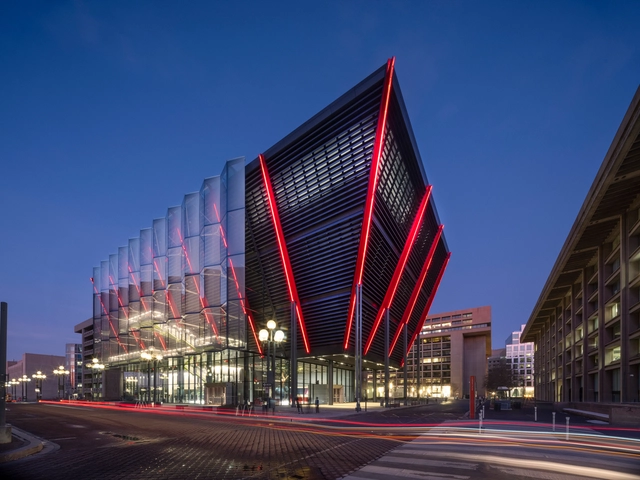
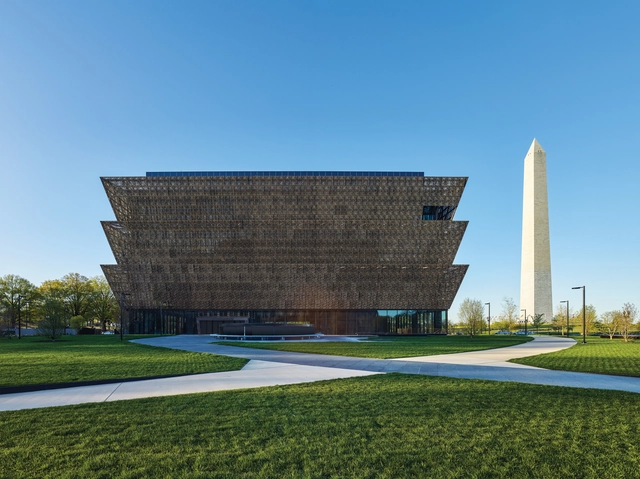
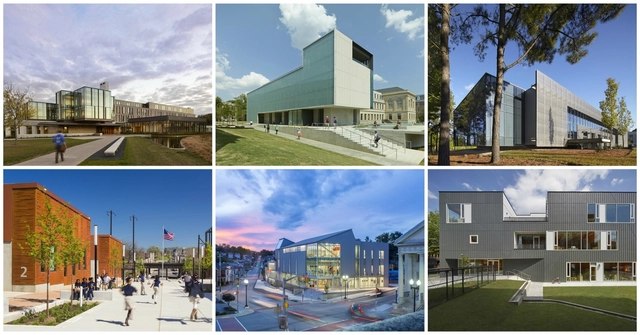
Washington D.C. has earned a reputation for iconic architecture. Emerging from the L'Enfant and McMillan Plans, Washington’s cityscape includes wide streets and low-rise buildings that sprawl out from circles and rectangular plazas. From the White House to Lincoln Memorial, Washington’s architecture was built to symbolize the nation’s values. Today, new projects are designed to rethink the city’s morphology while respecting its identity.
“Education continues to evolve, and the projects from this year’s Education Facility Design Awards program—presented by the AIA and the Committee on Architecture for Education—represent the state-of-the-art learning environments being developed in today's learning spaces,” explain the AIA. “These projects showcase innovation across the entire learning continuum, displaying how today's architects are creating cutting-edge spaces that enhance modern pedagogy.”
Now in its 21st year, the COTE Top Ten Awards program was established to honor projects that protect and enhance the environment through an integrated approach to architecture, natural systems, and technology.
Fifteen years ago, when I worked on the design of a high-performance museum, the concept was considered so unusual that the media questioned the very idea. The US Green Building Council (USGBC) had only very recently introduced its Leadership in Energy and Environmental Design (LEED) rating system, so much of the public wasn’t familiar with the concept. Over the following decade, it became more and more popular in every building type, including museums. A watershed year was 2008. The Water + Life Museums in Hemet, CA, became the first LEED Platinum museum, quickly followed by the California Academy of Science, which has been called “the world’s greenest museum.” The same year, the Grand Rapids Art Museum became the first LEED-certified art museum. By 2016, International Museum Day could highlight ten LEED-certified museums in the US alone.
The American Institute of Architects (AIA) have named 18 architectural and interior projects as recipients of the 2017 Institute Honor Awards, the profession’s highest recognition for excellence in design.
According to the AIA, “the 2017 Architecture program celebrates the best contemporary architecture regardless of budget, size, style, or type. These stunning projects show the world the range of outstanding work architects create and highlight the many ways buildings and spaces can improve our lives.”
The awarded projects were selected from nearly 700 submissions. The winners will be honored at the 2017 AIA National Convention in Orlando.
This article, originally titled "The Space of Resistance," was originally published on Lance Hosey's Huffington Post blog. It is part of a four-part series about the Smithsonian National Museum of African American History and Culture.
The city can be a powerful form of political myth, and Washington, DC, is the premier example.
Political myths dramatize historical events for ideological purposes, in order to strengthen the authority of the status quo. For example, America’s Founding Fathers often are portrayed as motivated only by a virtuous desire for universal freedom and equality, a simplistic depiction that ignores the complex socioeconomic forces behind the Revolution. The National Mall, its buildings, and its monuments, are America’s foundation myth writ large in stone and space. Manfredo Tafuri called the image of the District of Columbia “a timeless, indisputable, completely ‘positive’ Olympus” whose creation “presupposed great optimism and was thoroughly opposed to any polemical doubt.”
In this sense, the city as political myth is ripe for protest, and the National Mall has been the site of many of the most important protests in American history. Most often, these events consist only of people gathering for demonstration. Sometimes, however, they involve building.
This year's theme was “Visioning and Re-Visioning," which focused on "the ways in which pedagogical innovation and cutting-edge design impact and influence each other." The AIA also notes that education facility design may now be more important than ever, as recent studies have indicated that a positive learning environment can affect a child’s academic progress over a year by as much as 25%.
Find out which projects received awards, after the break.
Northerly Island / Studio Gang Architects + SmithGroupJJR
Seven exemplary projects in architecture, planning, landscape architecture, and urban design have been named winners of the 2013 Great Places Awards and were honored during the 44th annual conference of the Environmental Design Research Association (EDRA) earlier this month. The EDRA Great Places Awards recognizes professional and scholarly excellence in environmental design and pay special attention to the relationship between physical form and human activity or experience.
The American Institute of Architects (AIA) and its Committee on the Environment (COTE) have selected the top ten examples of sustainable architecture and green design solutions. Now in its 16th year, the COTE Top Ten Green Projects program is one of the profession’s best known recognition program for sustainable design excellence.
The highlighted projects are the result of a thoroughly integrated approach to architecture, natural systems and technology. They have made a positive contribution to their communities, improved comfort for building occupants and reduced environmental impacts through strategies such as reuse of existing structures, connection to transit systems, low-impact and regenerative site development, energy and water conservation, use of sustainable or renewable construction materials, and design that improves indoor air quality.
All the projects will be honored at the AIA 2012 National Convention and Design Exposition, next month in Washington, D.C. Continue after the break to review the top ten green projects.