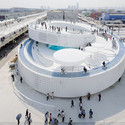
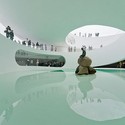
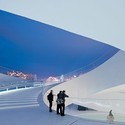
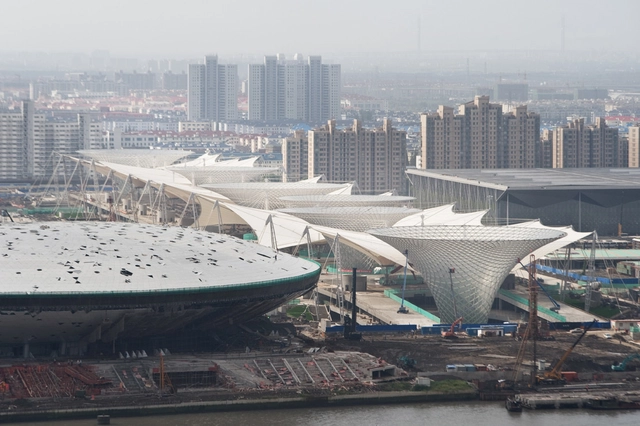
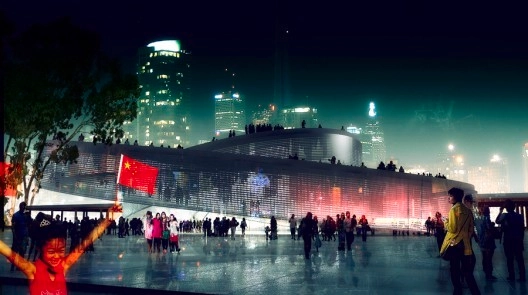
Here’s another great time lapse video from Seppe, this time walking us through the German Pavilion in Shanghai designed by Schmidhuber + Kaindl GmbH (more Shanghai coverage here). Entitled Balancity, the pavilion is designed by Lennart Wiechell and at 6,000 m2, it is the country’s largest structure at any exposition. The building’s geometric mass was conceived as a three dimensional sculpture and the form wraps certain spaces which showcase different aspects of Germany. As you can see in the video, the pavilion includes a central energy source, a factory-like section, an opera and cultural section, and even a park. The areas show Germany’s technological progressions and products meant to help solve urbanization problems, and visitors slowly glide past certain installations on moving walkways. Unlike other countries’ pavilions that seem to work off of one cohesive theme, the German pavilion seems much more “busy” – it is a conglomeration of many different ideas and products with lots to see at each turning corner. What do you think of Balancity?
Check out other videos Seppe has shared with us like his British Pavilion time lapse or his Denmark Pavilion video. Full list of credits after the break.
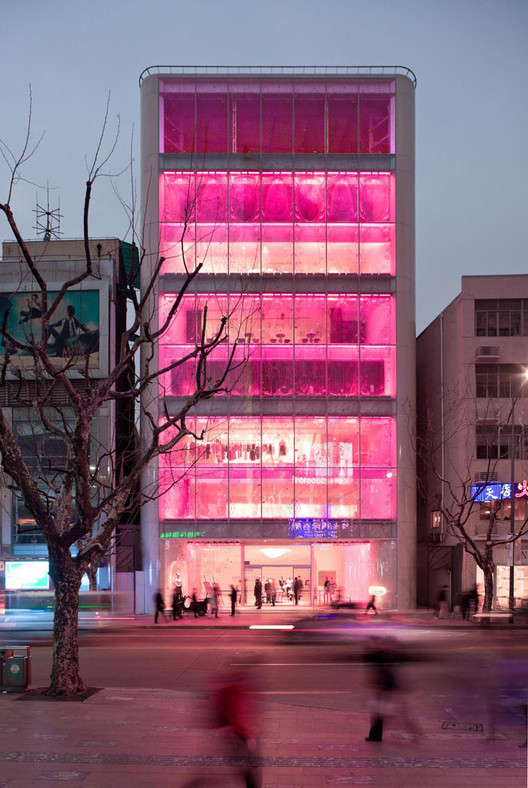
Similar to their identifiable products, the Apple stores require a sleek, almost instantly recognizable, aesthetic. As keepers of the latest technology, the buildings’ minimalist interiors boast a calm and sophisticated demeanor, complimenting, yet not overshadowing, their prized possessions. It may come as a surprise that the leading architects behind the stores are Bohlin Cywinski Jackson (BCJ), a firm that had never designed a retail store before Apple and whose principal, Peter Bohlin, winner of the AIA Gold Medal, ironically doesn’t use email.
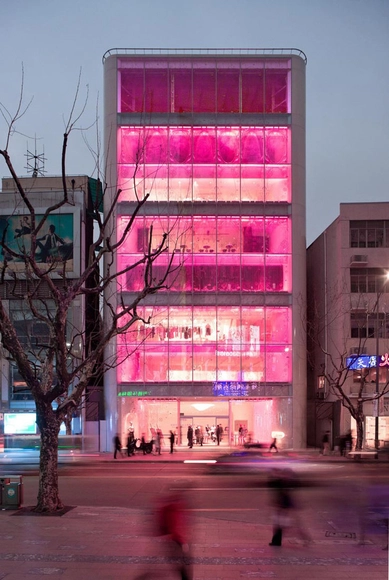
Bohlin has awed us in the past, especially with Apple’s second Manhattan retail store located on Fifth Avenue. Turning a tough retail space into a successful masterpiece, the store’s iconic cube, a 32-foot glass structure, marks the store’s entrance and beckons customers down to the retail level which is illuminated with natural light. And now, BCJ has just unveiled their latest Apple store, and the first of its kind in China which seeks to emulate similar design decisions as the Fifth Avenue project.
EXH Designwas hired to redesign the façades of high-rises in one of the most active urban areas in Shanghai. With the plans of the buildings already halfway through government approval, EXH was allowed little leeway in trying to change the existing plans. Instead, EXH turned their attention to “sculpting” the building’s surface. Taking a geometrical approach, the new façade aims to create a dynamic effect that will become a strong architectural expression for the surrounding areas.
As the key words “Sustainability, Innovation and Communication” cornerstones, the Swedish Pavilion, designed by SWECO, showcases how the nation’s spirit of innovation solves problems, improves the urban environment and living standards, and demonstrates the importance of communication under the new technology situation.
The pavilion comprises four cube-like structures that are arranged to form a cross-like space between them — a shape much like Sweden’s flag when seen from above.The outside walls show a city-like grid; the inside walls are covered with images of nature. These cubes are connected by elevated walkways, and house the exhibition,VIP areas, a shop, a café, and a large covered courtyard — room enough for everyone.
Morphosis Architects is currently completing a massive project in Shanghai: The Headquarters and offices for Giant Group, including residence for the chairman & all Giant Group employees, hotel, training center and clubhouse, with a total of 258,300 sqf (23,996 sqm).
Thom Mayne’s architecture has pushed building techniques in order to take his organics form to reality, and I think that the best way to understand his projects is not through renders or even drawings, but by watching the structure and the construction progress.
Construction for the MalaysiaPavilion for Shanghai World Expo began a couple of weeks ago. The 3,000-square-meter pavilion will be like a traditional and high Malaysian hut. The facade of the pavilion will be made from a combination of palm oil and plastic, which will be recycled for other constructions after Expo.
The country will showcase its natural landscape and the solidarity of its different ethnic groups with the theme “One Malaysia — City Harmonious Living.” Malaysia has 47 ethnic groups, who live comfortably together in urban and rural areas. The country would highlight the harmonious conditions and interactivity between cities and villages, Malaysian Tourism Minister Ng Yen Yen said.
Visitors will be able to pitch and putt at an indoor golf area in the two-story pavilion. The pavilion would hold lucky draws on key days during the Expo, such as August 31, Malaysia’s national day, and May 31 when China and Malaysia set up diplomatic relationships, Ng said.
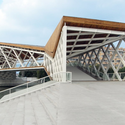
Last week, we featured the Quingpu Pedestrian Bridge designed by CA-DESIGN. The project received many good reviews from you, so they sent more images of the bridge, taken by Nacasa & Partners. See all the fantastic images of the project by day and night after the break.
Typical cases of structure damage show portions of or whole buildings collapsing, but this is the first time that I see a building perfectly toppled.
The 13-story building is part of the Lotus Riverside complex in suburban Shanghai. The cause of this epic structural fail is under investigation, but first sources claim that an error on construction and unstable soil conditions are the probable causes.
The Shanghai 2010 World Expo will without a doubt be a huge event. Countries from all around the world will show what they have to offer in gigantic pavillions built specially for the occasion. So we bring your our first Round Up of previously featured Shanghai Pavillions on ArchDaily.