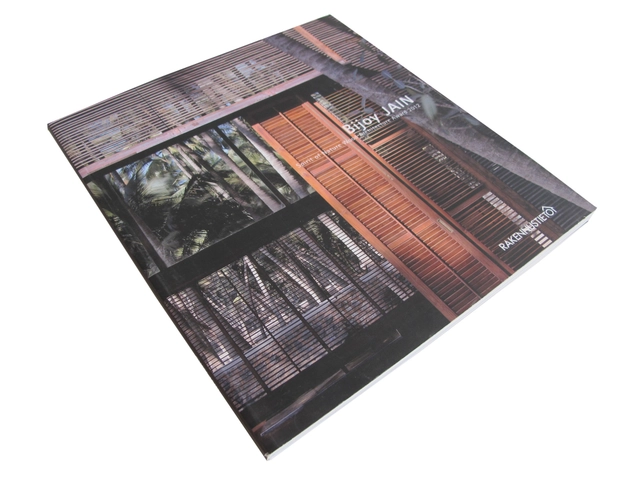
Rakennustieto is publishing now for the seventh time a monograph on the work of the architect awarded the international Spirit of Nature Wood Architecture Award. The 2012 winner is Indian architect Bijoy Jain, who together with his office Studio Mumbai Architects combine excellently traditional craftwork and architecture using meagre resources.
20th-Century World Architecture portrays, for the first time, an overview of the finest built architecture from around the world completed between 1900 and 1999. The unprecedented global scope of this collection of over 750 key buildings juxtaposes architectural icons with regional masterpieces.
Specially designed and commissioned graphics at the start of the atlas explore the changing economic and political contexts of architectural production throughout this fascinating century, and highlight the flow of architectural ideas and architects around the globe. The selection of projects brilliantly illustrates the built outcomes of these formal and cultural influences in every corner of the world, with some surprising revelations.
No one captured the midcentury modernism of the Mad Men era better than Balthazar Korab. As one of the period’s most prolific and celebrated architecture photographers, Korab captured images as graceful and elegant as his subjects. His iconic photographs for master architects immortalized their finest works, while leaving his own indelible impact on twentieth century visual culture. In this riveting illustrated biography, the first dedicated solely to his life and career, author John Comazzi traces Korab’s circuitous path to a career in photography. He paints a vivid picture of a young man forced to flee his native Hungary, who goes on to study architecture at the famed École des Beaux-Arts in Paris before emigrating to the United States and launching his career as Eero Saarinen’s on-staff photographer.
Typology, volume 2 of the new series Christ & Gantenbein Review, presents more than 150 buildings located in Rome, New York, Hong Kong and Buenos Aires that have been analyzed by the chair of Emanuel Christ and Christoph Gantenbein at the Swiss Federal Institute of Technology Zurich. This selective and subjective inventory of metropolitan and essentially anonymous 20th century building production provides a basis for urban project creation.
With its recent transformation, King’s Cross station has re-emerged as one of london’s most iconic buildings. Built in 1852, its elegance and simplicity stood in stark opposition to the neo-gothic extravagance of neighbouring St Pancras, and held its place as a prototype of modern architecture. The story of this station is a fascinating one. It’s a tale of changing fortunes and tides that follows the ascent and decline of Britain’s railways.
Social Media in Action: Comprehensive Guide for Architecture, Engineering, Planning, and Environmental Consulting Firms is, first and foremost, a how-to guide. Using facts, figures and a wide range of research to back up its claims, the book lays out exactly how Architecture firms can get the most bang out of their social media buck.
But the book also takes the time to establish the why of social media – particularly post-Recession – and offers a fascinating glimpse into its future relevance. As the authors explain in the very first chapter: “This new form of media is not a trend. It is the way businesses communicate.” As an Architectural Blog, we see the power and reach of social media strengthen everyday, and couldn’t agree more.
If you have wet feet about jumping on the social media bandwagon, whether out of intimidation or a lack of time, be aware that that many have already dived right in, and, as Walter and Berkley put it, are “riding that wave with some exciting results.” So, let us stress: if you haven’t jumped yet, you need too. Social Media in Action is a good way to start.
For more tips about improving your social media presence from Social Media in Action, read on after the break…
Founded 30 years’ ago by one of Taiwan’s most respected architects, J. J. Pan & Partners has been steadfastly pursuing its vision of creating lasting, beautiful architecture that is appropriate to its role, harmonious with its time and place, and that best expresses the cultural, social and technological environment. A must have companion to the original J.J. Pan and Partners title, this publication is fully illustrated with photographs and plans of J.J. Pan’s most interesting projects.
Once in a Lifetime presents tantalizing new possibilities for exploring and relaxing that redefine the idea of luxury travel.
The book showcases quality destinations beyond superficial pomp that represent a conscious choice for slowing down our hectic lives. The inspiring range of examples includes enchanting tree house hotels, incredible eco-friendly resorts, farms on which guests help with the work, simple hotels and glamping sites in spectacular scenery, as well as glamorous houses, trains, and boats. These are not only depicted in stunning photographs, but also insightfully described by renowned international travel, design, and architecture journalist Marie Le Fort.
Best of Housing by DETAIL Magazine: Housing is something individual: we each have our own ideas and aspirations for it, and we express a lifestyle by the way in which we house ourselves — the way in which we dwell. To dwell means to be “at home”, where one ideally has a sense of well-being.
When it comes to housing, there have been numerous studies of standards, developments and trends, which have analysed and compared people’s needs. But as needs change over time, so do trends. And also the global and demographic changes affecting society alter the way we dwell and flexibility becomes a decisive criterion.
The subject of housing also includes the integration of individual buildings in an urban context. Especially in cities, people often live in compact spaces in which there are fewer personal spaces and more communal areas. Yet each of us longs for a space of our own. Therefore it becomes important that designers develop ideas that meet our shared need for a balance between personal and communal space.
As innovation and new developments in technology now follow each other faster and faster, making yesterday’s architectural fantasies today’s construction realities, there’s already a movement to return to the essential things in life: be it a quest for sustainability, which implies basic principles such as incorporating a region’s typologies and materials, or for reasons of expense, which often prompt a search for efficient designs or manufacturing technology, or even aesthetic requirements that allow people to step out of our increasingly noisy and heterogeneous environment.
Wiel Arets: Autobiographical References offers a unique and unparalleled view of this internationally renowned architect. Wiel Arets’ optimistic outlook towards the future, which he calls ‘A Wonderful World: A New Map of the World’, underlies his global philosophy. This book presents Arets’ lectures on that topic, debates between him and other thinkers and makers, 60 exemplary designs from his studio, and an extensive series of interviews with Arets. Within these texts his background, education, projects, and teachings are interwoven in a discussion that highlights the evolution of his career.
Guilt has been effectively used to control and manipulate the masses. But it can also be the start of a change for the better: awareness, concern, action. Engagement and guilt are never far apart. Engagement is sublimated guilt. We can build on guilt, but can we build with guilt? Is guilt a material to design with?
Guilty Landscapes is the theme for the latest issue of Volume Magazine, a joint effort between AMO, C-LAB and Archis.
The firm’s founder David Stark Wilson cites his experiences in nature as the most profound influence on his architecture. In this volume he has chosen to pair images of his architecture beside the images from nature that inspired his designs. The origins of the firm’s work are also deeply rooted in the vernacular buildings of California and this influence is clearly illustrated in this impressive monograph.
There are few organizations that would utter the words: “we need to constantly look for ways to make ourselves redundant” (46).
But Architecture for Humanity isn’t your typical organization. Since its inception in 1999, the company has put design professionals in the service of local communities, empowering these locals to the point where, frankly, they don’t need the architects any more.
Beyond chronicling inspired designs and against-the-odds accomplishments, the book importantly offers a provocative philosophy : architecture belongs, not to the architect, but to the people and the world for whom it is designed.
More about life lessons and tips from Design Like You Give A Damn after the break…
One of the most impressive pavilions at the Shanghai World Expo 2010 was the UK Pavilion, designed by Thomas Heatherwick. In this book, we can see not only the impressive pavilion, but also a comprehensive overview covering the studio’s entire history. Over 150 projects are represented, each fully illustrated with images selected from Heatherwick’s personal and studio archives.
This informative 11″ by 11″ hardcover book presents a curated collection of award-winning residential and master planning work from leading American designers. Meticulously detailed and site-specific, the featured projects focus on sustainability, technology, and the human spirit. They reflect ideologies and philosophies that are rooted in the modernist doctrine or distilled from vernacular precedents.




![Design Like You Give A Damn [2] / Architecture for Humanity - Image 8 of 4](https://images.adsttc.com/media/images/55e7/288b/4d8d/5d0b/c000/15b9/medium_jpg/design-like-you-give-a-damn-ii.jpg?1441212549)

