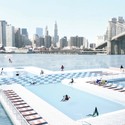
A 30-day Kickstarter campaign to raise funds for the continued development of + Pool is underway. From the creative minds at Family and PlayLab, + Pool is a collaboration to design a floating riverwater pool for everyone in the rivers of New York City. Beginning the next phase of the project, material testing and design, the online fundraising campaign hopefully will raise the initial $25,000 needed to begin physically testing the filtration membranes providing results to determine the best filtration membranes and methods to provide clean and safe riverwater for the public to swim in. A preliminary engineering feasibility report was initially conducted by Arup New York, which assessed the water quality, filtration, structural, mechanical and energy systems of + Pool.
Family and PlayLab launched a Kickstarter online fundraising campaign this month with the ultimate goal of generating enough support to prototype the filtration system by building a full-scale working mockup of the one section of + Pool. Research, design, testing and development will continue through the year in conjunction with permitting, approvals and building partnerships with community, municipal, commercial and environmental organizations.
Donation levels for the Kickstarter campaign range from $1 to $10,000 with the hope that everyone interested in cleaner public waterways can get involved. Donors can choose from a variety of incentives and gear up for a day at the pool. For more information about the project and the campaign or to donate click here. Or write to info@pluspool.org.
Follow the break for more details about this project and the history of floating pools in New York City, which date back to the early 19th century.
This project comes from architectural and urban planning firm, solus4 who has devised a set of principles that guided the design of the Sustainable Vertical Neighborhood. This “neighborhood” takes its form in an iconic 950 foot tall residential tower in New York City. Applying these principles to a vertical neighborhood requires the full engagement of the design team, the building team, the financing team and the owners.
West 57th, BIG’s design of a New York apartment building for client Durst Fetner Residential, takes shape in model form in this video. On display at the Louisiana Museum of Modern Art, the model is part of Living: Frontiers of Architecture III-IV exhibition. The exhibition which opened the first of this month and will run through October 2nd ‘is full of impressions and insights into the multiple ways we live in the world today’.
The young Parisian firm Planda Architecture has shared with ArchDaily their recent competition entry for the Museum of Comic and Cartoon Art in Manhattan. Follow after the break for additional images of this project in addition to a description from the architects.
Storefront for Art and Architecture, the New Museum, and New York City’s Department of Transportation (NYCDOT), are pleased to announce that a team of emerging New York City-based designers from the studios Family and PlayLab have been selected as the winners of Storefront’s StreetFest international competition to re-envision temporary outdoor structures. The StreetFest competition asked for designs that envisioned street tents not only as shelters but also as active elements within the collective construction and understanding of the city.
More on the results of this competition after the break.
Rem Koolhaas will provide the Keynote Address for the upcoming Festival of Ideas for a New City on Wednesday May 4th at 7:00pm held at the Rosenthal Pavilion at the Kimmel Center. Tickets are currently available for purchase.
We are happy to share that our friends from New York-based Weiss Manfredi will be recognized at the 2011 AIA Honor Awards Ceremony in New Orleans this May. The firm’s Diana Center for Barnard College has infused the urban campus with a new sense of vitality as the vertically organized quad unites landscape and architecture with interior and exterior spaces. While the building contains 98,000 sqf of mixed use functions, the project also strongly emphasizes the constant connection between urban user and nature as a grand diagonal slash through the building creates a double-height glass atria to provide inward, as well as outward views. The slipped atria and an unfolded glazed staircase bring in natural light and eliminate visual boundaries between the College and the city, while providing spaces for informal interaction to encourage collaboration and dialogue across disciplines. The building has achieved a LEED Gold certification and Debora L. Spar, president of Barnard College explained, “The Diana Center has not only transformed the way our community interacts, but through its environmentally responsible design and function, has inspired us to become active participants in sustainability efforts. The project was also named a winner of ArchDaily’s Building of the Year Award for 2010 [be sure to view our full coverage of the Diana Center previously on AD].
The main objective behind the design for the new Staten Island Animal Care Center was to create a high quality environment for the animals, staff and visitors. The building is sheathed in a highly insulating, translucent polycarbonate envelope. This provides higher performance in comparison to typical glass and maximizes the benefits of natural light. The roof of the outer perimeter housing the animals is raised above a lower interior roof plane, which covers other shelter functions. This configuration permits the daylight to enter the facility on multiple sides. Natural ventilation is encouraged along the periphery with the use of a passive air ventilation system. A sophisticated mechanical system that uses heat recovery to feed heat gain energy back into the system is incorporated into the design to provide constant fresh air exchange.
Architect: Garrison Architects Location: Staten Island, New York City, New York, USA Project Area: 5,500 sqf Renderings: Courtesy of Garrison Architects
https://www.archdaily.com/121670/in-progress-staten-island-animal-care-center-garrison-architectsChristopher Henry
Immediately, the plan was criticized for its monotony and, in particular, the 90 degree angles of the street intersections – which were designed in an economical fashion as right-angled houses were the most affordable to build. While cities such as Washington DC had grand diagonal cross streets, Manhattan’s plan divided the island into repetitious compressed parcels with no attention paid to changing topography or location. However, opinions of the system seem to be changing, as, over the course of decades, the grid’s logistical framework has proven beneficial and has allowed a magnificent modern city to rise.
Architects: Fabrica 718Project Team: Cara Solomon, Minyoung Song, Kim Letven, Michael Brehmer, Natalya Egon, Abigail Coover, and Corey Yurkovich Location: Soho, New York City, NY, USA Architect of Record: Melissa Cicetti, AIA MEP Engineer: D’Antonio Consulting Expediter: JAM Project area: 1,850 sq. ft. Project year: 2010 Photographs: Sean Hemmerle
Kate Orff shares her vision of ‘oyster-tecture’ utilizing oysters as an agent for urban change. Focusing on the New York Harbor, Orff, architect and founding principal of Manhattan based studio SCAPE, demonstrates how we can rethink our landscapes, both the green and blue spaces, linking nature and humanity for mutual benefit.
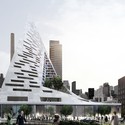
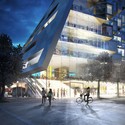
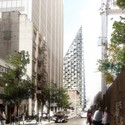
The awkwardly shaped large site at West Side Highway and 57th Street is about to get a whole lot more attention. Bjarke Ingels and BIG will finally make their architectural debut in North America, with an unusual apartment building design in none other than New York City. The asymmetrical peak almost pyramid in shape is the result of blending the mismatched forms of a typical Manhattan tower podium and a low-rise apartment block European in style.
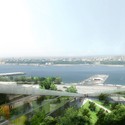
BIG’s reinvention of the ‘New York apartment building’ somehow is able to check all of the boxes, providing a connection to the waterfront and the Hudson River Park, acknowledging the surrounding context both in relationship to building size and neighbors’ views, and alleviating traffic noise. The leafy green courtyards that pop up within this new residential typology help to balance a steeply sloped facade, 450-feet at its peak. Designed for client Durst Fetner Residential, the building offers both a cultural and commercial program and will accommodate 600 residential units varying in size.
Follow the break for the architect’s description and more photographs.
Situated on a prominent waterfront site just across the East River from the United Nations and Roosevelt Island, the Queens Library at Hunters Point is scheduled to begin construction early next year. The design, which was approved this month is a collaboration between Steven Holl and partner Chris McVoy.
The open international ideas competition, hosted by suckerPUNCH, is for a new, larger home for the museum of cartoon and comic art . The museum was established in 2001 and currently is based in the Soho area of Manhattan in New York City. The main goal of the museum is to educate the public about comic and cartoon art, how it is crafted, and how it reflects history. More images and descriptions of winning entries after the break.