An international jury has selected Capital Cities Planning Group (CCPG), an Anglo-American team including Gillespies, John Thompson & Partners and Buro Happold, as winners for the design and planning of the new Federal District in Moscow.
Earlier this year, the Russian Federal Government announced that it was doubling the territory of Moscow to enable it to grow into a competitive 21st century world capital. In response, Genplan, Moscow’s city planner, earmarked an area of 155km2 to the south-west of the city for a new Federal Government Centre, aiming to relieve inner-city congestion through the relocation of the capital’s major employer. Ten international teams were invited to develop strategies and designs for the region during a six month, three stage competition. Continue reading to learn more.
The international team, lead by well-known Russian urbanist Andrey Chernikhov, and including McAdam Architects, Tower 151, Georgi Stanishev and Ginsburg Architects placed first in round two of the Moscow City Agglomeration Development Concept competition. The winning consortium sparked debate by suggesting Moscow officials should consider redeveloping the abundant brown field sites and other available infill spaces within the existing city boundaries before proposing new development. They highlighted vast areas occupied by goods railways and disused industrial sites from Soviet times as prime areas for regeneration and expansion, as well as a re-thinking of transport networks to alleviate pressure on existing systems.
Designed by TOTEMENT | PAPER, the residential area in Block No.5, as part of District D2 (“Science & Technology Park”) of “Skolkovo” Innovative Center, occupies a special area as it is the gate to the district and the main design point facing the Skolkovskoye Highway side. The architectural concept has been worked out to be presented at the second round of the competition. They took into the account close location of crowded housings of circles No.2 and 4 by closing our circle at their side. Bends of buildings allowed them to extend essentially the light front of the buildings and to get the necessary area for housing. More images and architects’ description after the break.
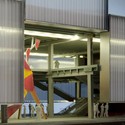
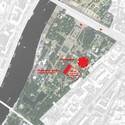
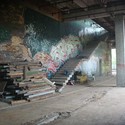
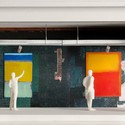
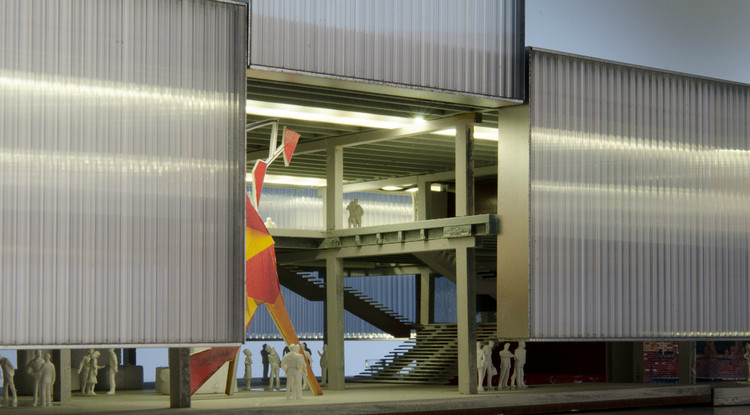
The Garage Center for Contemporary Culture – a non-profit international arts space based in Moscow founded by Daria Zhukova – has unveiled plans for a new building in Gorky Park. Designed by OMA, Garage Gorky Park will renovate the famous 1960s Vremena Goda (Seasons of the Year) restaurant, a prefabricated concrete structure that has been derelict for more than two decades. Garage is expected to complete and occupy this 5,400-square-meter building sometime next year, with plans to later expand to the nearby Hexagon pavilion (or Machine Pavilion).
Rem Koolhaas: “We were able, with our client and her team, to explore the qualities of generosity, dimension, openness, and transparency of the Soviet wreckage and find new uses and interpretations for them; it also enabled us to avoid the exaggeration of standards and scale that is becoming an aspect of contemporary art spaces.”
Chicago based Saltans Architects_Intl., ltd (SA_I) and Shenzhen basedJaeger and Partner Architects, Ltd. design collaboration was recently selected for the second stage international design competition for the Skolkovo Technopark District D2 Residential Area. Their master plan design envisions the “concept of the city at human scale with a strong relationship with nature”. Five distinct Districts comprising this planning strategy are separated and linked by natural landscapes, while each District’s master plan is designed specifically for function. More images and architects’ description after the break.
Skolkovo Innovation Center (‘Russian Silicon Valley’), a high-tech hub to be built at Skolkovo near Moscow, Russia, is intended to concentrate international intellectual capital, thereby stimulating the development of break-through projects and technologies. The modern approach to residential buildings often creates a feeling of isolation. A person has his or her own apartment and a little garden, while neighbors are perceived as competitors. The new residential area, including apartment houses and townhouses, designed by Arch Group, is designed for temporary accommodation of the scientific elite shown in the apartment houses while the townhouses feature a multi-layered environment. More images and architects’ description after the break.
At the Second Exhibition Forum on Architecture, Landscape Architecture and Garden Art last week in Moscow, the project Green River Project Brateevo has been awarded with the Russian National Award on Landscape Architecture. The project, designed byOKRA landscape architects, is a joint cooperation between Russia and the Netherlands. Supported by the Dutch Government, the Department for Natural Resource Management and Environmental Protection of Moscow and the Dutch Government Service for Land and Water management (DLG), are working together with the Dutch consultancy OKRA landscape architects, the Russian consultancy Ampir landscape architects and the Research and Design Institute for the Master Plan of Moscow on the development and exchange of ideas for a sustainable cityscape. Objective is to develop a toolkit for sustainable green development as an integral part of urban redevelopment. More images and project description after the break.
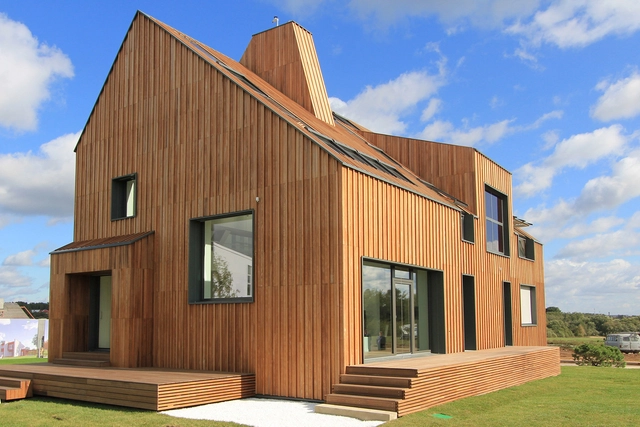
The arbor, designed by Shamsudin Kerimov Architects, is a living space project meant to accommodate a family of about 15 people. The design’s floor plan consists of a semantic differentiation on three zones which they conditionally named “kitchen-furnace”, “dining room-drawing room” and “terrace-scene”. More images and architects’ description after the break.