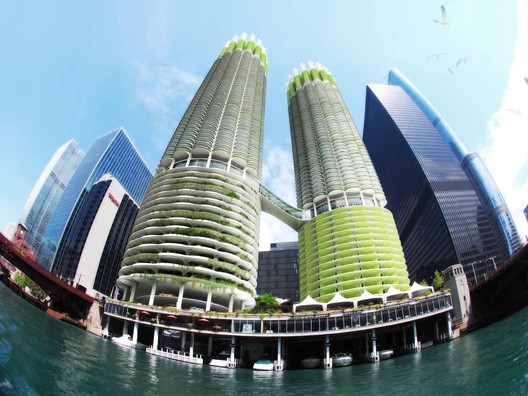
Wolf House Productions and Gabriel Pascariu shared with us their first prize winning proposal in the ‘Dnieper Pearls’ international urban planning competition in Kiev. THE BLUE LINE aims at providing a sustainable development framework for the Kiev islands as well as an infrastructural backbone for the future urban development of the entire metropolis. Their design suggests a paradigm shift: from large scale urban and infrastructure projects (specific to Ukrainian urban planning) to a more fluid and efficient place-making driven urbanism. More images and architects’ description after the break.
In reference to Living Steel‘s 3rd International Architecture Competition for Sustainable Housing, Glen Murcuttdiscusses his ideas surrounding the issue of sustainability. He emphasizes the strategies employed by the top contenders such as the planning of orientation, thermal performance, and human effort in addition to other variables involved in sustainable architecture. One particular method that Murcutt stresses is using materials that can dissolve back into the earth, citing earth walls as an excellent medium to build with and their inherent thermal mass qualities. Each team was invited to present their ideas in person, a variation from previous years which Murcutt believes led to the highest quality of work and diversity of the competition series.
RIBA President Angela Brady discusses design in 2012 with British architect Richard Rogers. Together, they discuss the important issues surrounding housing and cities, both agreeing that “intensification is critical”. Homes built within a compact city are said to be five times more efficient than those built outside the city. This realization is an important fact that should guide government officials, builders and architects to work together towards more intelligent and beneficial growth patterns.
The fundamental concern that guided the decision process from the start was how to produce a solution that is environmentally responsible, functional, cost effective and iconic. The circular shape of the building aims at giving a positive response to all of the above.The proposal by MOOV not only preserves the locations and offers living conditions to its dwellers, but also enhances the actual natural conditions, by regenerating the plot. More images and architects’ description after the break.
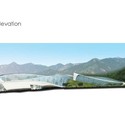
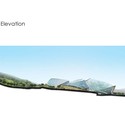
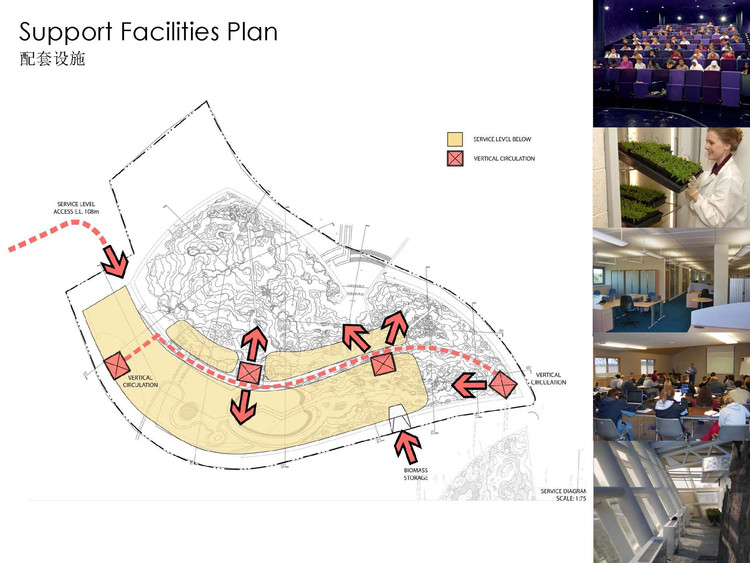
This unique landscape and future landmark for the city of Qingdao, China is a first place project, submitted by the Los Angeles office of HKS Architects, for the design of the Conservatory by the Office of 2014 Qingdao World Horticultural Expo Executive Committee. The winning proposal was selected from an international selection of projects and was shared with us by HKS. Read on for more after the break.
Serie Architects‘ proposal was recently selected as the design for the 2012 Olympic Pavilion for BMW following a sustainable design competition. Their cutting-edge design will represent a significant architectural addition to the Olympic Park, while reflecting the company’s deep commitment to sustainability. BMW’s pavilion, which has a floor space of 800m2, will be built on an elevated site above the Waterworks River, situated between the Olympic Stadium and the Aquatics Center. More images and architects’ description after the break.
Just last week, Mayor Bloomberg and City Council Speaker Christine Quinn enacted 29 new recommendations of the Green Codes Task Force that will provide the proper foundation for New York to meet the aggressive PlanNYC Goals for 2030. The impact of these new codes is estimated to reduce greenhouse gas emissions by 5 percent; lower the energy costs for lighting by 10 percent; save 30 billion gallons of water through better plumbing regulations; treat 15 million gallons of toxic construction water; recycle 100,000 tons of asphalt; and save $400 million in overall energy costs. The implementation of such codes is the result of the formation of the NYC Green Codes Task Force, an organization led by Urban Green Council, that proposed over 100 recommendations in 2010 to address a wide range of sustainable issues; and, in the two years since that report, the Mayor’s Office and City Council have made 29 of those recommendations law, and are currently working to codify 8 others.
More about the new building codes after the break.
European Union Climate Commissioner Connie Hedegaard urges world leaders attending the United Nations Conference on Sustainable Development in Rio de Janeiro this June to double the share of renewable energy they use by 2030 and give all citizens access to sustainable power.
The Preservation Green Lab at the National Trust for Historic Preservation has recently published their study The Greenest Building: Quantifying the Environmental Value of Building Reuse. Resolving many conflicted arguments, this study confirms that reusing and retrofitting existing buildings with an average level of energy performance almost always offers environmental savings over demolition and more energy-efficient new construction. The research provides the most comprehensive analysis to date of the potential environmental impact reductions associated with building reuse. The Preservation Green Lab utilizes Life Cycle Analysis (LCA) methodology to compare reuse and renovations with new construction over the course of a 75-year life span. Continue reading for more.
Barcelona designer Martín Azúa questions the idea of the private home with the Basic House – an inhabitable volume that is “foldable, inflatable and reversible”. The experimental prototype challenges the idea of homeownership, offering an alternative to the materialistic reality of today. Made from metalized polyester, the Basic House is a shelter small enough to fit in your pocket, allowing you to break away from the imprisonment of material ties.
In this interview published by Seattle Met, Lawrence W. Cheek speaks with Tom Kundig, principal at Olson Kundig Architects. Kundig has defined his career for designing homes that are flexible and considerate in their materials, functions, response to site and the way that the human body interacts with the space and mechanics of the environment. This interview is excellent at revealing Kundig’s inspiration and priorities when it comes to designing homes and he mentions some great examples and strategies that he has taken over the years.
Here is just a list of the variety, but consistency, representative of Kundig’s work:
On January 25th at 6pm, Tom Kundig will be speaking with Mark Rozzo at the New York Public Library about Tom Kundig: Houses 2. More information on that event coming soon.
Follow us after the break for the full interview, courtesy of SeattleMET, ”Q&A with Architect Tom Kundig” by Lawrence W. Cheek.
The United States Green Building Council‘s (USGBC) Center for Green Schools, started by the Georgia Chapter, is behind the transformation of the educational system in this country through the introduction of high performance schools and facilities. It all starts with providing an environment for learning focusing on health, education and the responsible use of funds, which are “the three major concerns that the school system struggles with”, says Laura Turdel Seydel – Chair of the Captain Planet Foundation. The fundamentals are simple and are the typical goals of the Board of Education. But this initiative, which is a coalition between some of the top educational and environmental associations in the country, does this by focusing on where students are learning and that means updating the technology of our schools.
British architect David Chipperfield recently gave an interview with Crane.tv discussing his architectural philosophy and affinity for the German culture. He expands on his approach to architecture and touches on his work for the completed reconstruction of the Neues Museum in Berlin. Be sure to check out some of his other recent works including; The Hepworth Wakefield art gallery in Wakefield, England, Turner Contemporary – a visual arts venue in Margate, England, America’s Cup Building in Valencia, Spain, and the Central Public Library in Des Moines, Iowa.
The main idea behind AME, the first concept by Wesh for a business incubator, is to re-create a small world where different companies can develop themselves and get bigger, with all services provided. The design questions the future of small companies in the periphery of the city for the next 20 years. How can a building enable many companies, each having their own singularity and size, to get along together and evolve? AME is all about wrapping plenty of entities into a bioclimatic greenhouse. For a monthly subscription, each company has its own space, which can be extended or reduced thanks to the company development. More images and architects’ description after the break.
Through our interview program, I’ve had the chance to meet with some of the world’s most renowned architects, while creating a moment to share their views about the profession with our readers.
ArchDaily is once again updating you on the progress of The Stavros Niarchos Foundation Cultural Center designed by Renzo Piano. We showed you initial plans for the building back in 2009. Since then, we have been provided with more detail on the development of the project, which we continue to share with you. As previously mentioned, the center will be a sustainable arts, education, and recreation complex that will contribute to the community of Athens, financed by the Stavros Niarchos Foundation. Plans for this building began five years ago but it was not until December 2011 that preparatory excavation work finally began. Construction is scheduled for Spring 2012 and according to the foundation website:
The beginning of the construction phase comes at a very critical juncture in modern Greek history and brings a much-needed sense of optimism and hope, as well as a whole range of significant economic benefits to the country. Approximately €1 billion of total economic stimulus will be derived from the upfront commitment in the construction of the SNFCC, while 1,500 to 2,400 people will be employed each year to support SNFCC construction and all related industries.
The United States Green Building Council (USGBC) and the American Institute of Architects (AIA) announce Burtland Granvil, AIA, LEED AP as the new Architecture for Humanity Sustainability Design Fellow. Succeeding the first Sustainability Design Fellow, Stacey McMahan, AIA, LEED AP, Granvil will be working directly with the Haitian community at the Architecture for Humanity’s rebuilding center based in Port-au-Prince.
“The earthquake didn’t take as many lives as the poor quality of construction did,” said Granvil. “Architecture for Humanity’s Rebuilding Center in Haiti will help educate and build together with local current and future builders of Haiti…this is the main reason why I joined Architecture for Humanity. I am here with others to work on the long-term approach. Haiti, as well as other post disaster areas, can benefit from this kind of transitional office with this mindset.”