Cinematographer Tomas Koolhaas, son of notorious Rem Koolhaas, has shared with us his latest clips from the feature length documentary film, REM. Set to debut in 2013, the motion picture breaks away from conventional approach to filming architecture and exposes the raw, human experience of Dutch architect’s most famous projects. As Tomas describes, REM gives the audience “a rare insight into the reality of the hidden internal life of the buildings”.
ArchDaily had the chance to discuss the film with Tomas. Continue after the break for the complete interview and another small preview of the film!
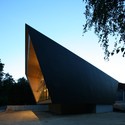
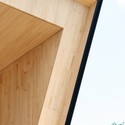
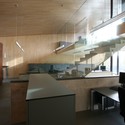
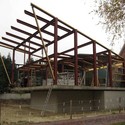
The Headquarters Krogmann in Lohne-Kroge, Germany, by Despang Architekten investigates the numerous characteristics and fundamental opportunities inherent within wood and exhibits a modern approach to the craftsmanship of traditional German vernacular. Designed as a new corporate center of operations for the woodworking company Krogmann, this new office would need to succeed not only in handcrafting a new image for them, but also serve as a catalyst for future growth while showcasing their ability as ‘makers’ in the field of construction. Having worked as the builders for several projects for Despang Architekten, their choice to retain them as the design architects for their own project was a natural extension of an already solid relationship built upon the dedication to quality and progressiveness. As an extension of this article, we also had the opportunity to speak with Principal and University of Hawaii Associate Professor Martin Despang about the process involved in the making of this project.
More details and our Q&A with Martin after the break.
Taking place October 10-12 at the University of Stuttgart, Germany, the “Beyond Green! – Tall Buildings in a Sustainable Future” symposium focuses on how tall buildings be designed, built and maintained in a sustainable fashion. The keynote lectures will be held by Christoph Ingenhoven and Helmut Jahn_Murphy/Jahn. The sessions are dedicated to urban development and economy, ecology, planning and realization, structure and skin and building services. More information after the break.
We interviewed Winnipeg- based 5468796 Architecture (Johanna Hurme + Sasa Radulovic) and Jae-Sung Chon (Faculty of Architecture, University of Manitoba), the team that curated the “Migrating Landscapes” exhibit at the Canadian Pavilion for the 13th Venice Biennale. The Migrating Landscapes Oganizer (MLO) invited, through a national competition, young Canadian architects and designers from a wide range of cultural and educational backgrounds to create scale models of ‘dwellings’ and accompanying videos that draw on cultural memories.
Since it’s founding in 1986, Reiser + Umemoto, RUR Architecture P.C. has become a widely published, internationally recognized practice with a diverse collection of projects ranging in scale. On multiple occasions, the firm has been awarded for their contributions to architectural practice and theory – the most recent being The Cooper Union’s 2008 Presidential Citation and the 2011 John Hejduk Award – as they treat “each project as the continuation of an ongoing inquiry, delving into relationships among architecture, territory and systems of distribution.”
For this week’s edition of our Recessionary Interviews series – in which we talk to Architects across the globe surviving the Recession - we decided to get one final perspective from the Iberian Peninsula. We chatted with Spain’s Josep Ferrando, of Josep Ferrando Bramona Architecture, who told us how the economic bust has shifted focus from public works towards an architecture of “re”: rehabilitating, re-structuring, re-inhabiting.
Get Ferrando’s take on the state of Architecture in Spain today, after the break…
The Research and Documentation Centre in Technology, Architecture and City in Developing Countries (CRD-PVS) at the Politecnico di Torino (Italy) has launched an international Student Design Competition tur(i)ntogreen – Farms in A Town. Sponsored by the UN-HABITAT within the “I’m a City Changer” campaign, participants are invited to apply their creative talents in developing new multidisciplinary solutions for a sustainable and inclusive city reflecting new forms of urban management and regeneration through agro-housing and urban-farming models.
Designer: Morag Myerscough of Studio Myerscough Customized ice cream bicycle: Luke Morgan Furniture: Morag Myerscough and Luke Morgan Location: Waller Way, Greenwich, London Se10 8JA, UKProject Year: 2012 Project Area: 140 sqm Client: Cathedral Group
During the opening of the Venice Biennale, we had the chance to sit down and talk with the curator and participants of the Japan Pavilion, awarded with the Gold Lion.
In the following videos you can see Toyo Ito, curator of “Architecture. Possible Here? Home-for-all”, along with collaborators Akihisa Hirata and Sou Fujimoto, discussing what Architecture means to them, the role of architects in our society, and how they approached the Biennale’s theme “Common Ground” on this particular exhibition, which reunites Japanese architects and an architectural photographer collaborating on the design of houses for those affected by the 2011 tsunami.
Jean Nouvel and Mia Hägg presented “Meetings Lines” at the Venice Biennale. For ‘Common Ground’ they decided to show their finalist project for the Slussen Masterplan competition, an ambitious urban design project that seeks to replace much of the degenerated water and transportation infrastructure in the heart of Stockholm. The project proposes three different public spaces, designed as living links for the city, inspired by infrastructure such as the Rialto Bridge in Venice.
“Forty years ago the public cause proved a powerful source of inspiration. Given the numbers of architects that chose to serve it, one might even speak of a common ground. In the age of the ‘starchitect’, the idea of suspending the pursuit of a private practice in favor of a shared ideology seems remote and untenable. In the context of the 2012 Venice Architecture Biennale, this exhibition hopes to provide a small contribution towards finding that common ground once more…” – OMA Partner Reinier de Graaf, August 2012
Throughout Europe in the late 1960s and early 1970s, large public works departments employed architects to design a multitude of public buildings in an effort to serve the public cause. Reinier de Graaf describes this “heyday of public architecture” as “a short-lived, fragile period of naïve optimism – before the brutal rule of the market economy became the common denominator.”
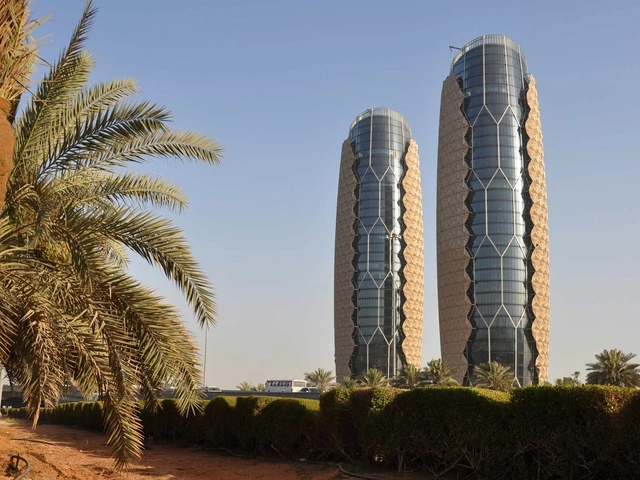
A quick glimpse at the upcoming weather for Abu Dhabi will show a week of intense sunshine, temperatures steadily above 100 degrees Fahrenheit with 0% chance of rain. In such extreme weather conditions, even architects listing environmental design as their top priority are up against a tough battle. Never mind that the sand can compromise the structural integrity of the building, the intense heat and glare can render a comfortable indoor environment relatively impossible if not properly addressed. For Abu Dhabi’s newest pair of towers, Aedas Architectshave designed a responsive facade which takes cultural cues from the “mashrabiya”, a traditional Islamic lattice shading device.
More about the towers’ shading system after the break.