BBC’s Sarah Montague interviews Renzo Piano, the mastermind behind London’s most controversial and newest skyscraper: The Shard. Prior to the interview, Montague spotted Piano blending into the crowd during the opening of the 310-meter skyscraper “spying” on the onlookers. When asked about this moment, Piano revealed the great advice he received from the prominent Italian film director Roberto Rossellini upon the completion of the Pompidou Center in Paris: “You do not look at the building, you look at the people looking at the building.” It was during this moment that Piano observed “surprise” and “wonder, but not fear” amongst the onlookers - a reaction he seemed to be content with.
Despite Piano’s attempt to refrain from controversy, it is hard to avoid when your design intends to celebrate a “shift in society.” Change tends to stir mixed emotions and spark debate. However, being part of the “human adventure” as an architect is what Piano finds most rewarding. He states: “You don’t change the world as an architect, but you celebrate the change of the world.”
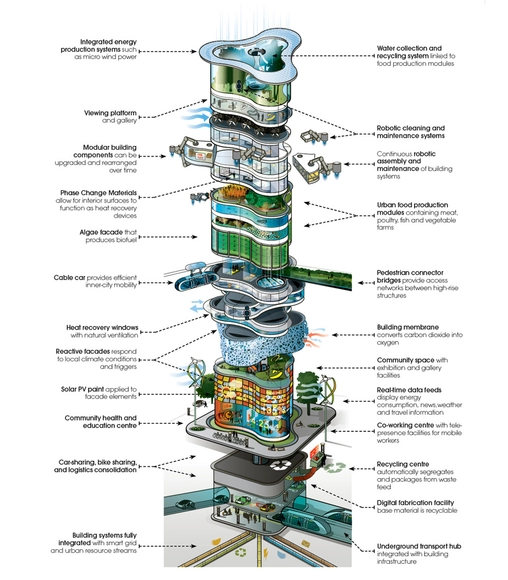
It is estimated that by 2050, 75 percent of the worlds - then 9 billion strong - population will live in cities. Urban Sprawl is already problematic and planners are faced with new challenges as they aim to build towards the sky rather than the horizon. In addition, cities are increasingly faced with climate change, resource scarcity, rising energy costs, and the possibility of future natural or man-made disasters. In response to these issues, Arup has proposed their vision of an urban building and city of the future.
In their proposal, titled “It’s Alive!”, they imagine an urban ecosystem of connected ‘living’ buildings, that not only create space, but also craft the environment. According to Arup, buildings of the future will not only produce energy and food, but will also provide its occupants with clean air and water.
How can a small 420 square foot apartment transform into eight comfortable rooms? It takes smart design solutions that incorporates modulation and interior planning that conforms to everyday needs in an increasingly competitive environment of living space. Founder of Treehugger.com, Graham Hill takes the viewer on a tour of his "Life Edited" apartment that provides a sustainable living solution to compact apartments in urban environments like New York City. This apartment provides all the amenities necessary with some additional effort of converting rooms to fit everyday needs. Interested in seeing this apartment transform into a living room, bedroom, kitchen, dining room and guest room? Join us after the break to find out.
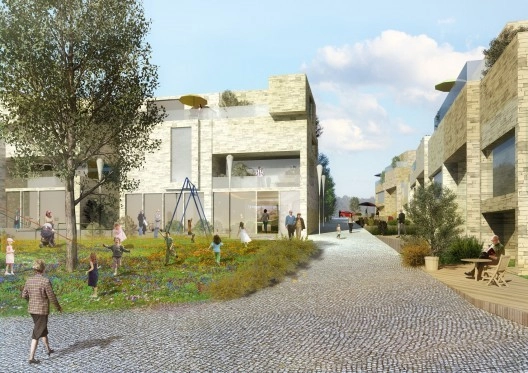
In recent years there has been a lot of talk in the United States about our aging population in terms of social security funds and medicare. We have asked how we should deal with the impending problem that our elderly will outnumber the population that can take of them. While speculations for a solution have generally settled within the realm of the economy, urban planners and architects are asking a different set of questions and looking for solutions regarding how we design. It is important to note, that while most of the discussion has been framed about the aging "baby-boomer" generation, Jack Rowe, speaking at the symposium for Designing Homes and Neighborhoods for an Aging Population in Washington, DC, pointed out that this concern is a conservative estimate of the bigger problem in our "demographic transformation". In fact, the trend is far more expansive; medical advancements and a longer life expectancy mean that for the next few generations each aging population is expected to outlive its parents and will exceed the population of its children. This makes the issue at hand a more over-arching concern, or as Rowe later states, an issue that all members of society must face.
This is why we must think about architecture and urban planning in terms of adaptability for the aging, as we have already starting thinking about it in terms of handicapped accessibility. More after the break.
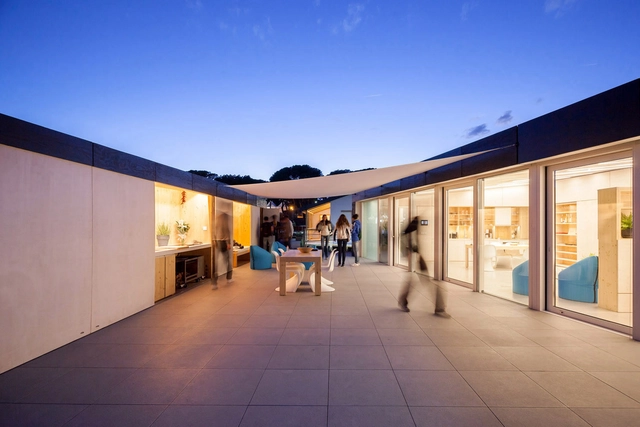
It may look unassuming, but this sleek black box is the culmination of a two-year long collaboration of more than 50 students from 7 different faculties of the Budapest University of Technology and Economics. Initially envisioned by two architecture students and built for the European Solar Decathlon 2012 in Madrid, the goal of Odooproject was to encourage a new sustainable life by designing a house where as much time as possible can be spent outdoors.
More information about Odooproject after the break...
The Transalley Technopole is a metropolitan scientific and technological project of an international dimension, dedicated to transportation and mobility, located on a strategic site of the Valenciennes urban area. The competition proposal by Mikou Design Studio aims to be a real ecosystem of innovation, and it will host the Institut des Transports Durables (Sustainable Transport Institute), the Institut International de Management, and the head office of IRT Railenium, which will be a major research and development center dedicated to railway infrastructure. More images and architects’ description after the break.
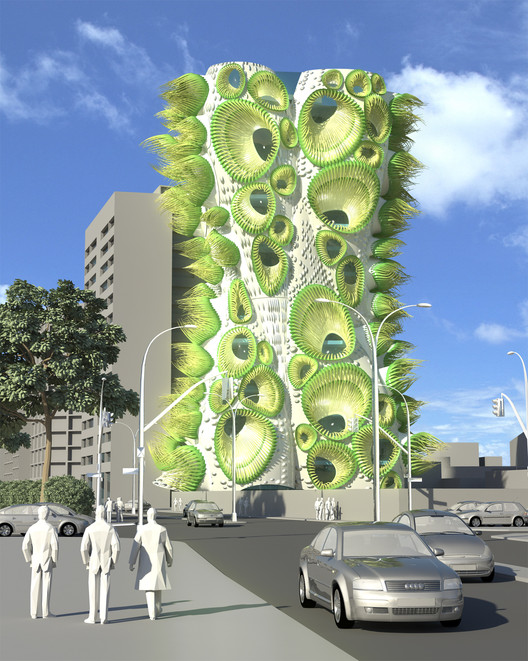
Los Angeles based B+U Architects, a design office recognized internationally for its digital techniques and use of new technologies and material resources, is once again pushing the boundaries of architecture and urban design with its Animated Apertures Housing Tower project in Lima, Peru. The conceptual framework for the design arose from a "clear interest in emphasizing an architecture that can exist between nature and technology," inspired by natural patterns, movements and colors with the overarching goal of creating an "interactive and intelligent building organism". According to the architects, its design aesthetic embraces incongruence, disruption and deformation rather than homogeneity and parametric smoothness - a common solution in many digital designs that the firm wished to avoid.
This past Monday, President Obama made climate change and sustainable energy the focal points of his Inaugural Address when he declared that choosing to ignore these key environmental issues "would betray our children and future generations." This is the first time in the last few months that the President has taken a firm stand for the future of our Earth, a direct result of Super Storm Sandy and a smart choice to reveal controversial policies only after re-election. Although Monday morning was not the time to outline a specific political strategy, President Obama made it very clear that this time around, denial of scientific judgment and Congressional opposition would not be reasons for failure to act.
While this is a sentiment easier said than done and there is doubtlessly a long and difficult road ahead for the President and his administration. The White House has revealed that it plans to focus on what it can do to capitalize on natural gas production as an alternative to coal, on "reducing emissions from power plants, [increasing] the efficiency of home appliances and [on having] the federal government itself produce less carbon pollution" (NYTimes). According to the New York Times, they aim to adopt new energy efficiency standards for not only home appliances but for buildings as well, something that should spark the interests of architects and urban planners already committed to designing with climate change and sustainable energy in mind.
During the 2012 World Architecture Festival held in Singapore, we had the opportunity to interview Richard Hassell, one of the founders of the highly acclaimed practice WOHA.
WE Architecture is a young firm based in Copenhagen, Denmark. Started by partners Marc Jay and Julie Schmidt-Nielsen in 2009, the practice is focused on public competitions and consultancy, along with teaching at the Royal Danish Academy. The partners studied in Denmark, but shaped their professional career working abroad in New York and Barcelona.
The future of design requires thinking innovatively about the way current construction techniques function so we may expand upon their capabilities. Sustainability has evolved far beyond being a trend and has become an indelible part of this design process. Sustainable solutions have always pushed against the status quo of design and now the Structural Technology Group of UniversitatPolitècnicadeCatalunya – BarcelonaTech (UPC) has developed a concrete that sustains and encourages the growth of a multitude of biological organisms on its surface.
We have seen renditions of the vertical garden and vegetated facades, but what sets the biological concrete apart from these other systems is that it is an integral part of the structure. According to an article in Science Daily, the system is composed of three layers on top of the structural elements that together provide ecological, thermal and aesthetic advantages for the building.
In Bangladesh, where rising sea levels are having profound effects on the landscape, one nonprofit organization called Shidhulai Swanirvar Sangstha run by architect Mohammed Rezwan is fighting back by adapting, a true quality of resilience. Rising water levels and the tumultuous climate is displacing people by the thousands; a projected 20% of Bangladesh is expected to be covered in water within twenty years. For a country that is one of the densest populated state on the planet, this figure has disastrous consequences for a population that has limited access to fresh water, food, and medicine. In response to these conditions, Shidhulai has focused on providing education, training and care against the odds of climate change by adapting to the altered landscape: moving schools and community centers onto the water – on boats.
The proposal by Joan Alomar, of Estudio Lunar, presents a building that completes the urban block and blends in to the neighborhood of Casablanca. This concept leads the architecture that mimics the events at it’s surroundings, the nature, vernacular architecture, etc. To blend is the rational sustainable concept to exist without causing a disturbance. Sustainability as a complete concept is not only about saving energy, the building first needs to be socially useful and improve the neighborhood, that’s the first target of this market; it’s not only a market hall. More images and architects’ description after the break.
The proposal for the Casablanca Sustainable Market Square competition by Nikolova/Aarsø (N/A) brings together the economic, ecological, cultural, and social aspects of sustainability together. The architects do so with the interplay of medieval Islamic design tradition and contemporary advanced building technology. The architectural concept is developed through the use of the girih tiles as a constantly present design method that elevates its purpose from pure ornamentation to a method of developing architectural composition, spatial organization, structural elements, integration of environmental sustainable technology and strategies, to the planning of flow of people. More images and architects’ description after the break.
A small group of students and architect Tobias Holler of sLAB Costa Rica at the New York Institute of Technology, have teamed up to design and build a communal recycling center for Nosara, Costa Rica – a city that is facing grave problems with sanitation and illegal dumping of garbage on beaches and in wildlife areas. Construction started last summer after a Kickstarter campaign that raised $15,000 helped provide expenses and costs associated with housing the students that assisted with the construction. A relaunch of the Kickstarter campaign will provide the project with additional funds to bring the students back to accelerate the pace of construction. The funds also support the documentary by Ayana de Vos, whose film follows the progress of the project and features waste management and sustainability in Costa Rica.
Join us after the break for more.
The motivation behind building a Communal Recycling Center is based in the severe problems that Nosara specifically, and Costa Rica in general, has in municipal waste management. Without appropriate infrastructure and policies, over 1400 tons of waste is deposited into unregulated dumps daily. A lot of the garbage makes its way into rivers and forests, pollutes ground water, threatens the health of local communities and destroys wildlife.