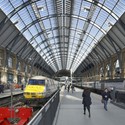
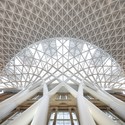
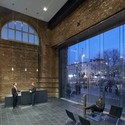
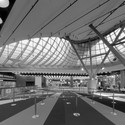
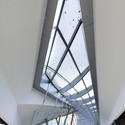
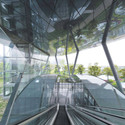
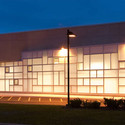
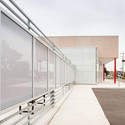
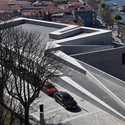
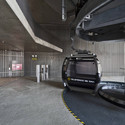
Metro officials have released six conceptual visions that suggest how the historic Los Angeles Union Station could be transformed by 2050. Preliminary “Vision Boards” were released in a public forum at Union Station last week, and although they are not part of the formal evaluation process, they have ignited an immense amount of public interest in the competition.
In an article posted on The Source, Los Angeles Mayor and Metro Board Chair Antonio Villaraigosa described that this competition is “about preparing for the future.” As plans for the California High-Speed Rail System evolve, it is imperative that Union Station is redeveloped to meet the standards of a 21st century transportation hub.
Continue after the break to view each Vision Board provided by the six well-known practices shortlisted for the competition.
Stein Hamre Arkitektkontor As shared with us their design for new hydraulic power stations in northern Norway. The main idea is that the power stations should adapt to the site. More images and architect description after the break.
https://www.archdaily.com/228668/power-stations-bjornstokk-and-ovre-forsland-stein-hamre-arkitektkontor-asVictoria King
A complementary and mutual beneficial partnership, Hong Kong and Shenzhen will join the globalization as an integrated image and get benefit. With intimate collaboration, the proposal for the Hong Kong-Shenzhen boundary control point by WAU Design will serve as a symbol of close communication. The scheme concept comes from “link”: many single units can be twisted into a solid and integrated form. This scheme, a twisted link, indicates multi-level and deep cooperation between Hong Kong and Shenzhen on economic, cultural, and multi-faceted levels. More images and architects’ description after the break.
Mecanoo architecten, in cooperation with local partner Cafer Bozkurt Architecture, shared with us their proposal, one of the competition’s three winning proposals, in an international design competition for Yenikapı Transfer Point and Archaeo-Park Area in Istanbul, Turkey. Yenikapı, ‘New Gate’, consists in a railroad and maritime transfer centre that connects Europe with Asia, as well as the inner city with the surrounding megapolis and the rest of the country. More images and architects’ description after the break.
Koen Olthuis’s Dutch practice, Waterstudio, has been preparing for the environmental impacts on architecture for ten years now – building a practice on the assumption that a new solution for inhabitation is on the water. Having lived in Amsterdam, Olthuis has intimate experience with the battle against water that people have posed for themselves. In an interview with Jill Fehrenbacher for Inhabitat, Olthuis describes how Amsterdam was settled, what it means to have a city built upon water and the maintenance required. Olthuis’ desire to colonize the oceans is not new, but his techniques, which he touches upon in this TEDx Talk in Warwick, focus on a refined and innovative way of approaching this strategy that is progressive in that it requires far less maintenance.
The project for the Macro inter-modal Terminal in the middle of Rio de Janeiro by Lucas Ramos, Priscila Bellas, and Thiago De Almeida seeks to create a new infrastructure to the city, which will create possibilities to transform an important axis of the city that nowadays is extremely undervalued and ignored into a new business center based in an efficient nodal point of different kinds of transport. In doing so, they chose to build a megastructure that possessed the ability to reorganize the different transport networks and their links with the city. More images and architects’ description after the break.
Designed by Michael Labory & Bertrand Schippan to be a city landmark, their proposal for the Amsterdam Pedestrian Bridge is made not only for crossing, but for the city’s life. The tulip, symbol of the Netherlands, turns out to be the evident choice for a city like Amsterdam. Its recognizable shape among thousands becomes the landmark that makes Hermitage a unique destination, an address never to be confused, while offering many activities to the inhabitants. More images and architects’ description after the break.
The approach for the Amsterdam pedestrian bridge by Kamvari Architects challenges the basic principles of a bridge as their design takes on a completely new form as it attempts to create space by looping across the river. They hope that ‘The Rink’ will become a new icon in the city by becoming an active and public node within the city fabric. More images and architects’ description after the break.