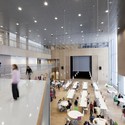
Architects: Verstas Architects Location: Espoo, Finland Client: City of Espoo Project Year: 2010 Project Area: 10,280 sqm Photographs: Rauno Träskelin, Tuomas Uusheimo


Architects: Verstas Architects Location: Espoo, Finland Client: City of Espoo Project Year: 2010 Project Area: 10,280 sqm Photographs: Rauno Träskelin, Tuomas Uusheimo

When the Taiwan Tower competition in Taichung asked participants for an iconic skyscraper, Visiondivision responded with a cluster of over 100 slender towers that challenges the expected experiences within and aesthetics of a 21st century tower. Tower Town, a result of examining the traditional skyscraper and questioning its spatial offerings, creates a dense urban environment with its fragmented massing.
More about the project after the break.
Just announced last night, the INDEX: Award winners for 2011 were unveiled highlighting five categories: Body, Home, Work, Play and Community. The award ceremony was held in the Copenhagen Opera with a diverse audience from 48 countries.
The winners of the awards propose designs that focus on vastly improving the lives of people all over the world. The non-profit Danish design organization received nearly 1,000 nominations from 78 countries, which were narrowed down to 60 finalist designs with the five award winners announced last evening.
Receiving the INDEX: Award HOME Category was Chilean architecture firm ELEMENTAL for their project Monterrey, a revolutionary new model for social housing in Mexico. ELEMENTAL’s social housing design for Mexican citizens, provides residents with the opportunity to construct part of the home themselves. By only building half the house residents, when time, effort and resources permit, personalize the home reflecting the needs and wishes of each individual family.

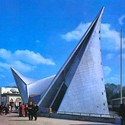
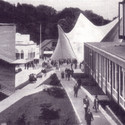
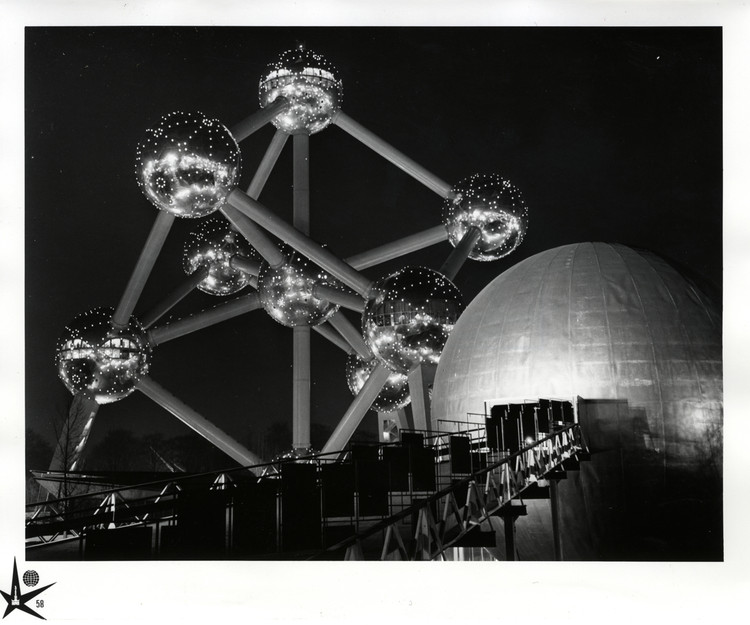
In 1956, preparations had begun for the 1958 World’s Fair in Brussels. This was to be the first World’s Fair held since the end of World War II, the concept behind the Expo was to celebrate the rejuvenation of civilization from the destruction of war through the use of technology. This World Fair is best known for the musical advances that was combined with architecture, creating a gestalt through an experiential encounter where body meets sound and space.

The NASDAQ equivalent Shenzhen Stock Exchange by OMA, continues to progress forward nearing completion. The latest photographs of the new building, which poses a strong representation of capitalism in China, highlight the robust exoskeletal grid and the and complexity of construction.
“For millennia, the solid building stands on a solid base; it is an image that has survived modernity. Typically, the base anchors a structure and connects it emphatically to the ground. The essence of the stock market is speculation: it is based on capital, not gravity. In the case of Shenzhen’s almost virtual stock market, the role of symbolism exceeds that of the program – it is a building that has to represent the stock market, more than physically accommodate it. It is not a trading arena with offices, but an office with virtual organs that suggest and illustrate the process of the market.”
- OMA
More construction photographs of the Shenzhen Stock Exchange after the break.

Next week we will be taking our Architecture City Guide to Beijing and we need your help. To make the City Guides more engaging we are asking for your input on which designs should comprise our weekly list of 12. In order for this to work we will need you, our readers, to suggest a few of your favorite modern/contemporary buildings for the upcoming city guide in the comment section below. Along with your suggestions we ask that you provide a link to an image you took of the building that we can use, the address of the building, and the architect. (The image must be from a site that has a Creative Common License cache like Flickr or Wikimedia. We cannot use images that are copyrighted unless they are yours and you give us permission.) From that we will select the top 12 most recommended buildings. Hopefully this method will help bring to our attention smaller well done projects that only locals truly know. With that in mind we do not showcase private single-family residences for obvious reasons. Additionally, we try to only show completed projects.

We would like to introduce you to a new weekly series we will be featuring here on ArchDaily. This exciting new set of posts will pull projects from our ArchDaily archives, highlighting projects that were featured this week but in previous years.
Today’s selection includes an unconventional museum design in Germany, an educational recycling concrete center in Korea, three well-crafted projects from Finland that pay careful attention to material choices, and a re-imagined 1950s German “Siedlungshaus”. We hope you enjoy taking a look at these projects that deserve a revisit!

When the iconic Apple glass cube on Fifth Avenue was shroud in barriers in preparation for renovation in June, the future of the flagship Apple store was unclear. It was only revealed that Apple would be removing the glass cube and working on drainage, pavers, and bollards on the plaza, but just what changes were to be made to the cube itself remained elusive.

The award winning sustainable German architecture firm, Ingenhoven Architects, has been hired by Google Inc to design their new headquarters in Mountain View, California. Expected to begin construction in 2012, Ingenhoven approached the design with the idea that ‘the architecture should be an expression of the corporate culture and at the same time a model for sustainable architecture in the broadest sense surpassing the LEED-Platinum-Standards with its holistic concept’. Jordan Newman, a Google spokesman shared about Ingenhoven, “we’ve asked them to build the most green, sustainable building possible.”
Google’s offices in Milan, previously featured on ArchDaily can be viewed here. More about this exciting news from the architects following the break.

There really is no way around the time tested adage; You get what you pay for. Good things cost money and better things cost more money. Where does one draw the line on good enough? Cars, clothes, watches, diamonds, food, vacations… the list goes on and on. However, when it comes to our home, do we really give it enough consideration? Our home is where we spend a great deal of our time. Our home is also our most personal possession. It may very well reflect almost everything we do in our most personal times. The quality of our homes could very easily parallel the quality of our lives. Simply stated, “if you don’t like going home, how happy can you possibly be?” However, if home is a place where you would rather stay, then you really have something. Shouldn’t your home be your favorite place to be?
If you don’t like how much something cost, what are you supposed to do?
A- Change your taste so something cheaper will suffice. B- Save your money so you can afford what it is that you really want C- Squeeze your master builder to the point that you can afford to get what you want at the expense of him or someone else….

By Federico Negro
Last week I had the pleasure of presenting our work on the construction of the Louisiana State Museum and Sports Hall of Fame by Trahan Architects at the Associated General Contractors of America (AGC) BIM Forum in Chicago. The event is meant to “facilitate and accelerate the adoption of building information modeling (BIM) in the AEC industry lead by example and synchronize with counterparts in all sectors of the industry to jointly develop best practice for virtual design and construction (VDC).” I also got a copy of Chuck Eastman’s new edition of his BIM Handbook which served as entertainment during the trip and which I’ll refer to later in this post.
It was my first time at the forum. Here is what I learned about the adoption of BIM by the industry and how it is understood.

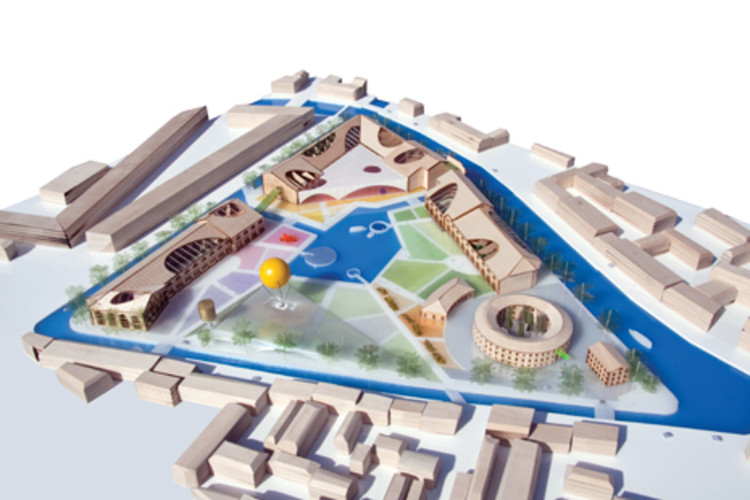
Within St. Petersburg lies a triangle shaped island that has been home to a naval prison, lumberyard, a radio station, and military barracks. Off limits to the public for 300 years New Holland Island, with its unique identity of canals and existing warehouse structures, will be part of a $12 billion dollar redevelopment project. Identifying the island as one of St. Petersburg’s most significant historical sites The Architecture Foundation held an international invitation-only competition New Ideas for New Holland, which included entires from David Chipperfield Architects, MVRDV, Russia’s Studio 44, and winning proposal from WORK Architecture Company (WORKac).
Amale Andraos and Dan Wood, principals of WORKac shared, “We are very excited at the opportunity to work with the Iris Foundation and NHD on this critically important project for one of the world’s most beautiful cities. Our master plan balances preservation with innovation, respecting St Petersburg’s past while paving the way for its continued artistic development and future.”
A few years ago we had a chance to visit WORKac at their studio in New York and spoke with principals Amale Andraos and Dan Wood (be sure to take a look at our interview with them!) More on this winning proposal by WORKac along with renderings and drawings following the break.

This week, with the help of our readers, our Architecture City Guide is headed to Amsterdam. With its numerous canals, Renaissance architecture, and bike friendly culture, it is hard not to fall in love with Amsterdam. Also, if you love modern or contemporary architecture one could hardly argue against making this city the first stop on a tour of Europe. Our list of 24 buildings hardly does justice to this amazing city, but it will certainly give those less familiar with the city a starting point. We will be adding to our list in the near future, as we didn’t come close to incorporating all our readers’ suggestions. In the meantime add more of your favorites to the comment section below.
The Architecture City Guide: Amsterdam list and corresponding map after the break.

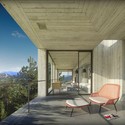
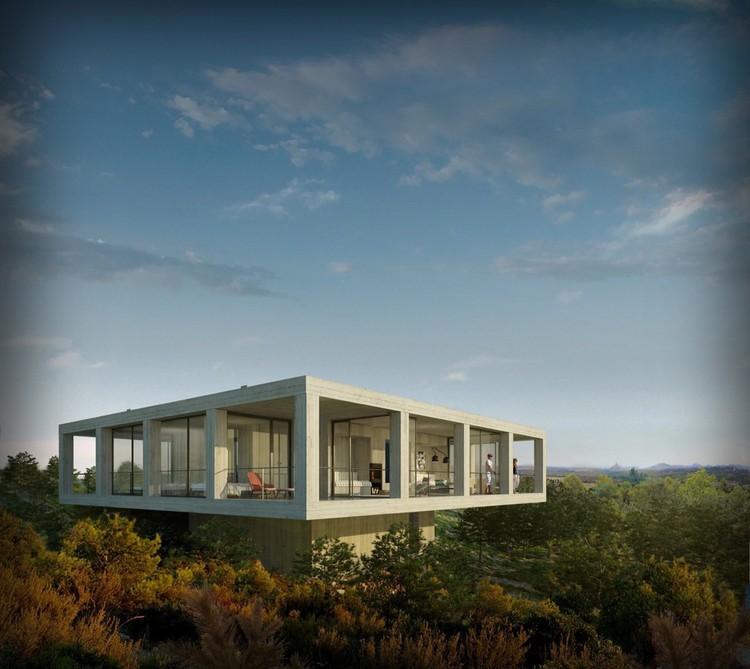
Solo House Casa Pezo is part of the Solo Houses concept, series of eight to ten vacation homes designed by some of the talented young international designers. Pezo Von Ellrichshausen Architects, Mos Office, Didier Faustino and his studio Mésarchitectures, Sou Fujimoto, Studio Mumbai, and TNA – Takei-Nabeshima-Architects are among the architects designing the 200 sqm size homes, with the first collection to be set in the countryside of Matarraña.
Solo Houses is a similar concept to Living Architecture. Set up as a new social enterprise to revolutionise both architecture and UK holiday rentals, Living Architecture commissioned Peter Zumthor, Michael & Patty Hopkins, NORD, Jarmund/Vigsnæs Architects & MVRDV to each design homes. Many of these have been featured on ArchDaily including MVRDV’s unforgettable Balancing Barn.
Follow the break for drawings and renderings of Solo House Casa Pezo by Pezo Von Ellrichshausen Architects.
Architects: Pezo Von Ellrichshausen Architects Location: Polygon 13, Parcel 245, Cretas, Teruel Province, Spain Architects: Mauricio Pezo, Sofia von Ellrichshausen Associated Architects: Alberto Haering, Gonzalo Urbizu Collaborators: Diogo Porto, Bernhard Maurer Valeria Farfan, Eleonora Bassi, Ana Franzisca Freese Client: Christian Bourdais Project Area: 313 sqm Project Year: 2009-2011

Editor’s note: Design + Build is a new series by Steve Lazar, owner and operator of Lazar Design/Build, focusing on aspects of the profession usually left unsaid.
Look up the word ARCHITECT in the dictionary and there is the typical Latin root of the word and other roots of the word, but essentially it says nothing more than MASTER BUILDER. Your architect or master builder will head your process in the proper direction. Let’s call the “point man”, the “go to guy”, or the “solution.” Whatever he is referred as, it is imperative that your chain of communication is with one and only one person to eliminate confusions today, tomorrow, and in the future. There is an inherent challenge to the standard relationship between the homeowner, the architect, and the builder. There are three different entities, all with possibly different goals or objectives.
Home owner: budget
Architect: creation
Builder: conflicted
Who is the client? Is the home owner? Is the architect? If the builder is hired by the home owner than of course the home owner is the client. Typically, this is the standard relationship. However, the builder also has some allegiance to the architect, and this is where things can start to get conflicted. The builder is caught in a pickle between two different entities with possibly two different goals. If budget is not a consideration than there is no conflict. In 20 years of designing and constructing custom homes, I have never been bound by some sort of budget.
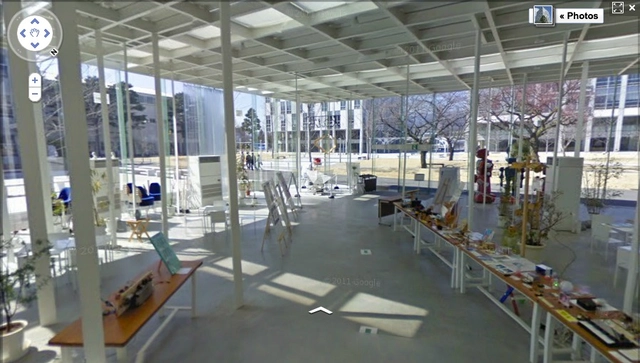
The Kanagawa Institute of Technology Workshop by Junya Ishigami is an elegant rectangular box with with floor-to-ceiling glass, enclosing an interesting interior space with 305 columns of various sizes supporting the stripped roof of skylights. The columns, although seemingly random, are specifically placed to create the sensation of zoned spaces, but their nonrestrictive quality provides a flexible layout to suit the changing needs of students.

VINCI-FAYAT consortium has been selected as preferred bidder for the ‘Grand Stade de Bordeaux’ which includes designs by Herzog & de Meuron and landscape design by Michel Desvigne. Slated for completion in 2015 the ‘Grand Stade de Bordeaux’ will be located within the city’s existing green belt district. The design provides a natural sense of fluidity, with easy approachability beginning with the multiple staircases at all points of the stadium. Never loosing site of the stadiums location a large focus of the concept incorporates the surrounding environment blending with the building, as reflected in the concave roof which is supported by a series of spindly white columns, appearing like a forest of birch trees. Home field to the FC Girondins de Bordeaux, the ‘Grand Stade de Bordeaux’ will also host a variety of cultural events.
Additional renderings and a video can be found following the break. Be sure to take a look.

This week, with the help of our readers, our Architecture City Guide is headed to Barcelona. We recently featured an engaging video where Wiel Arets half jokingly said Barcelona is fantastic but boring. He continued to say as soon as Sagrada Família is finished Barcelona is done; there is nothing left to do there (10:50). Arets can say what he wants about Barcelona supposedly being boring, but our city guide doesn’t reflect this. Barcelona is filled with fantastically expressive architecture that springs from its proud Catalan culture. It was impossible to feature all our readers suggestions in the first go around, and we did not even come close to including some of the most iconic building such as Casa Milà. Thus we are looking to add to our list of 24 in the near future. Further more there are so many fabulous buildings on the drawing board or under construction, i.e. the projects in the @22 district, we’ll most likely be updating this city guide for quite awhile, regardless of Sagrada Família’s completion.
Take a look at our list with the knowledge it is far complete and add to it in the comment section below.
The Architecture City Guide: Barcelona list and corresponding map after the break.