




-
Architects: Perkins&Will
- Area: 72000 ft²
- Year: 2015
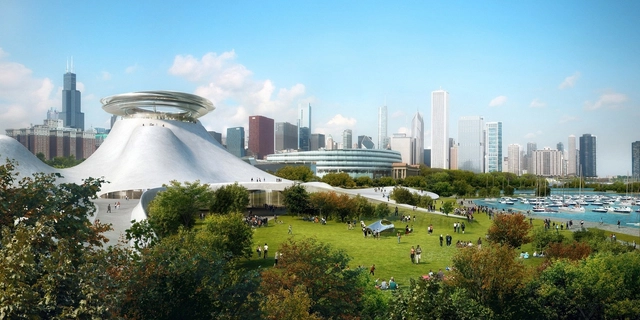
The Lucas Museum has been looking for a home in all the wrong places. Following months of fiery debate over the future of the museum’s proposed lakefront location, George Lucas announced that he is abandoning plans to build the project in Chicago and will instead return to looking for a site in California. This is the second failed location for the museum, after being rejected by San Francisco’s Presidio Trust in early 2014.

The Society of Architectural Historians will present its 2016 Awards for Architectural Excellence at the 6th annual SAH Awards Gala on Friday, November 4, 2016. The awards represent a unique coming together of architectural practice and academic study, honoring the contributions of individual projects to our built environment. Proceeds from the gala benefit the Society's educational mission and the ongoing restoration of SAH's headquarters, the Landmark Charnley-Persky House.
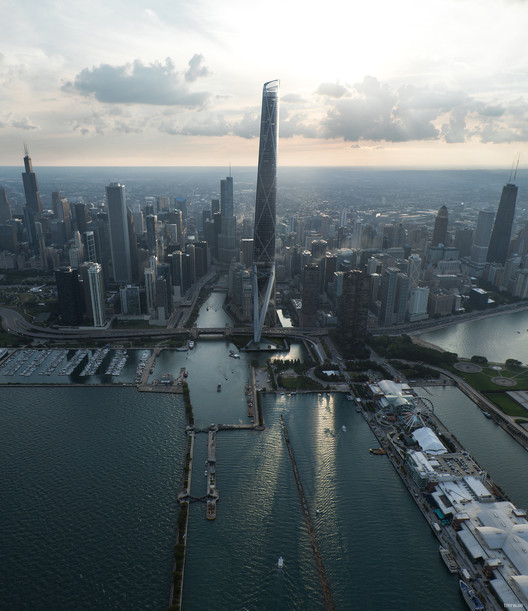
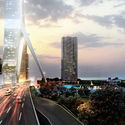
Gensler’s “Gateway Tower” is a 2000-foot (610 meter) conceptual proposal for the Chicago Spire site. The project is the winning entry for a company-wide internal competition to generate a new megatall structure for the 2.2 acre plot at 400 N. Lake Shore Drive. The mixed-use proposal throws out the residential luxury model that drove Santiago Calatrava’s design, with a concept inspired by tourism and public engagement. Gateway Tower’s volume is still largely devoted to residential functions, but now condos and apartments are coupled with a hotel and public attractions that connect to the riverwalk, lakefront, and city. The building would include four unique experiences including riverfront public access at DuSable Park, a Funicular ride of pods ascending the building’s structural “leg” over Lake Shore Drive, a Skylobby with hotel and retail amenities, and a Skydeck with a restaurant and sky-garden at the building’s pinnacle.
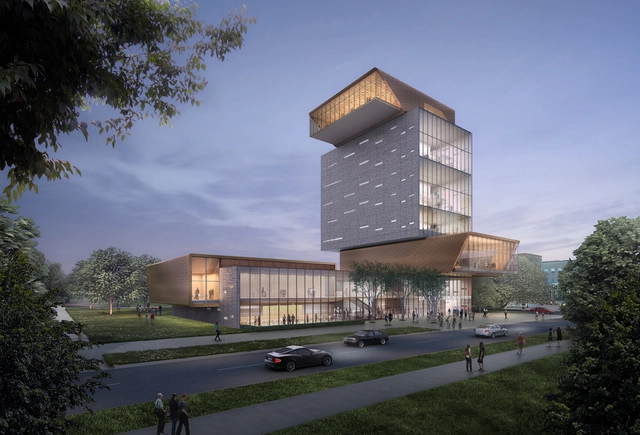
Diller Scofidio + Renfro (DS+R) has unveiled its design for the David M. Rubenstein Forum at the southeast corner of Woodlawn Avenue and 60th Street on the University of Chicago's campus. The 90,000 square foot (8,500 square meter) facility has been devised as a place of intellectual, institutional, and educational exchange, fulfilling a variety of campus needs for meeting spaces. A collection of block-like volumes, the building’s two-story base is anchored by a narrow 165-foot (50 meter) tower, with the exterior materials and structure reflecting the programmatic divisions within.
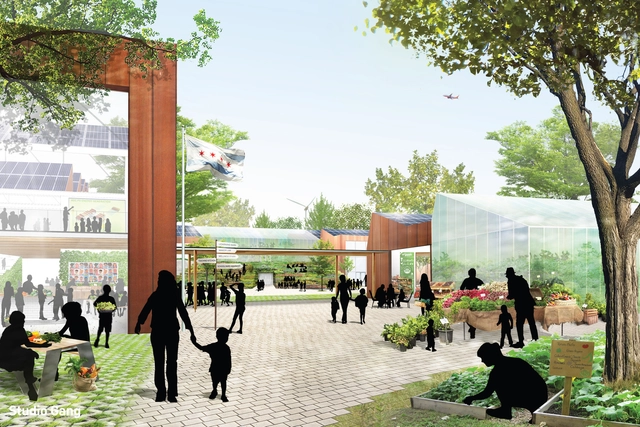
Studio Gang has designed a new home for the Academy for Global Citizenship (AGC), a Chicago Public Charter School in the Garfield Ridge neighborhood. Established eight years ago with the operating philosophy that a more sustainable world begins at school, the proposed campus is an urban farm and educational institution wrapped into one.


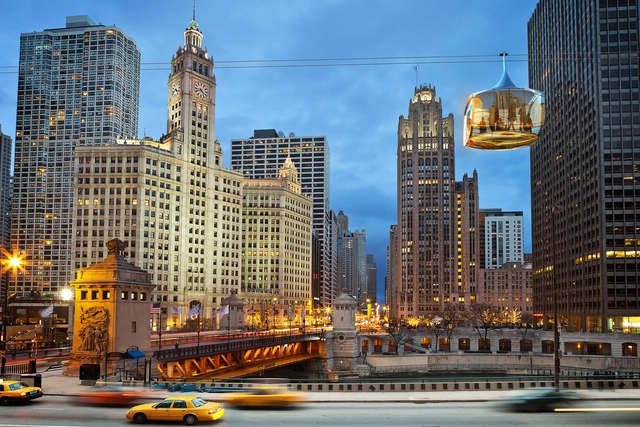
Marks Barfield Architects and Davis Brody Bond have revealed plans for the “Chicago Skyline” an aerial cable car attraction spanning from the Chicago Riverfront to Navy Pier and through Downtown along the Riverwalk. The project, still seeking permission, is meant to enable visitors to experience the fabled Chicago skyline in a new way, viewing the city and lakefront from custom-designed pods or “gondolas”. The design shares many similarities with the pill-like capsules surrounding the London Eye, which was also designed by Marks Barfield Architects. The Skyline is being marketed as a practical solution to link Navy Pier to the transit network within the Chicago Loop.
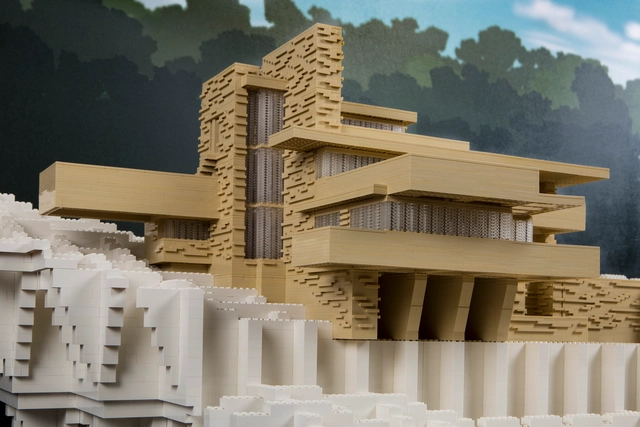
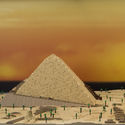
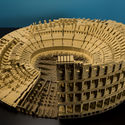
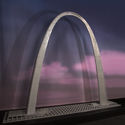
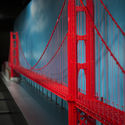
Brick by Brick features a spectacular collection of more than a dozen LEGO-built structures of engineering marvels, constructed by LEGO Certified Professional and Chicago native, Adam Reed Tucker. These model structures include:

At the Chicago Architecture Biennale, David Brown’s project “The Available City” addressed the fact that Chicago currently owns 15,000 vacant lots, many of which have become “havens for illegal dumping, weeds, rodents and street crime.” In this article, originally published on Autodesk’s Line//Shape//Space publication, Jeff Link takes a look at Brown’s project, examining its unique approach to developing the empty lots and converting them into public space.
David Brown’s Chicago Architecture Biennial project, The Available City, responds to a striking fact: Chicago, in an exodus story echoed across the rust belt, owns 15,000 vacant lots.
The parcels, many of them on the South and West Sides, don’t generate tax revenue, but the city is obliged to maintain them. Outside the watch of homeowners, many are havens for illegal dumping, weeds, rodents, and street crime.
Chicago hasn’t exactly turned a blind eye, says Brown, associate director of the University of Illinois at Chicago’s School of Architecture and the author of Noise Orders: Jazz, Improvisation, and Architecture. Through the Large Lot Program—a pilot that began in Chicago’s Englewood, East Garfield Park, and Austin neighborhoods—individuals and nonprofits that live on the same block as a city-owned vacant residential lot can buy select pieces of land for a dollar.
It’s a compelling idea, and through it and the related Adjacent Neighbors Land Acquisition Program, about 1,000 lots have been purchased in the past five years. But Brown says the city can do more; he suggests thinking of architecture and urban planning like jazz: a formal compositional structure inside of which experimentation can take place.

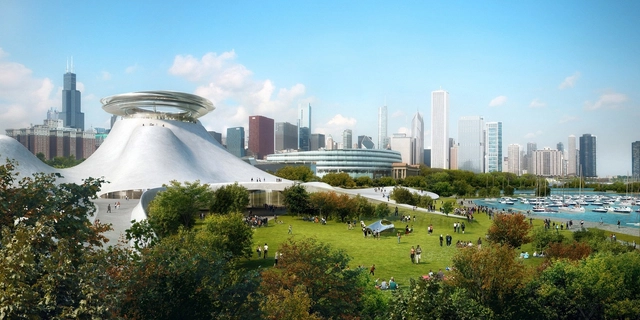
Over the past few months, Chicago Mayor, Rahm Emanuel, has been caught in the crossfire between two groups who have very different opinions on the future home of the George Lucas Narrative Art Museum. The site in question is a 1,500-space parking lot situated north of the McCormick Place’s Lakeside Center and just south of Soldier Field. The commission for the museum was won in July of 2014 by MAD Architects. Their design proposes a large, white, sculptural “mountain” which rises up from the site and is topped by a “metallic crown”.

Chicago Sukkah Expo ’16 is a national design competition that challenges entrants to re-imagine the sukkah. The sukkah, a temporary structure that is built during the Jewish festival of Sukkot, commemorates the 40 years that Jews spent wandering the desert (Leviticus 23:42-43). The impermanence of the sukkah reminds us that many community members do not have adequate shelter and are threatened by the dangers of homelessness. We must devote attention and support those without a permanent home.

Fifty-two years after its completion, the Marina City Complex in Chicago has been named an official architectural landmark. Following a 48-0 vote by the City Council, the buildings by Bertrand Goldberg will be given their official designation on March 16, reports The Architect Magazine.

AAgora is a newly-founded critical architecture debate platform at the Architectural Association in London, which aims to shed light on relevant architectural topics. These debates take the form of an open-table discussion which encourages the audience to participate at any time. AAgora's second debate will be "On the Chicago Biennial" - On Biennials, and how we define contemporary architecture.
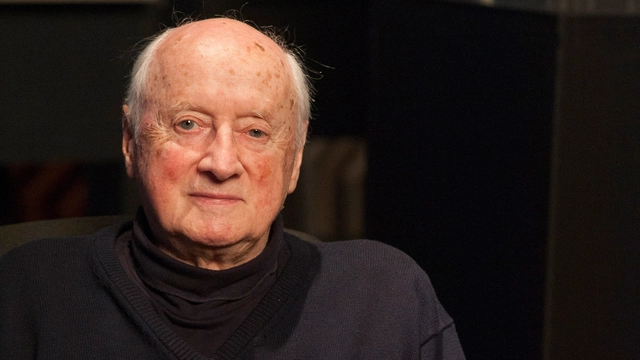
In an exclusive thirty minute-long discussion with Kevin Roche, described in this interview as "arguably the greatest living architect you've never heard of," Monocle's Steve Bloomfield hears about his early years in practice through to the evolution of his design philosophy over a career which has spanned five decades.


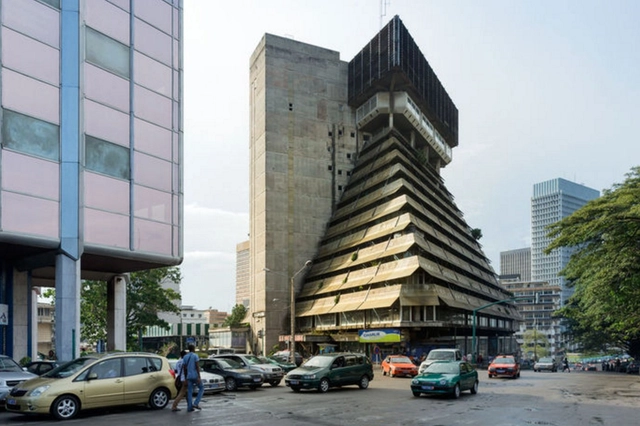
A new exhibition opening later this month at Chicago's Graham Foundation seeks to explore the complex history and legacy of modernist architecture in sub-Saharan Africa during the 1960s and 1970s. Architecture of Independence: African Modernism will feature nearly eighty buildings in commissioned photographs by Iwan Baan, Alexia Webster, and Manuel Herz. Alongside archival material, the exhibition "imparts a new perspective on the intersection of architecture and nation-building in Ghana, Senegal, Côte d’Ivoire, Kenya, and Zambia and investigates some of the most compelling yet under-studied examples of 1960s and 1970s architecture worldwide."