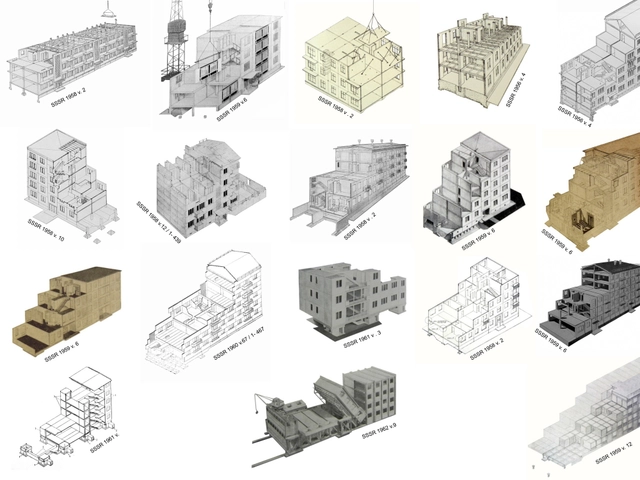
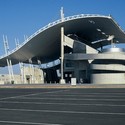
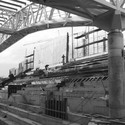
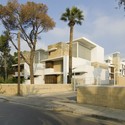
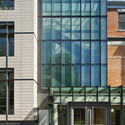
Housing Prototype Systems; Courtesy of Pedro Alonso
Pratt Institute's School of Architecture will present "COLD war COOL digital," an exhibition of 20 scaled prototypes of modernist, pre-fabricated, and globally-distributed Cold War era housing systems that were created using contemporary 3D printing technologies (opening reception 2/18 at 6:15, details below). The exhibition will investigate architectural modernism and its global influence and will connect with contemporary prototype pre-fabrication methods and digital research in housing and skyscraper design. A symposium that explores the technical, aesthetic, and political aspects of prototyping and pre-construction in architecture will be held tonight in conjunction with the exhibition.
Forest City Ratner Companies (FCRC) just announced that they will be partnering with Skanska, one of the world’s largest construction and development groups, for the B2 project. This project is making headlines because it will be the first residential tower that is part of the Atlantic Yards Development in Brooklyn using modular construction. FCRC plans to break ground on the 32-story building on December 18th and anticipates that the building will open in 2014. While high-rise modular technology has been initially developed for use at Atlantic Yards, this new industry has the potential to create modular components for construction projects across New York City and worldwide, becoming the first major manufacturing expansion in New York City since manufacturing began its decline over a generation ago. More information after the break.
If you are considering turning your designs and business practices into a more eco-friendly, deeper shade of green, then we strongly encourage you to attend the ‘Implementing Green Practices in Your Designs’ free event as part of the How to Make it series. Hosted by UncommonGoods, a brooklyn-based online retailer of unique gifts and creative designs, the event includes a panel of design professionals sharing their advice on how to source more eco-friendly materials and how to set up a studio or workspace with little environmental impact. Taking place October 29th from 6:30pm-9:00pm, attendees will also have the opportunity to discuss their product ideas and designs with the buyers and panelists. For more information on the event, please visit here.
Taking place October 20-21, modeLab is putting on Simulation Lab, a two-day workshop on the topic of simulation with processing. In a fast-paced and hands-on learning environment, they will cover technical programming concepts such as syntax, control, and modularity. Utilizing a suite of libraries to extend processing’s functionality, they will explore and incrementally develop force-based, physics-based, and agent-based simulations. Additionally, they will examine strategies for visualizing the dynamic nature, unexpected tendencies, and behavioral effects present in our simulations. For more information, please visit here.
modeLab is putting on a two-day workshop August 18-19 on the topic of Parametric Patterns with Grasshopper for Rhinoceros. In a fast-paced and hands-on learning environment, we will experiment with the materiality, craft, and effects of patterning through the distribution of simple and repeatable material events (the cut, the fold, and the perforation). Coupling Parametric Design and Digital Fabrication workflows, we will iteratively test our patterns while learning best practices for use of a large-format Laser Cutter. Prototypes will range in material palette (fabric, paper, plastic) based on participants’ interests and will be used to discuss issues of craft, detailing, and the assembly process. For more information, please visit here.
Taking place August 17 from 10am-6pm in Brooklyn, Intro Lab is a one-day workshop put on by modeLab on the topic of Parametric Design with Grasshopper for Rhinoceros. In a fast-paced and hands-on learning environment, we will cover introductions to Algorithmic Design, Computational Geometry, and Parametric Modeling. Additionally, participants will explore concepts such as Object Attributes/Parameters, Part to Whole Relationships, and Data Flow. Emphasis will be placed on consistent organization of data through Lists and Data Trees and best practices for Creative Project Workflow Integration, File Modularity, and Data Visualization. For more information, please visit here.
The Hegeman, designed by Cook + Fox Architects, is a residential community in Brownsville, Brooklyn that provides housing for low-income and formerly homeless individuals. Developed by Common Ground Community – an innovative non-profit whose mission is to end homelessness – the Hegeman Residence will also provide a range of on-site social services in a model known as supportive housing. For a little bit of context, Brownsville has the highest concentration of NYCHA (New York City Housing Authority) developments in New York City. A wave of arson in the 1970s destroyed most of the residential structures; Brownsville is just one of the many neighborhoods that were affected. The urban renewal that followed rebuilt many homes and designated them as low-income housing. The community has had many problems since associated with poverty, including crime and drug addiction, as well as low test scores and high truancy rates in the education system.
Remember the “Cosmic Quilt” kickstarter campaign we published a few weeks ago? Well, it was a success! With the help 20 students from the Art Institute of New York, The Principals were able to construct a reactive architectural environment just in time for the New York Design Week that took place May 19-21.
Approach, a two-day parametric design workshop June 23-24, put on by Studio Mode / modeLab, will introduce participants to advanced topics in Grasshopper for Rhinoceros. In a fast-paced and hands-on learning environment, participants will iteratively engage a diverse set of parametric approaches to case-study design scenarios, each requiring advanced creation and manipulation of Data Structures and/or the extension of Grasshopper’s Parametric Workflow. The collection of case-studies will furthermore provide a mechanism to critically assess the value in each approach relative to workflow, best practices, linear versus non-linear design processes, and opportunities for modular re-use in other design contexts. For more information, please visit here.
With the forthcoming release of Rhino 5.0, RhinoScript will be moving to a new syntax: Python. The new, more intuitive interface for manipulating Rhino from the inside gives us the opportunity to quickly and easily create a wide variety of complex systems based on simple rules that are easily implemented with no prior programming experience.
We introduce RhinoScript for absolute beginners, including the basics of programming techniques (variables, flow control, etc.) as well as the working knowledge of how Rhino represents geometrical objects such as points, curves, surfaces and even text. We then move quickly into techniques for automation and generative design which address the specific ways in which each participant can use Rhino.Python.
suckerPUNCH recently announced the winners of their Robot Workshop competition. The past few years have seen an exciting rise in the fascination with robotics. Simultaneously, the ability to develop and build robots capable of complex and experimental applications has become easier and more accessible to the general public. From hardware like Arduino to open source programming like Processing, there now exist inexpensive and even free ways to dabble with robotics. With the site located in an open lot in Clinton Hill, Brooklyn, the Robot Workshop will be a place people can come to work on their projects, utilizing shop facilities while simultaneously interacting with fellow robot enthusiasts. More images and descriptions on the winning proposals after the break.
This workshop is a two-day intensive parametric design workshop by Studio Mode / modeLab to be held in Brooklyn during the weekend of April 07-08, 2012. In a fast-paced and hands-on learning environment, this workshop will engage both the conceptual as well as technical domains of applied parametric design.
Tonight in Brooklyn, New York – Architect, alumnus and longtime Pratt Architecture Professor Theoharis David, FAIA, will deliver a lecture which will be introduced by visionary architect Lebbeus Woods reflecting on David’s 43 years as a teacher through the work of his former students, many of whom have gone on to become accomplished architects and teachers. The lecture will be followed by an opening reception for “Built Ideas: A Life of Teaching, Learning, and Action,” an exhibition of models, photos, and concept drawings by David that will be on view at The School of Architecture through March 30. The Pratt’s Department of Exhibitions are also presenting “An Architect Drawing,” an exhibition of drawings and texts from David’s architectural experiences through September 28.
Tonight’s lecture is open to the public; however please note that seating priority is reserved for members of the Pratt community at 5:30PM and members of the public will be admitted at 5:50PM. Continue reading for more information.
Globally recognized for its distinguished academic reputation and one of the world’s most prestigious independent colleges, Pratt Institute’s School of Architecture will present their spring 2012 lecture series from February 13 through April 9, 2012 at the Institute’s Brooklyn and Manhattan campuses. The lectures are free and open to the public; however, seating priority will be given to current students with Pratt identification. More information on the event after the break.
We have been keeping close watch on the progress of Barclays Center, SHoP’s 650,000+ stadium for Brooklyn at Atlantic Yards. The project has an interesting history as the client, Bruce Ratner, originally looked to Gehry to design an urban solution and iconic image for the 22 acre site, prior to teaming with Ellerbe Becket and SHoP. As we’ve reported earlier, SHoP’s response has developed to become a sweeping pre-fabricated volume, with a perforated latticework steel skin and a transparent ground level. Photographer Roger Edwards has shared some recent photos with us of the construction process as the building is quickly beginning to take shape.
Studio Mode / modeLab is pleased to announce the modeLab 2012 Spring Workshop Series. The series starts off with the Agent Forms, a two-day intensive design and programming workshop to be held in Brooklyn during the weekend of February 04-05.