During the Olympics in Rio, on the afternoon of August 13rd, an international landmark design “Olympics”—“Green Skyline • Country Garden • Forest City Landmark Architecture International Design Competition kicked off at Beijing Parkview Green and called for international design powers.
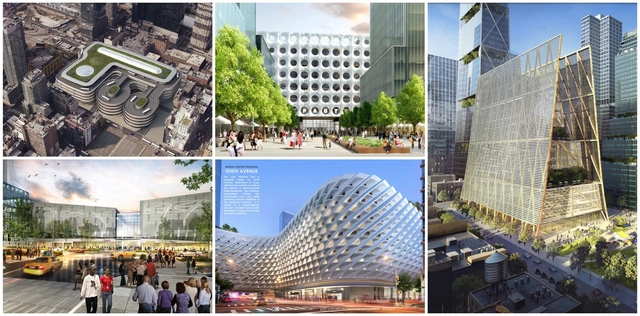
The Port Authority Bus Terminal International Design + Deliverability Competition challenged architects to reimagine the current terminal building, built in 1950 and expanded in 1979, for the demands of modernday ridership. The terminal currently accommodates approximately 220,000 passenger trips and more than 7,000 bus movements on an average weekday, with demand projected to increase to 270,000 daily peak-hour passengers by 2020, and as many as 337,000 daily peak-hour passengers by 2040.
Blur Building. Exposition Pavilion: Swiss Expo, Yverdon-Les-Bains, 2002. Architects: Diller Scofidio + Renfro. Image Courtesy of Diller Scofidio + Renfro
Today, the MacArthur Foundation announced the 23 recipients of their 2016 MacArthur Fellowship Grants, which are awarded annually “to encourage people of outstanding talent to pursue their own creative, intellectual, and professional inclinations.” Each fellowship comes with a stipend of $625,000 for the recipients to use for individual pursuits, paid out in equal quarterly installments over a five year period. Fellows are selected based on 3 criteria: exceptional creativity, promise for important future advances based on a track record of significant accomplishment, and potential for the fellowship to facilitate subsequent creative work.
This year’s fellows include artists, playwrights, geobiologists, poets, jewelrymakers, novelists and historians, but, for the fifth straight year, no architects. In the program’s 36 year history, just 6 recipients have come from architecture-related fields.
According to urban sociologist Ray Oldenburg, people need three types of places to live fulfilled, connected lives: Their “first place” (home) for private respite; their “second place” (work) for economic engagement; and their “third place,” a more amorphous arena used for reaffirming social bonds and community identities.
This third place can be a barbershop, neighborhood bar, community center, or even a public square. The desire for these three separate spheres drives how human environments are designed at a bedrock level, but increasing urbanism—as well as geographic and economic mobility—are collapsing these multiple spaces into one. The result is a new hybrid building type: a live-work multiunit dwelling that is home, office, and clubhouse.
Aerial view looking south at dusk. Image Courtesy of Roger Partners / Nelson Byrd Woltz
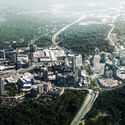
Rogers Partners Architects+Urban Designers and Nelson Byrd Woltz Landscape Architects have released preliminary designs for a new park floating above a divisive highway and commuter rail line in the Buckhead neighborhood of Atlanta, Georgia. A 2,400-foot-long elevated traverse, Buckhead Park Over GA400 aims to bring the community together with safe, convenient access to the amenities and cultural attractions in Buckhead.
The Wizarding World of Harry Potter (WWoHP) at Universal theme parks in Florida. Image Courtesy of Volume Magazine
The following essay by Kazys Varnelis was first published by Volume Magazine in their 49th issue, Hello World! You can read the Editorial of this issue, Going Live, here.
During the last decade, the idea of a technological singularity has passed from science fiction to a plausible prediction of the proximate future. In its simplest terms, a technological singularity will take place when an artificial general intelligence (AGI), capable of modifying its own code, advances so rapidly that subsequent technological progress (and as a result history itself) become as unpredictable and unfathomable as what happens within a black hole. In the most radical vision, the ‘hard takeoff’, within hours or even minutes of artificial intelligence developing the capacity for recursive self-improvement, the intelligence advances so greatly that it fundamentally transforms life on Earth.
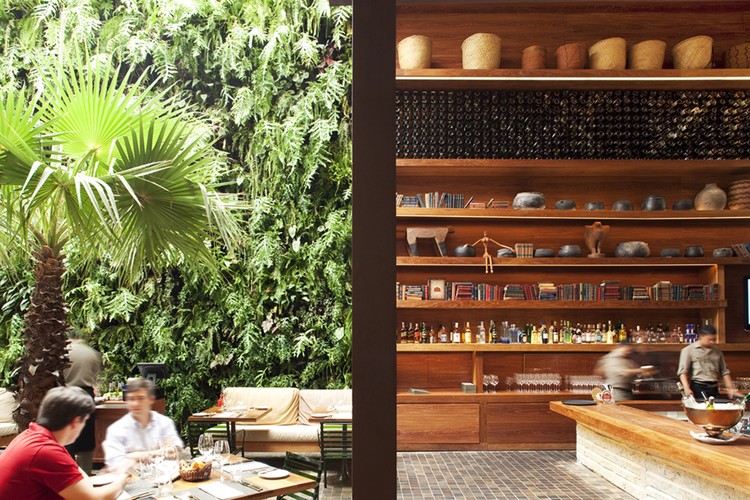
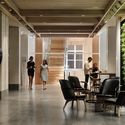
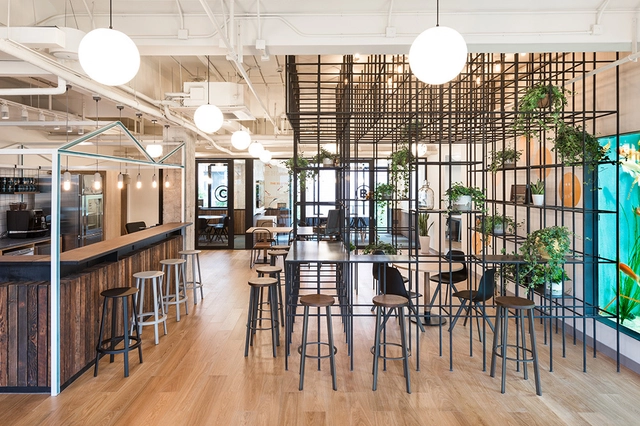
Manufacturers: Fritz Hansen, Wilkhahn, Bene, Briggs Veneers, Coffee and side table, +7Herman Miller, Kvadrat, Living Edge, Punt Mobles, Schiavello, Stellar works, Vitra-7
Winter Stations is now embarking on its third-year, opening an international design competition to bring temporary public art installations to The Beaches, exhibited to celebrate Toronto's winter waterfront landscape. This year we are expecting to include up to six lifeguard stands, including an addition three by invited universities, across Balmy, Kew and Ashbridges Bay beaches located in the heart of the Beach community, south of Queen Street East, between Woodbine and Victoria Park Avenues. These utilitarian structures are to be used as the armature for temporary installations, which will need to be able to withstand the rigours of Toronto winter weather. This is a single-stage open international competition, welcoming artists, designers, architects and landscape architects to submit concept proposals for Winter Stations' temporary artwork installations.