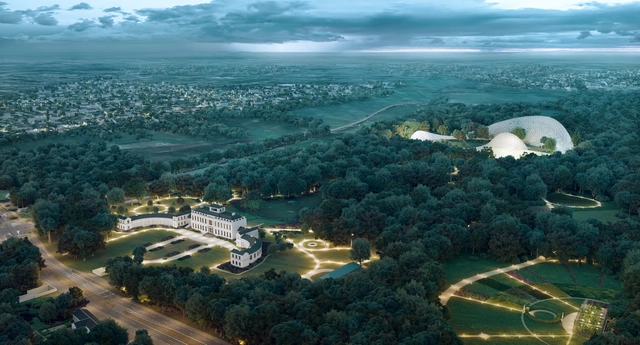
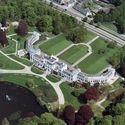
Mecanoo has unveiled its design to transform The Soestdijk Estate into Eden Soestdijk, “an experimental garden for a sustainable society and a paradise destination for all” in The Netherlands. In an effort to become an educational tool for environmental awareness, the project aims to make a significant contribution to meeting the UN’s Sustainable Development Goals.
“The world is facing pressure from increasingly larger and more complex problems when it comes to water, food, climate and energy,” said Anton Valk, chairman of the Eden Soestdijk foundation. “Eden Soestdijk wants to tackle these problems and contribute to a more sustainable society by stimulating and inspiring visitors to change their behaviour in a positive way.”
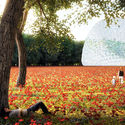
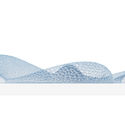
An architectural greenhouse behind the palace gardens will be the centerpiece of the project, and will house an interactive exhibition focusing on topics like circularity, ecological balance, and social aspects of sustainability.
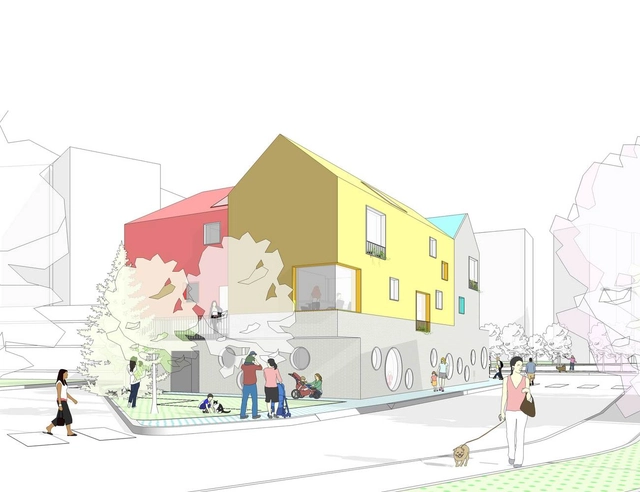
Daniel Valle Architects has been awarded first prize in the public competition to design a kindergarten and senior welfare center in Seoul, South Korea, with its project, Maebong Daycare Center.
Located in the neighborhood of Oksu-dong, the 700-square-meter Center is designed around the idea of shifting the scale of the building, so that children feel more comfortable. For example, the massing of the space is broken down into five units that utilize various colors, geometries, and materials to emphasize smaller units within the whole.
“Interior spaces are designed considering both the adult and the children size. Classrooms and other spaces are provided with smart storage solutions to maximize the usage of space and flexibility. A 'thick wall' will contain most of the items needed in the classroom as well as provide exercise and fun features.”
Since we’ve started to branch out into China, the ArchDaily China team has been able to discover the rich layers beyond just these rising Chinese stars. As part of the country's large-scale urbanization process, last year, we posted some of the large-scale projects designed by China’s (largely unknown) Design & Research institutions such as train stations and cultural centers.
In addition, we’ve also come across a series of smaller, lesser known, younger practices that focuses more on small-scale experimental work. Here are our top ten favorites:
As every good design professional knows, the client is at the forefront of every project. Sometimes this can feel like the client plays judge, jury, and executioner to every last revision, and in a field as detailed and complex as architecture, satisfying these demands, as well as the designer’s own creative vision, can be bewildering and aggravating. But in the end, doesn’t adapting to another person’s tastes just push us to be better?
BIG are known for unconventional buildings that often raise the question “how were they able to do that?” Such is the case for BIG’s Honeycomb, a luxury eight-story condominium currently under construction in the Bahamas. The project’s hallmark is its hexagonal façade made up of private balconies, each with its own glass-fronted outdoor pool. The façade was also the project’s greatest engineering challenge, with each balcony (including pool water) weighing between 108,000 and 269,000 pounds (48,000-122,000 kilograms) while cantilevering up to 17.5 feet (5.3 meters) from the structure. Tasked with this challenging brief were DeSimone Consulting Engineers, who previously worked with BIG on The Grove. Read on for more detail on the Honeycomb’s innovative engineering.
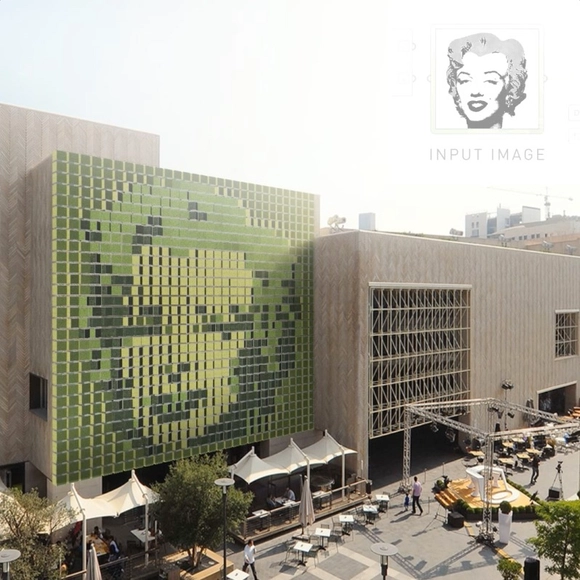
The Canvas consists of individual modules, each of which is a cube made from steel framework, back paneling, L-shaped jambs, secondary structure, waterproofing board, irrigation piping, Green Studios hydroponic skin, and plants. These layered components are assembled on four sides of the cube module, with a motor and water pipe attachment that circulates water throughout.












_spado_(2).jpg?1480374625)
_spado_(8).jpg?1480374715 "© Kurt Kuball")
_spado_(18).jpg?1480374772 "© Kurt Kuball")
_spado_(6).jpg?1480374681 "© Kurt Kuball")
_spado_(26).jpg?1480374853 "© Kurt Kuball")
_spado_(2).jpg?1480374625)












.jpg?1499084758 "© Christopher Frederick Jones")
.jpg?1499084301 "© Christopher Frederick Jones")
.jpg?1499084047 "© Christopher Frederick Jones")
.jpg?1499084468 "© Christopher Frederick Jones")


.jpg?1475112898&format=webp&width=640&height=580)