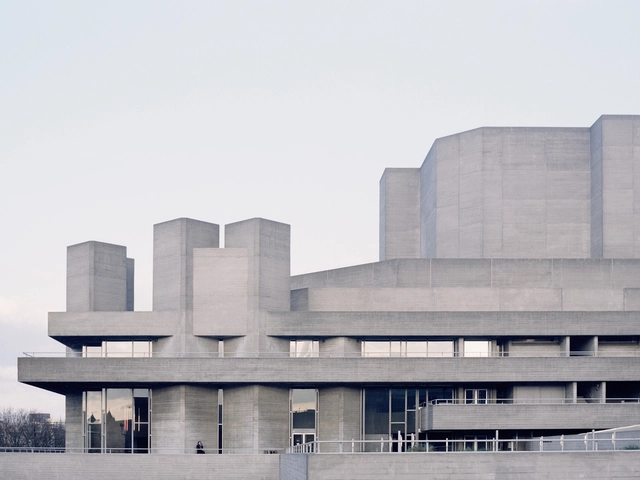
UK transport minister John Hayes has declared war on Brutalist architecture, The Independent reports. Citing public distaste for the functional, modern designs characterized by exposed concrete and brick masonry, Hayes warned against a revival of the style, referring to it as "aesthetically worthless, simply because it is ugly." Meanwhile, Hayes named Boris Johnson's New Routemaster and the redeveloped St. Pancras, Blackfriars, and King's Cross stations as specimens of exemplary design. At the heart of this ire is a push to rebuild a Doric arch outside Euston station, which was demolished in 1962.
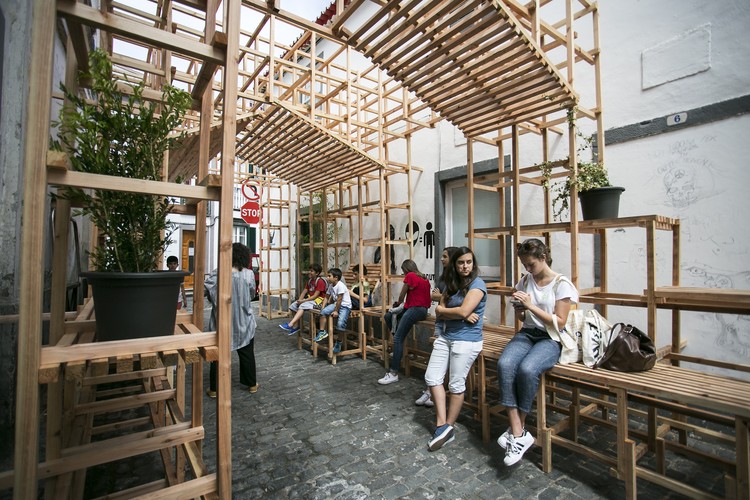
Orrizontale has constructed “Casa do Quarteirão,” a permanent wooden installation developed for Walk&Talk 2016, an annual arts festival in the Azores islands, that reclaims the physical space of the street for “convivial and collaborative use.”
Studio Ossidiana, founded by Alessandra Covini and Tomas Dirrix, investigates architectural materials through experimental research projects. Their recent work "Petrified Carpets" explores the "ideal garden" found in Persian carpets and will be showcased at the Dutch Design Festival of 2016 along with other exhibitions.
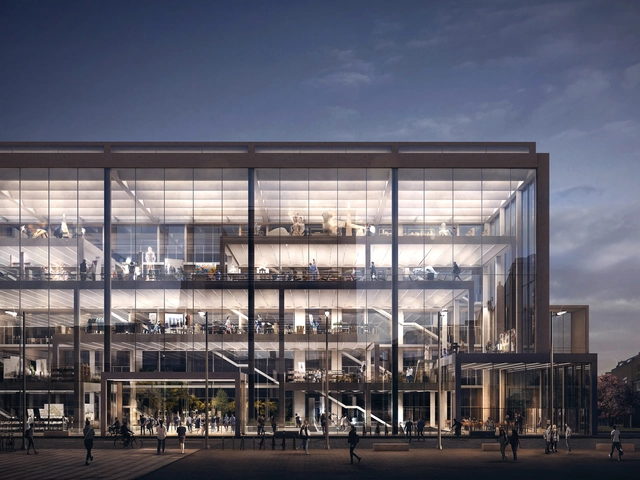
Clément Blanchet Architecture has released its bid for the international Nice Station Extension competition, which also received entries from Marc Mimram, Jean Duthilleul, and winner Daniel Libeskind. The proposal integrates buildings in the city center of Nice—which is surrounded by railways, a ring road, and the city—including a new mixed-use public complex, retail and office spaces, and a boutique hotel.
Launched in 2007, The Buckminster Fuller Challenge has quickly gained a reputation for being what Metropolis Magazine once called “Socially-Responsible Design’s Highest Award.” This year, for the first time, a Student Category was reviewed separately from the general applications, however still based upon the same criteria: comprehensiveness, feasibility, replicability, ecological responsibility, and how verifiable and anticipatory the project is. Students from the Centre for Human Habitat and Alternative Technology (CHHAT) claimed the prize with their adaptable and lightweight modular domes, made from natural, local or recycled materials.
Serie Architects has released its proposal for the Royal College of Art’s (RCA) campus in Battersea, London. Designed for the campus’ competition—which was won by Herzog & de Meuron—the 15,000-square-meter project would house the schools of architecture, material, and fine art, as well as specialist research centers and entrepreneurial incubators.
In an effort to create a spatial model that encourages collaboration across academic disciplines, the proposal centers on the idea of stacked planes, or “tables,” each of which defines a particular space, but which is not enclosed. The resulting space, through the overlapping of tables and double- and triple-height ceilings, creates an open and highly visible environment.
Geography and climate are two important conditions that determine how people can live in a certain environment. When we add to this the cultural characteristics of a region, what appears, as Carl Sauer would say, is a "cultural landscape," a result of humankind’s settlement and adaptation to the territory. When architecture adopts a sensitivity to these conditions, and concerns itself with what the environment offers, living conditions take on a quality of lasting comfort.
Socrates Sculpture Park and The Architectural League invite designers and architects to help shape the physical setting in which the park fulfills its mission as a venue for art, creative expression, public programming, and education. Socrates Sculpture Park, located in Long Island City, Queens, is one of the most distinctive cultural organizations in the country with its combination of waterfront setting, accessibility, and community-based programming. As a venue for the presentation of public art, a New York City park, and an active social space, Socrates has for 30 years harnessed the power of creative minds to transform the urban landscape.
This piece of Brazilian architecture was conceived in 1961 by São Paulo architects João Batista Vilanova Artigas and Carlos Cascaldi. Together with the architectural movement of the Paulista School, they form part of the most important history of São Paulo, because of the large amount of works they constructed there and the recognition of many of them at an international level.


















.jpg?1478766358&format=webp&width=640&height=580)


