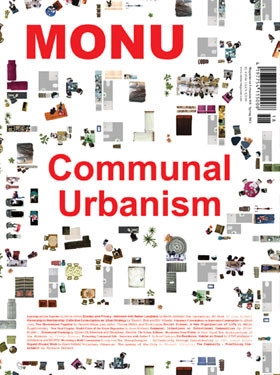
MONU, a unique bi-annual international forum for artists, writers and designers that are working on topics of urban culture, development and politics, just released their newest issue #18 on the topic of 'Communal Urbanism'. How should we live together? is the central question focusing on contemporary communal living in cities. According to Martin Abbott's contribution "Learning to Live Together", this is a question often discussed among the housemates of Berlin's 40 year old communal "Hausprojekt Walde". Rainer Langhans, one of the early members of the legendary "Kommune 1", founded in Berlin in 1967, is convinced that in the future we will live increasingly communally. For more information on MONU's latest issue, please visit here.
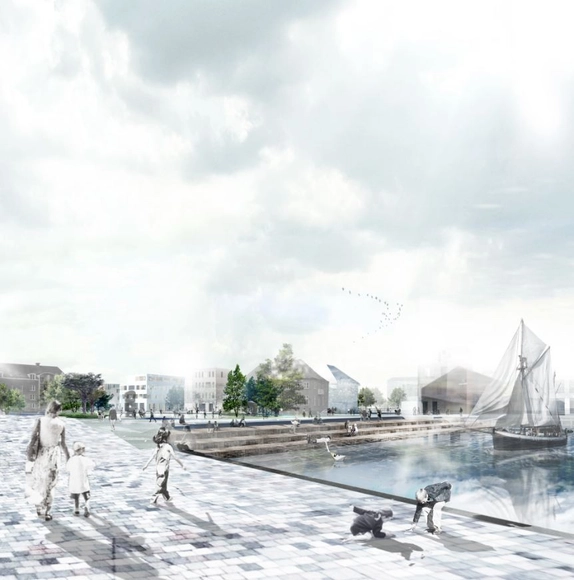
HOBRO – a city finds its lake, is the 1st prize winning proposal by Holscher Arkitekter, which aims to tie the historical center of Hobro to the harbor area. The philosophy behind the strategy is that the urban and landscape spaces are created first, then the streets and at last, the buildings. The architects wish to create a robust frame for a long lasting urban development. A strategy that allows the urban plan to exert itself and be experienced as completed in all phases of the development. More images and architects’ description after the break.
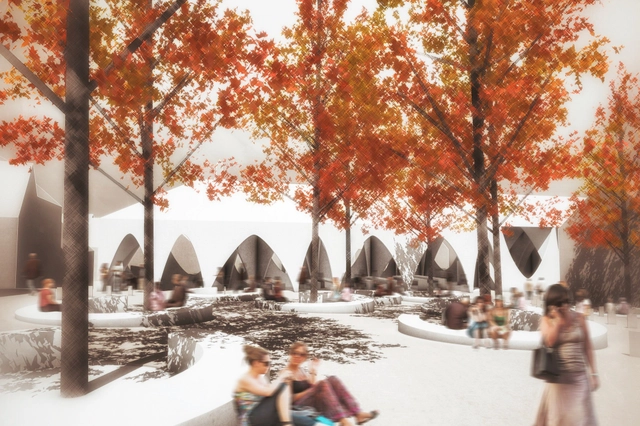
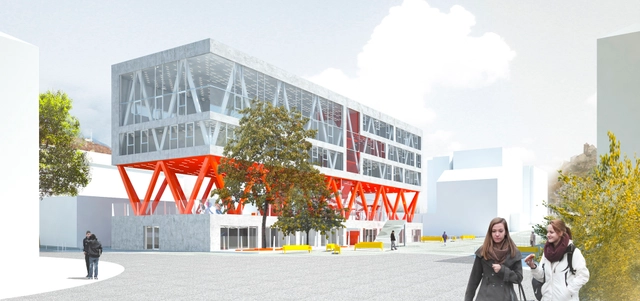
Situated in the very center of the historical town core, the Novo mesto central market feels somewhat removed today, being separated by its level and oriented towards the low-quality city space of Florjanov Square. Therefore, one of the basic guidelines for locating the new central market into the space must be to create the best possible entrance from the main square. Designed by Enota, the backbone of the new central market is formed by the covered Market Street, which lies on the level of main city square and connects the two spots closest to it on both access streets.
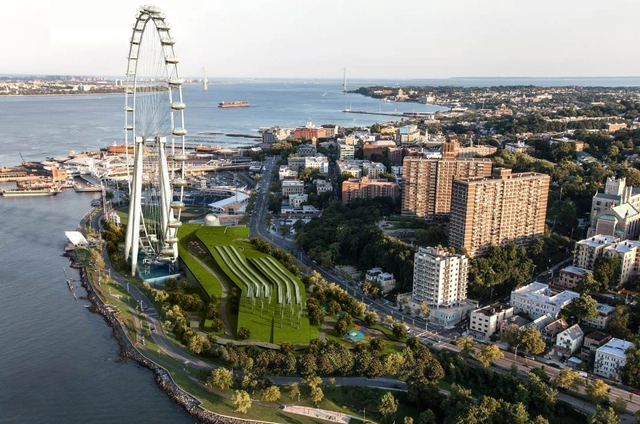
With the intention of restructuring the school complex in the city of Sion, the starting point for OVERCODE was to conceive a compact building deploying a strategy of economy of means and space. Consisting of a school extension, new nursery and new gymnasium, their urban strategy spins around the idea of closing and opening the site at the same time. More images and architects’ description after the break.
The Future of Places Forum, the inspiration for our Ten Ways to Transform Cities through Placemaking & Public Spaces article published earlier this week, will open this June in Stockholm, Sweden. The forum will be hosted by UN-HABITAT, Project for Public Spaces (PPS) and the Ax:son Johnson Foundation and will be the first of three conferences leadingup toHabitat III in 2016. Its overall aim is to "contribute to a New Urban Agenda around people and places" and to "highlight how and why cities need to embrace a people centered approach in order to achieve positive urbanization." The conference series will define examples of excellent urban practices from around the world as well as future projects that reflect sustainable and equitable processes which build community, enhance quality of life, and creates safe and prosperous neighborhoods.
Courtesy of Center for Architecture & AIA New York
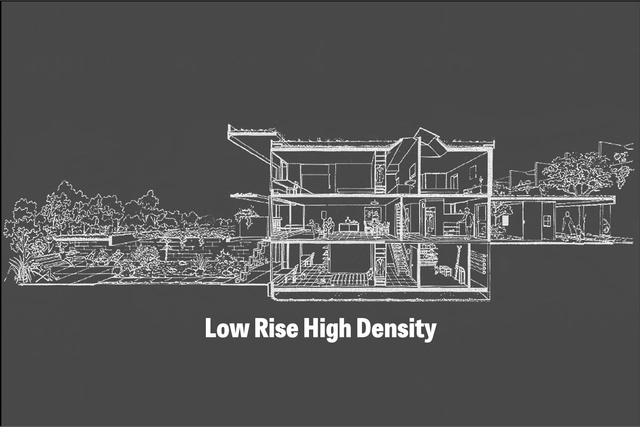
Opening today at the Center for Architecture in New York, the 'Low Rise High Density' exhibition examines a housing type celebrated in the 1960s and ‘70s, and what it means in the United States today. Co-sponsored by the Institute for Public Architecture with AIA New York, architectural drawings, photographs, and oral histories will be presented with project architects, tracing the typology over the last 50 years. The exhibition will be on view until June 29. More information after the break.
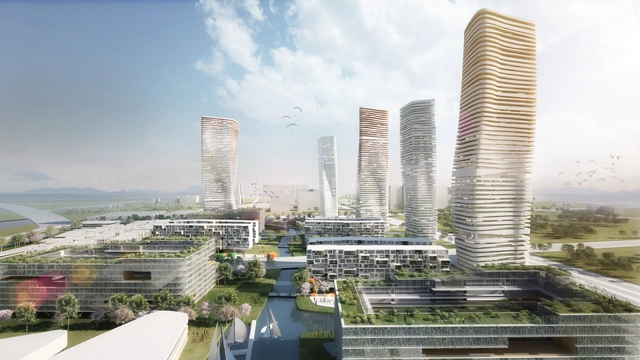
ATENASTUDIO, in collaboration with Archmaster studio, has developed a masterplan for a new district in Wuxi, China, which takes a 200,000 sqm buildable zoning lot to present two main keywords which are the base of all design choices and that can be defined as generator elements of all the project: landscape and waterscape. The intention is to emphasize to the maximum the presence of water making it become a diffuse system, introducing it inside the area and in every part of the project, and using it as if it was a “3D liquid material”. More images and architects' description after the break.
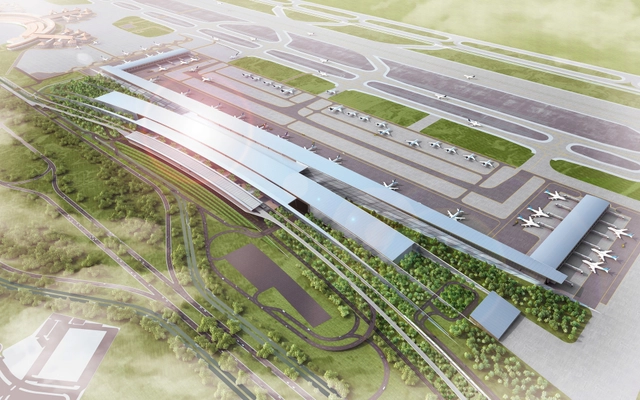
Woodhead recently won the commission against three other international design, engineering and contractor teams to be the lead designer of architecture and interiors for the new 380,000m2, 25 million passenger Terminal 3 at Soekarno Hatta International Airport in Jakarta. The terminal is for Garuda’s expanding international and domestic fleet of aircraft and is a model of efficiency and comfort overlaid with the curation of Indonesia’s unique cultural and environmental experiences for passengers. Construction is due to be completed and the new terminal building fully operational by the close of 2015. More images and architects' description after the break.
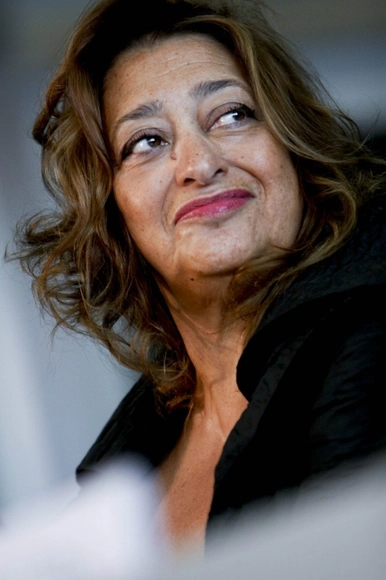
Zaha Hadid has been announced as the winner of the 41st Veuve Clicquot Business Woman Award at a ceremony in London on Monday. Now in its 41st year, the Veuve Clicquot Award was set up by the Champagne house to recognize the work of successful businesswomen worldwide, who embody their spirit of Madame Clicquot.
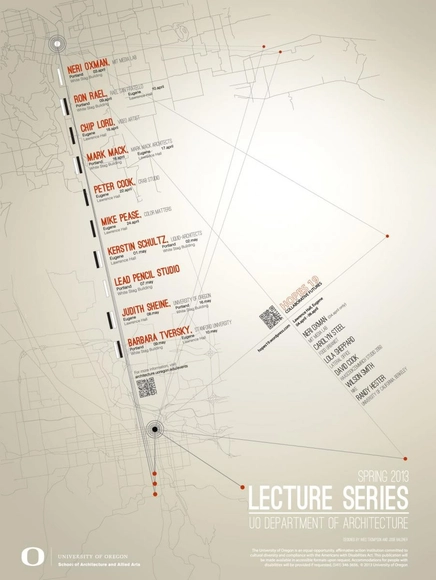
Courtesy of University of Oregon's School of Architecture and Allied Arts
With programs in both Eugene and Portland, the University of Oregon's School of Architecture and Allied Arts recently launched their Spring 2013 lecture series which began early this month with Neri Oxman of MIT's Media Lab, and concludes May 16th with University of Oregon's Judith Sheine's lecture in Portland. The lectures take place in Portland, Eugene, or in both cities, depending on the lecture. The full list of remaining lectures can be viewed after the break.
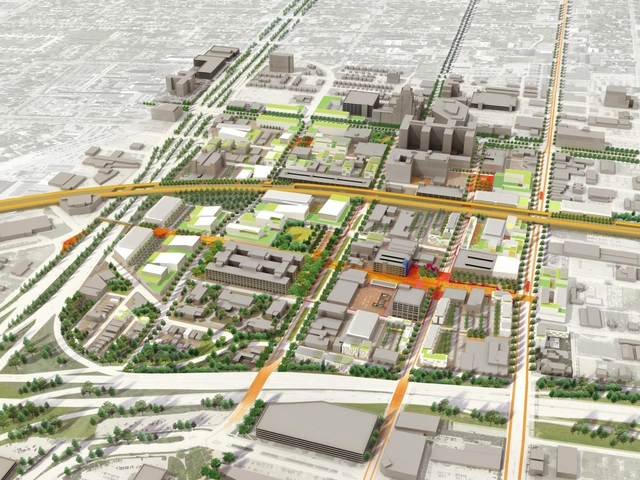
The TechTown District Plan by Sasaki Associates articulates an inspiring vision for the revitalization of the district. An emerging knowledge district in Midtown Detroit, this town is currently characterized by surface parking, vacant properties, and inward-facing, siloed hubs of activity. The architects' concept, however, aims to accelerate innovation, promote entrepreneurship, and build community around the generation of ideas in a vibrant, mixed-use setting. More images and architects' description after the break.
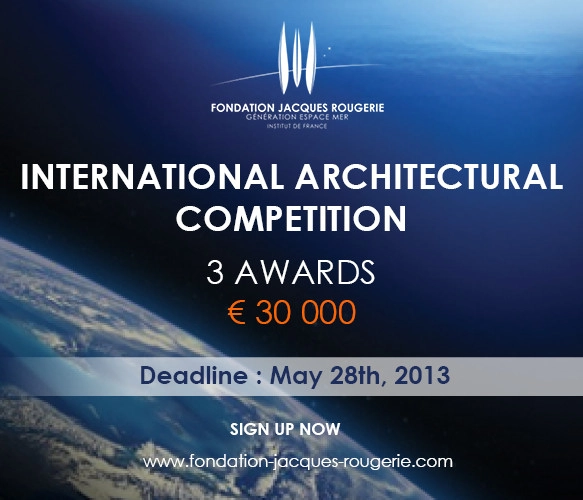
Jacques Rougerie, a famous French Sea oriented architect, had the chance during his career to receive help and support from those who believed in his talent. Open to everyone, his foundation, the Jacques Rougerie Foundation, has launched an International Competition which aspires to offer a unique opportunity for students in architecture, engineering or design, from all around the world to make their projects come true, or simply to reward their creativity. The competition aims to reward the most innovative, creative and bold projects at the service of architectural innovation, relative to topics that are dear to the foundation; Water and Space. The deadline for entries is May 28. For more information, please visit here.
To become an architect is to learn to fall in love with clean lines, pure functionality, and minimal simplicity. Which is why it’s so hard for us to understand why the majority of clients remain so tied to their “traditional” homes. You must understand that, for the typical home-buyer, a modern home seems “cold” and “austere” - even “clinical.”
https://www.archdaily.com/362861/the-benefits-of-modern-designSponsored Post
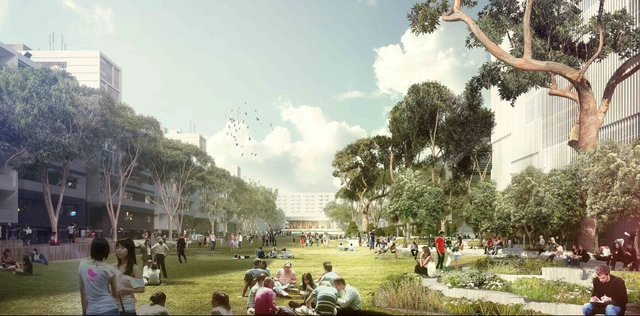
ASPECT Studios, in collaboration with Choi Ropiha Fighera, Barbara Flynn Grounds, ARUP, Deuce Design and People for Places and Spaces, was recently selected as one of five finalists by the University of New South Wales (UNSW) in a design competition for Alumni Park. In an effort to reconnect the University’s spatial hierarchy and movement patterns, the architects provide clearly articulated wayfinding and circulation routes with the new 2ha ‘Social Spine’. More images and architects' description after the break.
The American Academy of Arts and Letters recently announced the recipients of its 2013 architecture awards. Beginning in 1955 with the inauguration of the annual Arnold W. Brunner Memorial Prize in Architecture, this is awarded to a preeminent architect from any country who has made a significant contribution to architecture as an art. In 1991, the Academy began giving Arts and Letters Awards (formerly called Academy Awards) to honor American architects whose work is characterized by a strong personal direction. An additional award category was created in 2003 to honor an American from any field who has contributed to ideas in architecture through any medium of expression. Information on the winners after the break.
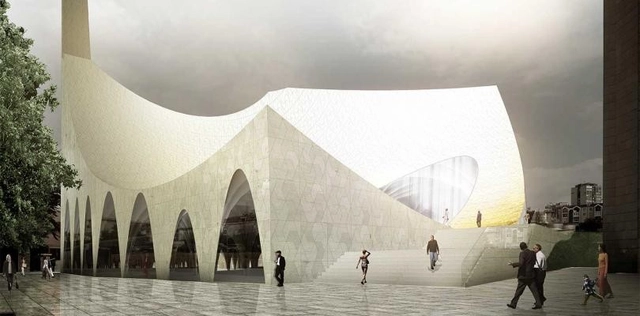
Designed by APTUM Architecture, their proposal for the Central Mosque of Pristina, titled MI’RAJ, is about a journey of ascension to prayer and the spatial experience that evolves. As the ascension to prayer begins, a sequence of events unfolds. As a result of the Islamic community of Pristina searching for a unifying symbol and identity that can bring together many disparate mosques scattered throughout the city, the proposal harnesses that need and brings together a sense of place and provides public space for the greater good of the community. More images and architects' description after the break.
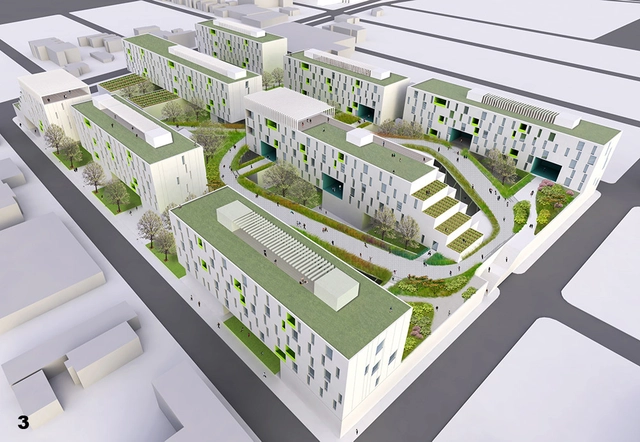
The proposal for Healthy Urbanism is a collaboration between a visionary client, a health scientist and ISA - Interface Studio Architects to investigate the potential for health outcomes to influence large-scale neighborhood and building design. The consulting team developed a conceptual tool in order to bring spatial design and health outcomes into communication with one another. “The Matrix” is a key proposal of the work which creates a bridge between health-related research and literature, factors, health impacts, program, and design parameters. More images and architects' description after the break.