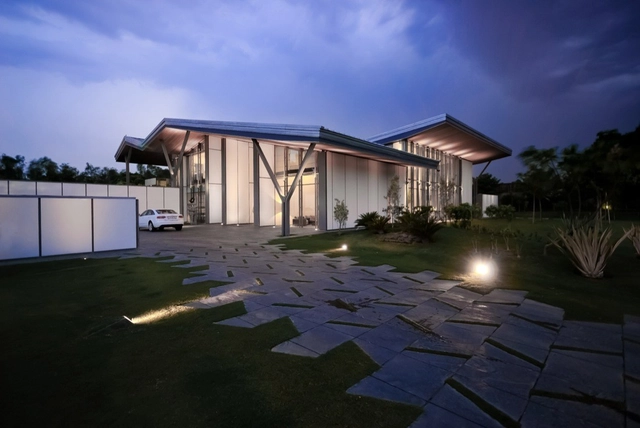
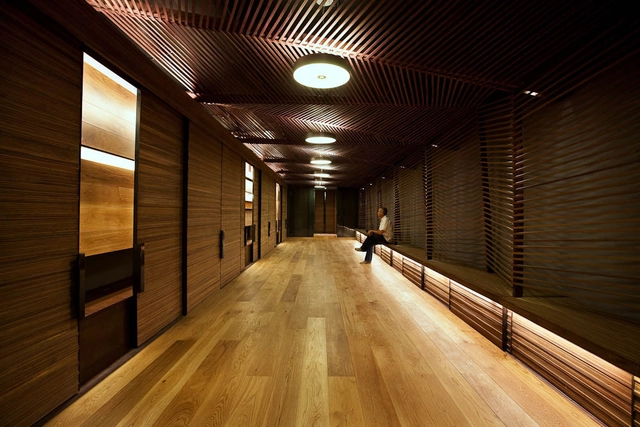
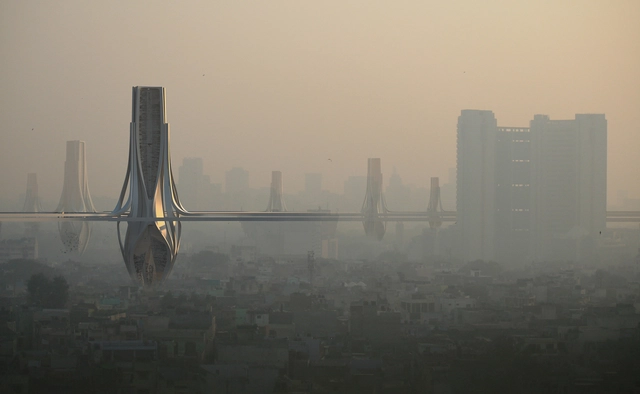
Dubai-based architecture firm Znera Space have released "The Smog Project," a design to clean the air in Delhi, one of the world's most polluted cities. Shortlisted in the World Architecture Festival's Experimental Project Category, the Smog Project hopes to address Delhi’s noxious air quality by adding a network of smog filtering towers throughout the entire city. India's capital has become known for toxic smog levels from overcrowding and industrial waste. Znera's proposal hopes to cleanse the smog chamber and generate smog free air.
Last month, ArchDaily had an opportunity to speak with Akshat Nauriyal, Content Director at Delhi-based non-profit St+Art India Foundation which aims to do exactly what its name suggests—to embed art in streets. The organization’s recent work in the Indian metropolises of Delhi, Mumbai, Hyderabad, and Bengaluru, has resulted in a popular reclamation of the cities’ civic spaces and a simultaneous transformation of their urban fabric. Primarily working within residential neighborhoods—they are touted with the creation of the country’s first public art district in Lodhi Colony, Delhi—the foundation has also collaborated with metro-rail corporations to enliven transit-spaces. While St+Art India’s experiments are evidently rooted in social activism and urban design, they mark a significant moment in the historic timeline of the application of street art in cities: the initiative involves what it believes to be a first-of-its-kind engagement between street artists and the government.
On the morning of April 24th, Delhi’s architecture community reacted in shock and disgust to the news that the city's Hall of Nations and the four Halls of Industries had been demolished. Bulldozers had worked through the previous night at the Pragati Maidan exhibition grounds in central Delhi, where the Indian Trade Promotion Organisation (ITPO) razed the iconic structures to the ground, ignoring pleas from several Indian and international institutions.
The Hall of Nations, the world’s first and largest-span space-frame structure built in reinforced concrete, holds special significance in India’s post-colonial history—it was inaugurated in 1972 to commemorate twenty-five years of the young country’s independence. The demolition was met with widespread condemnation by architects and historians alike, not just because of the loss of an important piece of Delhi's heritage, but also for the clandestine manner in which the demolition was conducted.
Urban artist DAKU has created a dynamic solar mural, “Time Changes Everything,” on a building in the Lodhi Colony area of Delhi as part of India’s first ever public arts district. Words associated with human emotion and the passage of time have been mounted perpendicularly on the building facade, casting shadows that shift as the sun moves across the sky, eventually extinguishing as the sun completes its journey.
A three-day Building Energy Modeling workshop in Delhi for architects that equips them with knowledge related to building science, software training to design energy efficient and sustainably cooled buildings that save money for their clients, enhance energy access for underprivileged sections of our society, and reduce carbon emissions.
Agroecologist Amlankusum, together with Paris-based Vincent Callebaut Architectures, has created Hyperions, a vertical, energy positive eco-neighborhood proposed for Jaypee Green Sports City in the Delhi National Capital Region (NCR) in India. Aiming to “reconcile urban renaturation and small-scale farming with environment protection and biodiversity,” the project combines low-tech and high-tech elements with the “objective of energy decentralization and food deindustrialization.”
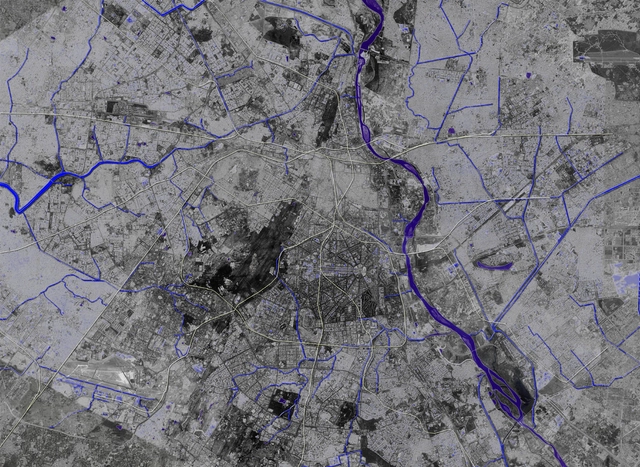
Map of Delhi's nullah network. Image Courtesy of Morphogenesis
The city of Delhi has a transportation problem. The streets are crowded and dangerous, and with 1,100 new vehicles being added to the roads each day the city is suffering from the consequences. Last year, New Delhi was rated the most polluted city in the world by the World Health Organization, with nearly 3 times the particulate matter of Beijing. Noise levels throughout the city consistently exceed regulations set by the Indian Central Pollution Control Board, and heavy traffic means increased travel times and perilous pedestrian conditions. Even walking the last mile from a bus stop to a destination has become a game of chance.
At the same time, the river upon which the city was founded, the Yamuna (a main tributary of the Ganges), has been polluted to the point where it has become little more than a glorified sewer drain. Illegal settlements without sewage systems pollute the river directly, and even within the regulated systems, 17 sewage drains empty directly into the Yamuna. For a city already struggling with water shortages, polluting a main water source is akin to throwing salt into a wound. However, a proposal by Dehli-based Morphogenesis Architects attempts to tackle all of these issues through the revitalization of the river and its canals, known as nullahs.
Design Intiatives has once again sent us their latest work, The Crowd in the Cloud, their firm’s entry in the SpireTec mixed use competition for Greater Noida, Delhi, India. Images and a narrative by the architects after the break.
Tesseract is a collective of architecture students from RGU in Aberdeen, Scotland, who came together under the common ambition of using our creativity for humanity. They are now traveling to Delhi, India to work with local NGO Anusaran in the construction of a new hostel that will provide accommodation for children, young women and visiting volunteers, as well as classrooms, meeting and dining areas.
The innovative Urban Workshop series will explore the varied challenges facing some of the most dynamic global cities. The initial Workshop will convene in Delhi from January 3 to 21, 2011. The Workshop will explore current urban conditions and issues facing this ancient and legendary city that later evolved into Mughal and imperial capitals, and since Indian independence has become the vibrant center of an increasingly influential nation.






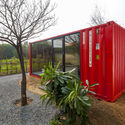




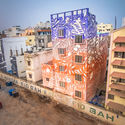
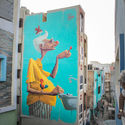
__Anpu_Varkey___photo_by_Akshat_Nauriyal.jpg?1501258835 "Gandhi Mural by Hendrik Beikirch and Anpu Varkey, Delhi. Image © Akshat Nauriyal")