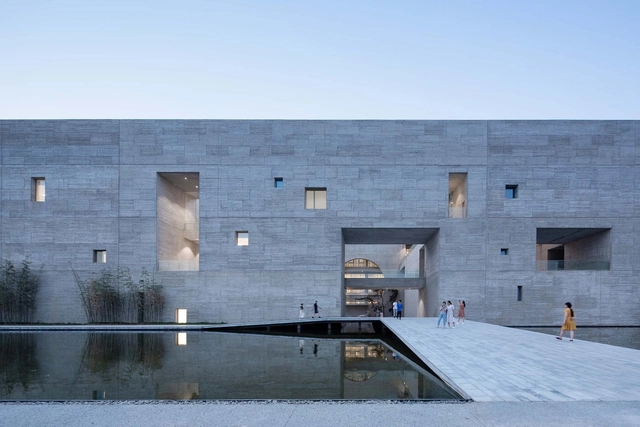
As a Chinese architectural educator and practicing architect, Zhu Pei has founded Studio Zhu-Pei in 2005. Since then, he has been focusing on cultural architecture in both theoretical and practical ways. Based on the concept of 'natural architecture’, he has designed a series of experimental and artistic buildings.
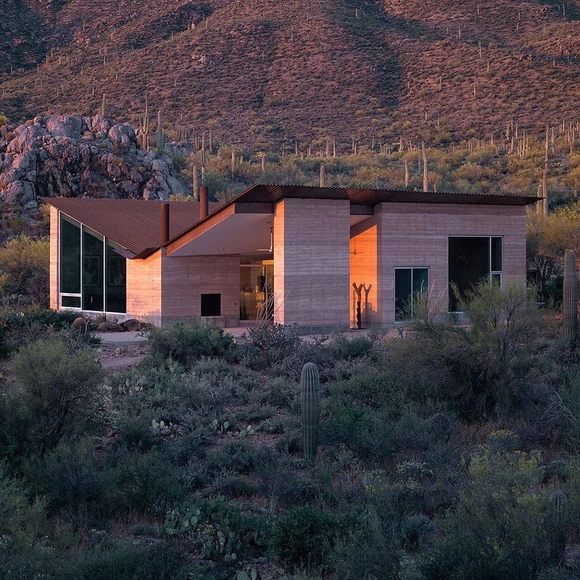
The author gained a grasp for innovative architectural materials and their application while working for architects such as Rick Joy, whose Mountain House in Tucson, Arizona, employed rammed-earth walls. (Creative commons/Flickr user designmilk)
There is a slide I like to show at the beginning of the architecture courses I teach that provides an overview of the last hundred years or so in design and technology. In the left column, a car from the beginning of the 20th Century (a Ford Model T) is poised over a contemporary car (a Tesla). The middle column contains a similar juxtaposition, showing a WWI-era biplane and a modern-day stealth fighter (an F-117A). In the right column, Walter Gropius’s 1926 Bauhaus Dessau building is seen next to an up-to-date urban mixed-use building. The punch line, of course, is that the two buildings—separated by roughly 100 years—look basically the same, whereas the cars and planes separated by the same timespan seem worlds apart. What is the reason for this?
The Midnight Charette is an explicit podcast about design, architecture, and the everyday. Hosted by architectural designers David Lee and Marina Bourderonnet, it features a variety of creative professionals in unscripted conversations that allow for thoughtful takes and personal discussions. A wide array of subjects are covered with honesty and humor: some episodes provide useful tips for designers, while others are project reviews, interviews, or explorations of everyday life and design. The Midnight Charette is also available on iTunes, Spotify, and YouTube.
This week hosts David and Marina are joined by Marc Neveu—Chair of Architecture, The Design School, Arizona State University and Executive Editor of the Journal of Architectural Education; Renée Cheng—Dean of the College of Built Environments, University of Washington; and Kiel Moe—Gerald Sheff Chair in Architecture, School of Architecture, McGill University to discuss how COVID-19 has impacted teachers and students, the future of education (changing studio, reviews, and lectures), and more. Enjoy!
https://www.archdaily.com/940505/covid-19-and-the-future-of-architectural-educationThe Second Studio Podcast
Courtesy of the coronavirus, universities are closed around the world, and classrooms are now entertained over video conferencing. This is not overly dramatic as this temporary arrangement will eclipse after cases are contained, and classes will resume soon after. However, the impacts on the university ecosystem and on the urban fabric will require immediate renovations in higher education that will shape the architectural syllabus for years to come.
https://www.archdaily.com/939423/how-covid-19-will-shape-architectural-educationZaheer Allam, Gaetan Siew and Felix Fokoua
The annual QS- Quacquarelli Symonds ranking for top universities has been unveiled. Based on academic reputation, employer reputation, and research impact, the ranking highlights every year the best universities for each profession. In the 2020 Architecture/ Built Environment division, the list reveals that the Massachusetts Institute of Technology (MIT) is back on top.
The Best Architecture Masters (BAM) platform presented the second edition of its ranking of the best architecture master programs in the world in the year 2019.
The Harvard Graduate School of Design has relaunched its free online course entitled “The Architectural Imagination.” Directed by the school’s Eliot Noyes Professor of Architectural Theory, K. Michael Hays, the course seeks to teach students “how to understand architecture as both cultural expression and technical achievement.”
The free 10-week program runs until July 2019 and is carried out through the online edX platform, a Harvard/MIT system that specializes in high-quality massive open online courses. During the course, students will engage with the social and historical contexts behind major works of architecture, basic principles to produce drawings and models, and the pertinent content for academic study or a professional career as an architect.
https://www.archdaily.com/910644/harvard-gsd-relaunches-free-online-architecture-courseNiall Patrick Walsh
Architectural students of my generation—the last of the baby boomers, starting college in Europe or in the Americas in the late 1970s—had many good reasons to cherish architectural history. Everyone seemed to agree at the time that the Modernist project was conspicuously failing. Late Modernist monsters were then wreaking havoc on cities and lands around the world, and the most immediate, knee-jerk reaction against what many then saw as an ongoing catastrophe was to try and bring back all that 20th-century high Modernism had kicked out of design culture: history, for a start. I drew my first Doric capital, circa 1979, in a design studio, not in a history class (and my tutor immediately ordered me to scrape it, which I did).
Three SCI-Arc graduates became the recipients of the first Woods Bagot Prize, an award that recognizes the top design portfolios and academic achievements from students in the undergraduate and graduate programs on September 9. The prize-winners were awarded USD $20,000 along with an offer for a position at any of the international firm’s 15 studios. From a pool of over 50 applicants, the prize-winners Mikiko Takasago from Japan, M.Arch 1, José Carlos García from Mexico, M.Arch 2, and undergraduate Luciano Meghini from Italy, B.Arch, were selected.
Office Ou, a Toronto-based landscape design firm, in collaboration with INOSTUDIO Architects, has designed a new public school for the historic Smíchov district of Prague. The initial competition, organized by the Centre for Central European Architecture, chose the Office Ou & INOSTUDIO design out of 66 anonymous submissions. This school would be the first new public school built in Prague's urban center in close to 100 years.
https://www.archdaily.com/898457/the-foster-plus-partners-led-trailblazer-apprenticeships-bring-overdue-relief-for-disenfranchised-architecture-studentsNiall Patrick Walsh
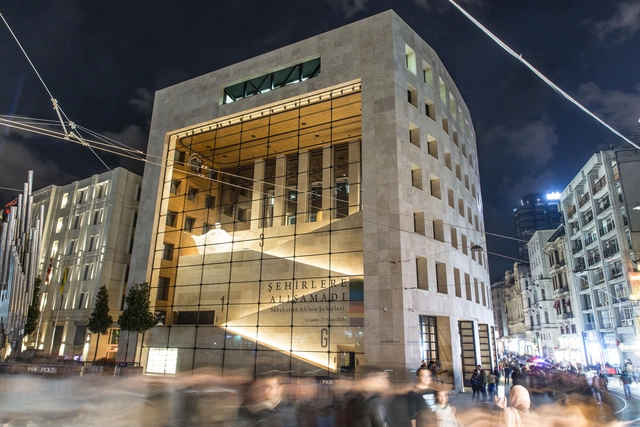
“Today, design has become a form of inquiry, power, and agency,” say Jan Boelen and Deniz Ova, curator and director of the 2018 Istanbul Design Biennial. “It has become vaster than the world itself, permeating all layers of everyday life.” Their curatorial statement for the 4th Istanbul Design Biennial, which opens later this year themed with the title “A School of Schools,” seeks to explore how design education, and education in general, can evolve and adapt in a new age of artificial intelligence.
The team is determined that the Biennial should not read as a two-year scheduled event, but should “reinvent itself and become a productive, process-orientated platform for education and design to research, experiment, and learn in.” The team is undoubtedly well equipped for the challenge.
https://www.archdaily.com/894670/jan-boelen-and-deniz-ova-curators-of-the-2018-istanbul-design-biennial-discuss-the-future-of-design-educationNiall Patrick Walsh
Global higher education analysis firm Quacquarelli Symonds (QS) has revealed its rankings of the world’s top universities for the study of Architecture / Built Environment for 2018. The eight edition of the survey compared 2,122 institutions across the globe offering courses in architecture or the built environment, narrowing down the list based on criteria including academic and employer reputation.
For the fourth straight year, MIT has topped the rankings, once again coming out ahead of the Bartlett School of Architecture and the Delft University of Technology (TU Delft) in 2nd and 3rd respectively. Read on for the full rankings.
The issue of how we educate our architects of the future is a divisive one. With the capabilities of our technology advancing rapidly, new mediums of Virtual Reality, robotics, and artificial intelligence are all changing the architectural profession at a fundamental level. This creates the question of whether architectural pedagogy is keeping up with the times and educating students to be ready for both professional practice and an uncertain future.
The Harvard Graduate School of Design’s popular free online course, The Architectural Imagination, has returned for 2018, again offering anyone across the globe the opportunity to study the fundamentals of architecture from one of the world’s foremost design schools at absolutely no cost.
Led by professors Erika Naginski, Antoine Picon, and K. Michael Hays, alongside PhD student Lisa Haber-Thomson, the 10-week course will cover topics ranging from learning to “read” buildings as cultural expression to technical drawing and modeling exercises.
Columbia Graduate School of Architecture, Planning and Preservation (GSAPP) has launched the United States’ first-ever Ph. D in Historic Preservation. GSAPP is ranked within the top 10 architecture graduate schools in the US in the latest figures for 2017. It’s leadership in learning and experimental practice is about to be further enhanced by the introduction of the course.