As the founder of SITE (Sculpture in the Environment), an architecture firm most widely-known for its seminal series of buildings for the BEST discount-store chain in the 1970s, James Wines (b. 1932, Oak Park, Illinois), originally an artist, introduced his unique approach of practicing architecture as a form of cultural criticism. It struck a chord by delighting the public and infuriating many architects and critics for corrupting architecture with his witty ideas. His buildings were among the first to engage nature head-on, both for pure delight and to raise environmental issues.
AD Interviews: The Latest Architecture and News
“The Point is to Attack Architecture!“: In conversation with James Wines of SITE
https://www.archdaily.com/920798/the-point-is-to-attack-architecture-in-conversation-with-james-wines-of-siteVladimir Belogolovsky
Mario Botta on Modernism, Technology and Main Principles of His Work
During Milano Arch Week 2019, we had the chance to speak with one of the most influential Swiss architects, Mario Botta. Defining himself as a stonemason, Botta has been working since the age of 16, realizing a vast number of projects of different typologies — from private homes to museums and churches.
https://www.archdaily.com/919544/mario-botta-on-modernism-technology-and-main-principles-of-his-workMaria Erman
ArchDaily Interviews: Tom Kundig at AIA'19
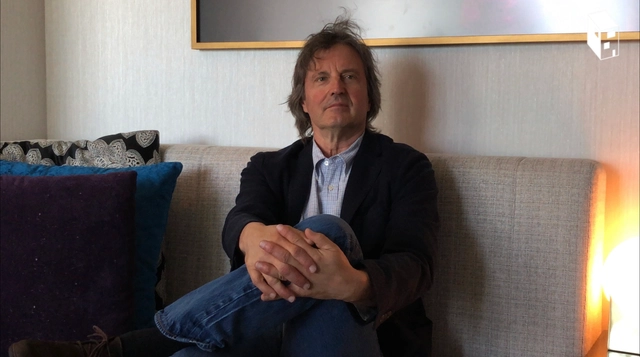
During the recent AIA Conference in Las Vegas, ArchDaily had the opportunity to interview Tom Kundig, Principal at Olson Kundig who has been designing and building for the firm for the last 30 years.
Having been raised in a mountain context, Tom relates strongly with the landscape and its natural elements, acknowledging the weathering of materials as something valuable and poetic. In this conversation, Tom explains the importance of context in each project, particularly the contrast and dispersion of buildings as a meaningful response to the landscape. He also addresses the importance of technology and communication as part of a new design process that we must all start to integrate, as well as open source initiatives.
Keep reading to see the video and complete interview.
https://www.archdaily.com/919439/archdaily-interviews-tom-kundig-at-aia19Fernanda Castro
"If You Can’t Do Beautiful Things You Are Doomed": in Conversation with Zhang Li of Atelier TeamMinus
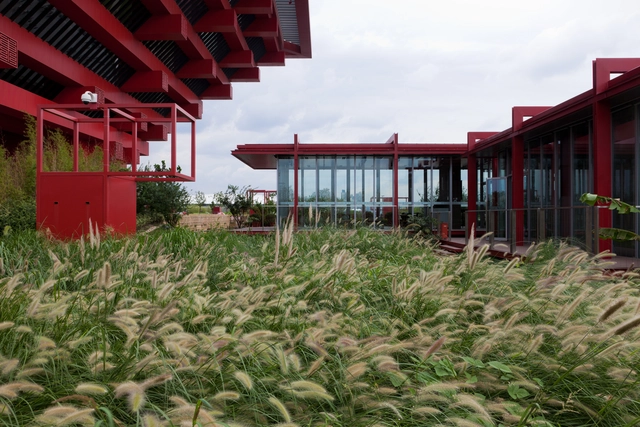



I live in a bubble. I hop from conversation to conversation with architects who live in their own bubbles. I bounce from one bubble to the next. These bubbles are formed by the gross misalignments and discrepancies between what these architects say and what they do. I like venturing into their fascinating minds; they form the mythology of architecture that I love to inhabit. In the following interview Beijing-based architect, educator, and critic Zhang Li helped me to diagnose these discrepancies. He said, “No matter how moral, how ethical, how correct you are if you can’t do beautiful things you are doomed… Architecture is great because it is beautiful.”
Zhang Li graduated from Tsinghua University in Beijing and taught at prestigious European and American universities. He has been a Professor of Architecture and Chair of the Architecture Department in the School of Architecture, Tsinghua University, China’s most prestigious university. His 50-person practice Atelier TeamMinus was founded in 2001. Since 2012, the architect has been serving as the Editor-in-Chief of the leading Chinese monthly magazine World Architecture. The following is an excerpt from our recent conversation at his Beijing studio.
https://www.archdaily.com/918369/if-you-cant-do-beautiful-things-you-are-doomed-in-conversation-with-zhang-li-of-atelier-teamminusVladimir Belogolovsky
AD Interviews: Kim Nielsen of 3XN
During the World Architecture Festival 2018, which will be held this year again in Amsterdam, we had the chance to sit down with Kim Nielsen, one of the founders of Denmark-based firm 3XN.
3XN is today one of the most renowned Danish firms, operating on a global scale. With strong expertise in healthcare and institutional projects, the firm early on decided to focus on a global strategy. "When we came into the crisis in 2008, we have already done a couple of buildings abroad. [...] but after the crisis we realized, we had to be global," Kim explains.
https://www.archdaily.com/918437/ad-interviews-kim-nielsen-of-3xnMaria Erman

"Creative Cynic" Peter Cook Explains Why Archigram Designs Were Always Meant to Be Built
Last week ArchDaily attended the 2016 World Architecture Festival in Berlin. We chatted with Sir Peter Cook and asked him about the current state of global affairs (Brexit, the US election, etc). He explained how his experience and work has influenced a career that has spanned over five decades, and reminds us of the inspiring power of architecture.
Peter Cook: You have to understand that I'm a very particular kind of animal both politically and in my general opinions. I'm what I would call a creative cynic. I'm an old person and I've seen a lot of not very good things happen. On the other hand I was privileged as a child to have free education and free college.
https://www.archdaily.com/799846/creative-cynic-peter-cook-explains-why-archigram-designs-were-always-meant-to-be-builtBecky Quintal
AD Interviews: Bart Lootsma / Curator of Montenegro Pavilion
Ahead of this weekend's symposium “THE DEBATE”—which will take place in Kotor, Montenegro and will present the results of the Project Solana Ulcinj for the national and international audience of the KotorAPSS (Kotor Architectural Prison Summer School)—we present an interview with Bart Lootsma, co-curator of the Montenegro Pavilion at the 2016 Venice Architecture Biennale.
The exhibition "Project Solana Ulcinj," co-curated by Lootsma and Katharina Weinberger and commissioned by Dijana Vucinic and the Ministry of Sustainable Development and Tourism, features four proposals for the re-use/re-purposing/re-programming of a former industrial site in Montenegro. With an eye on not only sustainability, but also natural and economic viability, four firms proposed different spatial strategies to transform what Lootsma calls an "unreal man-made artificial and abstract landscape."
https://www.archdaily.com/791477/ad-interviews-bart-lootsma-curator-of-montenegro-pavilionAD Editorial Team
Video: Daily Life, Daily Tao – Jingyu Liang Discusses the Chinese Pavilion at the 2016 Venice Biennale
In this interview, curator Jingyu Liang of Approach Architecture Studio discusses the concept behind "Daily Design, Daily Tao – Back to the Ignored Front," the theme of the Chinese Pavilion at the 2016 Venice Biennale. Responding to 2016 Biennale director Alejandro Aravena's overall theme of "Reporting From the Front," the pavilion takes an introspective look at China's own architectural front, and the impact that the country's ongoing development boom has had on Chinese architecture.
https://www.archdaily.com/791457/video-daily-life-daily-tao-nil-jingyu-liang-discusses-the-chinese-pavilion-at-the-2016-venice-biennalePatrick Lynch
AD Interviews: Amale Andraos / Columbia University's GSAPP
We recently sat down with Amale Andraos, co-founder of WORKac, about her past year as the new dean of Columbia University’s Graduate School of Architecture, Planning and Preservation (GSAPP). Appointed as the University’s dean in September 2014, Andraos has made steps to improve the program’s connectivity within itself and challenge students and faculty with considering the role of discourse in architecture.
https://www.archdaily.com/779761/ad-interviews-amale-andraos-columbia-universitys-gsappEric Oh
AD Interviews: Francis Kéré / Chicago Architecture Biennial
Kéré Architecture’s “Place for Gathering” exhibition at the Chicago Architecture Biennial creates a meeting place at the entrance to the Chicago Cultural Center. Made from a locally sourced material (wood), the exhibition emits a fresh, natural smell, and creates a place for people to meet, connect and share “differing cultural narratives, traditions and aspirations," writes Kéré in the official Chicago Biennale Guidebook.
Selected by ArchDaily Editors as one of their favorite exhibitions at the Biennial, “Place for Gathering” is based on two themes that are central to the work of Francis Kéré: “maximizing local resources and facilitating the exchange of ideas and knowledge." Listen to Kéré explain the inspiration and philosophy behind the exhibition in the video above.
https://www.archdaily.com/777875/ad-interviews-francis-kere-chicago-architecture-biennialKatie Watkins
AD Interviews: Vicente Guallart / Moscow Urban Forum
During the 2015 Moscow Urban Forum, city experts from different regions and countries united to exchange practices, projects, and trends. The event fueled discussion on the city of Moscow, which is currently working on its expansion plans, new transport infrastructure, and a series of urban initiatives that are having a positive impact on the quality of life in the city.
https://www.archdaily.com/776864/ad-interviews-vicente-guallart-moscow-urban-forumDavid Basulto
AD Interviews: Sou Fujimoto / Chicago Architecture Biennial
Sou Fujimoto Architects' "Architecture is Everywhere" was among the ArchDaily editors' favorite exhibitions in the Chicago Architecture Biennial. The thought-provoking, entertaining collection of mundane objects truly embraced the idea that the public—not solely architects—should be included in the Biennial's celebration of architecture.
Before the fruits of architectural labor are realized, we rarely revel in the seeds cultivated in the minds of architects. It's hard to capture these formative ideas, much less present them in a way that seizes the satisfying moment in which architecture is "found."
The deceiving simplicity of displaying "found architecture" actually imparts a deeper, thoughtful lesson, which Fujimoto has inscribed on an accompanying placard "Architecture could come into being from anywhere. I believe fostering that architecture-to-be into real architecture itself is also architecture."
https://www.archdaily.com/775921/ad-interviews-sou-fujimoto-chicago-architecture-biennialBecky Quintal
AD Interviews: Joseph Grima / Chicago Architecture Biennial
A few weeks ago, during the opening of the Chicago Architecture Biennial, we eagerly awaited our opportunity to speak with Joseph Grima, the co-artistic director of the first Chicago Architecture Biennial. In an exhibition with such an open theme, we wanted to understand the driving forces behind the assembly of the participants, in addition to how the city of Chicago itself influenced decisions in the planning of this largest gathering of architecture in North America. Watch the video above and read a transcript of Grima's answers below.
https://www.archdaily.com/775633/ad-interviews-joseph-grima-chicago-architecture-biennialAD Editorial Team
AD Interviews: Santiago Calatrava
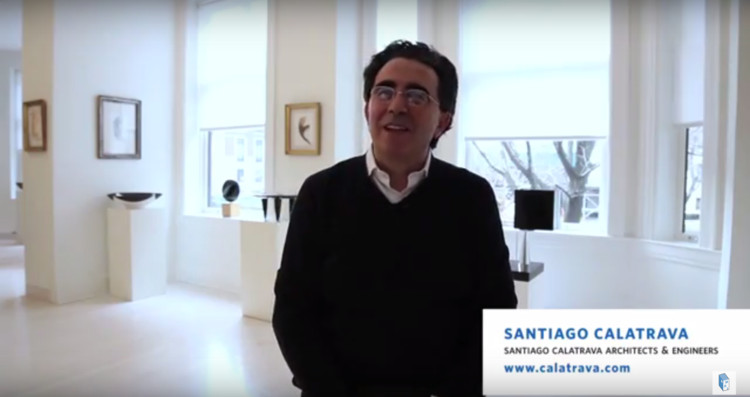
Earlier this year we had the chance to interview Spanish-born architect Santiago Calatrava in his New York apartment. Trained first as a structural engineer, he has designed and completed over 50 projects, which include bridges, transportation hubs, theaters and even a skyscraper. Calatrava has built a career through public architecture, and thanks to open competitions he has received commissions for mostly large-scale, cultural and transport projects. Many cities around the world—from Europe to the US and Asia and beyond—can proudly lay claim to the structurally dramatic projects that Calatrava has dreamed up.
His architectural explorations fuse engineering and art, and result in impressive structures that are honest in revealing the forces at play. In this respect, he is a pioneer; when working on his earliest projects, he didn’t have access to software and tools that are ubiquitous today.
We asked him about his definition of architecture, his high-profile commission for the World Trade Center Transportation Hub, and the challenges he has faced while running his practice. The WTC hub is one of Calatrava's most-anticipated projects in New York; though its inherent complexity has resulted in a long construction period, he has created a project rich in not only form, but also in spatial quality.
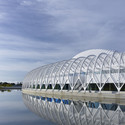
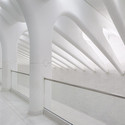
Some of Calatrava's projects use an almost modern-day gothic vocabulary—where big spans, vaults and thin lines define large spaces. Other works, such the St. Nicholas Cathedral in New York, mobilize larger masses and big, stacked walls.
Watch the interview above to learn how Calatrava sees the intersection of art and architecture.
.jpg?1441986671 "Margaret Hunt Hill Bridge / Santiago Calatrava © Alan Karchmer")
.jpg?1441986639 "AD Classics: Bac de Roda Bridge / Santiago Calatrava © Flickr littleeve / www.flickr.com/littleeve. Used under <a href='https://creativecommons.org/licenses/by-sa/2.0/'>Creative Commons</a>")
https://www.archdaily.com/773481/ad-interviews-santiago-calatravaDavid Basulto
AD Interviews: Li Xiaodong / Li Xiaodong Atelier
During our last trip to Beijing we had the opportunity to visit Li Xiaodong at his recently opened extension for the School of Architecture at Tsinghua University. Li Xiaodong has become recognized worldwide thanks to his recent projects in rural China, which are deeply connected with the landscape and local community and use a mix of traditional and contemporary techniques.
His built works are strongly connected with his academic research. As a professor at Tsinghua University he has focused on understanding Chinese architecture, co-authoring publications such as “Form Making in Traditional Chinese Architecture” and “Chinese Conception of Space." His research has led him to develop a unique style, which he calls a “new regionalism," focusing on how the local can deal with the global in this era.
https://www.archdaily.com/770056/ad-interviews-li-xiaodong-li-xiaodong-atelierAD Editorial Team
AD Interviews: Martha Thorne / IE School of Architecture and Design
During the Mextropoli Festival in Mexico City, we had the chance to sit down with Martha Thorne, the Vice Dean of the IE School of Architecture and Design, and the Executive Director of the Pritzker Prize, who spoke with us about some of the challenges currently facing architecture education.
"When there is globalization in any field there’s the danger that every place becomes similar, or in this case the danger that schools can become similar or standardized, all trying to approach architecture and the academics of architecture in the same way,” she explained. “I think what’s really interesting is to try to look at schools and see how they try to differentiate themselves.”
https://www.archdaily.com/641029/ad-interviews-martha-thorne-ie-school-of-architecture-and-designKatie Watkins
AD Interviews: Barozzi / Veiga
Earlier this month, during the award ceremony for the 2015 EU Prize for Contemporary Architecture-Mies van der Rohe Award, we had the opportunity to speak with winners Barozzi / Veiga, who won for their Philharmonic Hall Szczecin. We asked Fabrizio Barozzi and Alberto Veiga, founders of the eponymous, Barcelon-based firm, about their project and their office.
The architects describe the process of incorporating and filtering many influences to arrive at the final design for the Philharmonic Hall, emphasizing that they strove to "create a quality" that transforms from day to night. Learn more about the project by watching the video above, and see what the jury had to say after the break.
https://www.archdaily.com/633976/ad-interviews-barozzi-veigaBecky Quintal
AD Interviews: Nanne de Ru / Powerhouse
At the ARKIMEET event in Istanbul, Turkey, we had the chance to catch up with Nanne de Ru, a co-founder of Powerhouse Company and the current director at The Berlage Center for Advanced Studies in Architecture.
“I think architectural thinking is quite often about how to manage complexity, how to manage the complexity of different stakeholders -- an architect is a mediator between those different demands. And politics operates quite often in similar ways,” he said on the connection between architecture and politics. “I think what politics and architecture have in common is the need for strategy and for thinking and to design strategies."
Check out some of Powerhouse Company’s designs below and watch the full video above to see what else de Ru has to say about politics, empathy and education in architecture.


https://www.archdaily.com/561554/ad-interviews-nanne-de-ru-powerhouseKatie Watkins