Beneath an elevated railway in the former red-light district of Kogane-cho, the city of Yokohama and NPO Koganecho Area Management Center commissioned five architects to transform a 100 to 150 square meter site into what is now a destination for local artists and residents. Each practice - Contemporaries, Studio 2A, Workstation, Koizumi Atelier, and Nishikura Architectural Design Office - was assigned a single project, providing the community with a gallery, cafe, studio, meeting hall for artists, and stepped outdoor plaza. Tour through each space with this video, provided by JA+U.
Videos
Video: Studio Beneath the Railway + Step Plaza
https://www.archdaily.com/384812/video-studio-beneath-the-railway-step-plazaKarissa Rosenfield
Video: American Design Club

https://www.archdaily.com/383336/video-american-design-clubSebastian Jordana
Dubai Timelapse
Check out this Vimeo Staff Pick, filmed by dimid, that captures the towering city of Dubai.
More images after the break...
https://www.archdaily.com/381159/dubai-timelapseKarissa Rosenfield
VIDEO: Five Great Buildings in Chicago
A short and sweet animation displaying 5 of Chicago's great buildings - including, the John Hancock Center, by SOM, The Willis Tower (formerly known as the Sears Tower), also by SOM, and Marina City by Bertrand Goldberg. Enjoy!
https://www.archdaily.com/380773/video-five-great-buildings-in-chicagoVanessa Quirk
Video: Teshima Art Museum / Office of Ryue Nishizawa
Designed for the artwork of artist Rei Naito, the Teshima Art Museum is a seamless, earthen form of white concrete in which responds to the rolling landscape of an island located in the Inland Sea of Japan. Architect Ryue Nishizawa created the museum to be an open gallery, exposed to the elements, that is shaped by a 25cm thick concrete shell in which spans up to 60 meters.
Video courtesy of JA+U. More images after the break...
https://www.archdaily.com/381150/video-teshima-art-museum-office-of-ryue-nishizawaKarissa Rosenfield
Video: WikiHouse co-founder Alastair Parvin at TED2013
In this talk at TED 2013, WikiHouse co-founder Alastair Parvin elaborates on some of the ideas which he presented in 2012. WikiHouse is his project to create an open-source library of houses which can be downloaded, manufactured with a CNC machine and assembled in a day - an idea which he hopes will democratize the production of housing and the city as a whole - as he puts it, "In a way it should be kind of obvious that in the 21st century maybe cities could be developed by citizens".
https://www.archdaily.com/379597/video-wikihouse-co-founder-alastair-parvin-at-ted2013Rory Stott
Video: Pin-Up Magazine

https://www.archdaily.com/380323/video-pin-up-magazineSebastian Jordana
Video: Future Focus

https://www.archdaily.com/379483/video-future-focusSebastian Jordana
Cathleen McGuigan: "Women and the Changing World of Architecture"
In this video. Cathleen McGuigan, editor-in-chief of Architectural Record, discusses gender within the professional setting, specifically within the world of architecture at the Harvard GSD. As she begins, she addresses the question that most people have when such a topic is approached. "Why are we still talking about this?" McGuigan lays out the position of women in architecture and the rational that still supports inequality, however subconscious, within the profession. Referencing Sheryl Sandberg's new book Lean In, McGuigan shows how this topic is still unresolved and still needs to be discussed in the public forum.
https://www.archdaily.com/377332/cathleen-mcguigan-women-and-the-changing-world-of-architectureIrina Vinnitskaya
Strelka Talks: Architecture and Community / Reinier de Graaf
"The Community" might be the most frequently used term over the last 50 years of Architectural and Urban discourse. For decades, "the community" has served as a legitimization for anything from Team X to New Urbanism, from Celebration to "vancouverism". But what is "the community"? Where should we look for the proper definition? How did communities appear in the past and how do they form today? Can 'the community" influence the design of its own space, territoiry or context? If yes, what could be the relationship between the community and architecture in the future?
In his Strelka talk Reinier de Graaf is trying to answer these and other, even more complex questions.
Via the Strelka Institute.
https://www.archdaily.com/377566/strelka-talks-architecture-and-community-reinier-de-graafKarissa Rosenfield
Alexander Brodsky at Architekturzentrum Wien in 2011
For this architect, there is an indiscernible line between art installation and building. Alexander Brodsky studied architecture in Moscow, while working on art installations and drawings both independently and in collaborations with other artists. Brodsky admits that his career path was unconventional, that he felt unready to take on the responsibility of building. Instead, Brodsky's approach to architecture is through the lens of art: occupiable, room-sized installations that test spatial and sensory boundaries.
More after the break.
https://www.archdaily.com/375085/alexander-brodsky-at-architekturzentrum-wien-in-2011Irina Vinnitskaya
Charles Correa in Conversation with RIBA President Angela Brady
After generously donating an archive of over 6000 drawings and 150 projects, architect Charles Correa sat down with RIBA President Angela Brady to discuss his life and work as one of “India’s greatest architects.” The short interview touches on a wide range of topics, from the inspiration behind some of his greatest projects to advice for future architecture students.
“The thing about architecture is that you cannot teach it. You can learn it, but you cannot teach it. And a good school is a school which makes you passionate about architecture and that teaches you how to ask questions. [...] If you know how to ask the right questions, you will develop your own philosophy and your own visual vocabulary.”
https://www.archdaily.com/377704/charles-correa-in-conversation-with-riba-president-angela-bradyKarissa Rosenfield
Video: Steven Holl and Jeffrey Kipnis in Conversation
In this fascinating conversation, critic and theorist Jeffrey Kipnis and architect Steven Holl discuss modern architecture, from competitions to cantilevers, courtesy of our friends at 32BNY.
https://www.archdaily.com/377502/video-steven-holl-and-jeffrey-kipnis-in-conversationRory Stott
Video: Rafael de Cárdenas

https://www.archdaily.com/377462/video-rafael-de-cardenasSebastian Jordana
Video: archiDUTCH Documentary
Conducted by a group of Canadian design students, archiDUTCH is a 19-minute documentary about how the Dutch build and design the cities we live in, including a collection of interviews of Dutch architects and designers. The footage was shot and edited by first-time student filmmakers from Simon Fraser University’s Interactive Art and Technology program. OMA's Reinier de Graaf, Inside Outside's Petra Blaisse, and MVRDV's Jacob van Rijs (along with dutch model maker Vincent de Rijk) comment on the Dutch point of view of designing for the architectural and urban scale, both in the Netherlands and worldwide in this film. Detailed interviews and more information about the students involved in this field study can be found here. More images can be viewed after the break.
https://www.archdaily.com/376239/video-archidutch-documentaryAlison Furuto
Video: Bianca Bosker Discusses Architectural Imitation in China
In China's effort to modernize its cities, it has used architectural mimicry - essentially "copy-cat architecture" as journalist and author Bianca Bosker puts it - to rapidly and substantially "adapt to the market" for urban development. Watch this video as Bosker describes the atmosphere of imitation that China has adapted to bring western architectural styles to its housing market. Bianca Bosker is the author of "Original Copies: Architectural Mimicry in Contemporary China" in which she gives a tour of the various towns within major cities that have seen this rapid development. Cities like Hangzhou has its own imitation of Venice, which includes man-made canals, townhouses, and villas. Shanghai has its own version of Paris, Eiffel Tower included. And Beijing has an imitation of the London Bridge.
https://www.archdaily.com/368453/video-bianca-bosker-discusses-architectural-imitation-in-chinaIrina Vinnitskaya
Video: Thom Mayne Talks With Toyo Ito
At 71, the 2013 Pritzker Prize winner Toyo Ito is not content with settling down just yet, at least not architecturally-speaking. Where many architects have established distinct styles, Ito is known for constantly shifting, experimenting, questioning and developing his approach to architecture. As one member of the Prtizker jury put it "he has been working on one project all along - to push the boundaries of architecture. And to achieve that goal, he is not afraid of letting go what he has accomplished before.”
In this video entitled Learning from Laureates - which comes courtesy of the good folks at ARCHITECT magazine - fellow experimentalist and Pritzker Prize recipient (not to mention 2013 AIA Gold Medalist) Thom Mayne gets to grips with Ito's motivation. The pair of laureates converse via Skype examining the drive behind Ito's evolutionary approach, before getting down to discussing how they think architecture is being affected by society's biggest change yet - the advent of the post-digital age.
See more of Ito's work along with some of our previous coverage after the break...
https://www.archdaily.com/366665/video-thom-mayne-talks-with-toyo-itoNicky Rackard
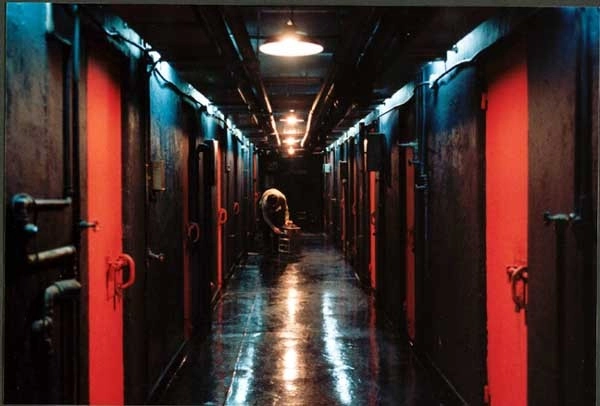
Films & Architecture: "Old Boy"
https://www.archdaily.com/358958/films-and-architecture-old-boyDaniel Portilla