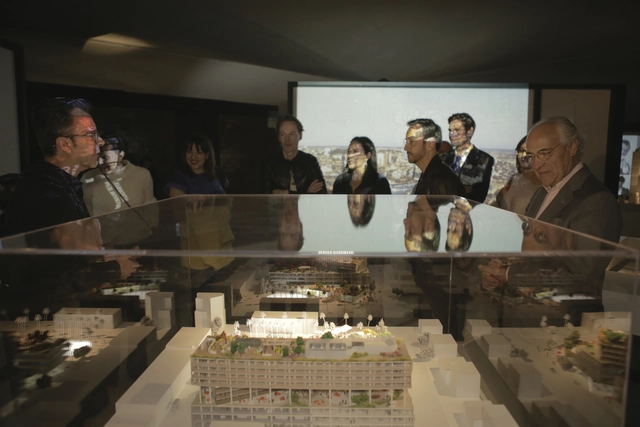
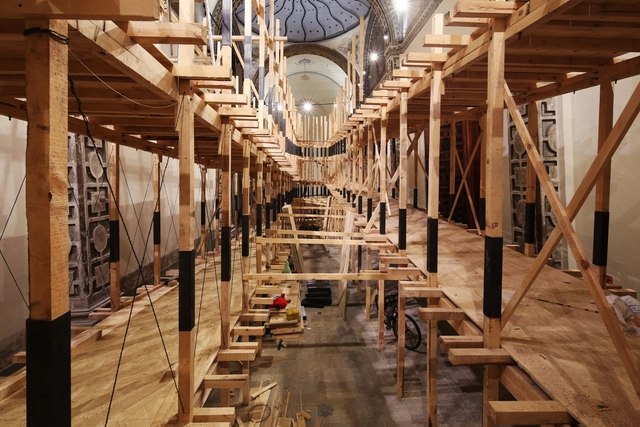
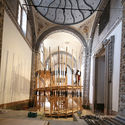
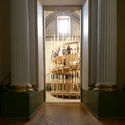
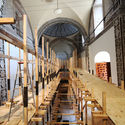
As part of the acoustic exhibition "Modos de Oír," Mexican architect Mauricio Rocha built an architectural and sculptural structure designed to unfold the space of the central nave, creating an ascending path that evokes the cochlear shape of the ear.
The exhibition is spread across the various spaces of the Convento de San José and the Templo de Santa Teresa la Antigua, currently Ex Teresa Arte Actual. Built in the early 17th century, this venue is renowned for hosting numerous events, exhibitions, and sound showcases due to its unique acoustics. Sound art has experienced a significant boom in Mexico in recent decades, with specific links to other historical periods where sonic thinking was also present. Driven by the unique character of this venue and its rich history, Laboratorio Arte Alameda and Ex Teresa Arte Actual sought to create a comprehensive exhibition featuring works that spark a collective reflection echoing the richness, complexity, and significance of the sound art scene.
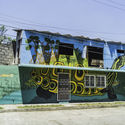
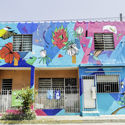
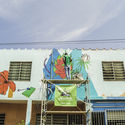
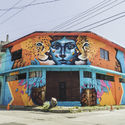
Colectivo Tomate is a Puebla-based civil organization made up of 20 artists, lawyers, architects, designers, nutritionists, and administrators who have intervened in around eight cities across Mexico, inviting people to take action in the streets to drive transformation, demonstrate the power of citizens in communities, and strengthen community ties.
On September 30, 2013, at the Palacio de Bellas Artes in Mexico City, the collective was recognized with the Quórum award for their Ciudad Mural project. This award recognizes, among other categories, the strategic use of design to impact quality of life as an agent of change, as well as its role as a key ingredient for innovation, productivity, and economic development in the country.
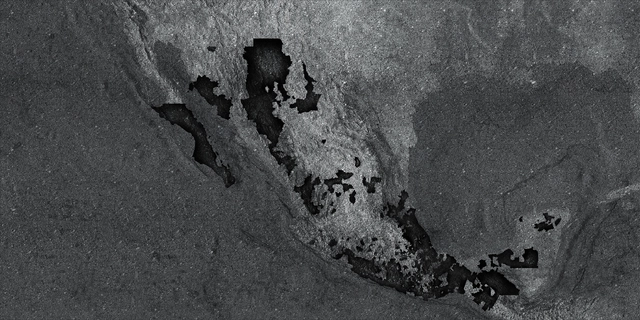
The Mexican Pavilion presents a creative process in which architecture embraces geographic sensitivity and diversity. The exhibition visualizes the territory, its layers, and cultural expressions through sixteen murals that showcase architectural abstractions, intentions, and contextual appropriations for each work.
Curated and designed by Gabriela Etchegaray and Jorge Ambrosi, the exhibition establishes sequences that reveal a dialogue between natural phenomena, geographic formations, and design solutions. Each stone panel shapes the space, highlighting cross-cutting readings: a country vulnerable to natural disasters due to its geological conditions; a highly diverse architecture in terms of scale, site, and integration; and a critical reflection on architecture's role in relation to the Freespace theme of the 16th International Architecture Exhibition at the Venice Biennale.
https://www.archdaily.com/1114006/echoes-and-territory-mexico-at-the-venice-biennalePabellón de México
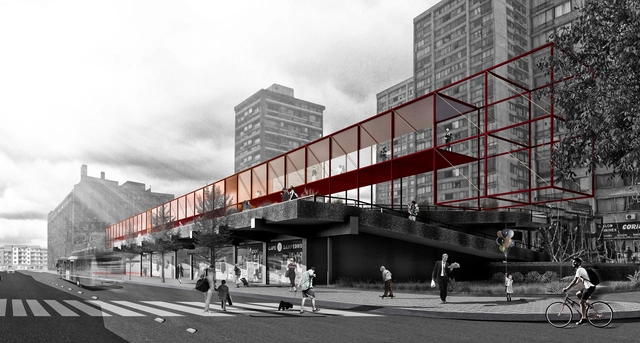
The Architecture and Landscape Ideas Competition for the Pasarelas San Borja and Surroundings announced its winning proposals during an event held on Thursday, September 6, at the National Headquarters of the Chilean Association of Architects (Colegio de Arquitectos de Chile). The main objective of the competition was to recognize, through a qualified and representative jury accredited by the sponsors, the best urban design ideas that help define intervention criteria and generate proposals for the San Borja neighborhood.
A total of 86 interdisciplinary teams registered for the competition, with 34 proposals successfully submitted and evaluated. The jury awarded first, second, and third place, along with three honorable mentions. Additionally, a Neighborhood Mention was awarded to two projects highlighted by the Neighborhood Advisory Commission during the evaluation process.
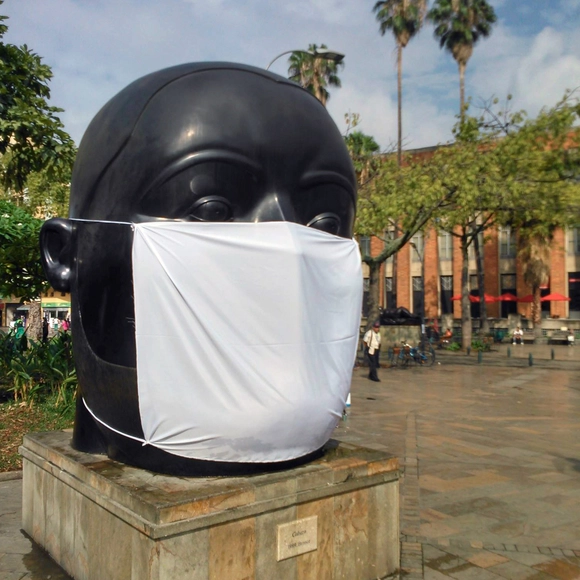
An initiative by Low Carbon City involved placing face masks on Botero's statues in Medellín, due to the current state of pollution. Image via La Ciudad Verde [Facebook]
On March 6, environmental pollution in Medellín, Colombia, triggered the highest alert levels. For three days, industrial production and driving restrictions (locally known as pico y placa) have been tightened. According to specialists consulted by the local newspaper El Tiempo, meteorological conditions are expected to make the situation “most critical” in two weeks.
In light of situations like this, air quality monitoring and control have taken on greater importance in Colombia. This is especially critical given that one in eight deaths worldwide is caused by air pollution, according to figures from the World Health Organization (WHO). In Colombia, 10,527 deaths and 67.8 million cases of related symptoms and illnesses occurred in 2015, as reported in 2017 by the National Planning Department following a study on the health costs of environmental degradation.
The measure is based on the principle that it makes no sense to continue applying the same rules to two such different types of vehicles.
Mayor Valérie Plante has promised improvements to the city's cycling infrastructure. Her ideas align closely with those of Councilor Marianne Giguère, who is responsible for sustainable development and transportation. Giguère believes that, under current laws, the message to cyclists is that they must be just as cautious as drivers, “even though you [the cyclist] pose much less of a danger.”
Artista: AkaCorleone. Ano: 2014. Foto de Target . Image Cortesia de Undergdogs
Over the past five years, Lisbon has attracted significant international attention, driving major changes in the Portuguese capital's urban life. From foreign technology investment to the promotion of cultural initiatives, these transformations are both positive and negative—a complex issue currently debated through the lens of gentrification, echoing developments in other global cities such as Berlin, Portland, and San Francisco.
On the cultural front, the city boasts an impressive diversity of initiatives, ranging from the opening of major, world-class museums—such as MAAT and Coches—to a rich culture of urban graffiti murals. This scene is supported by initiatives like the Underdogs cultural platform, which has worked with artists from around the world since 2013 to bring these paintings to the city's walls.
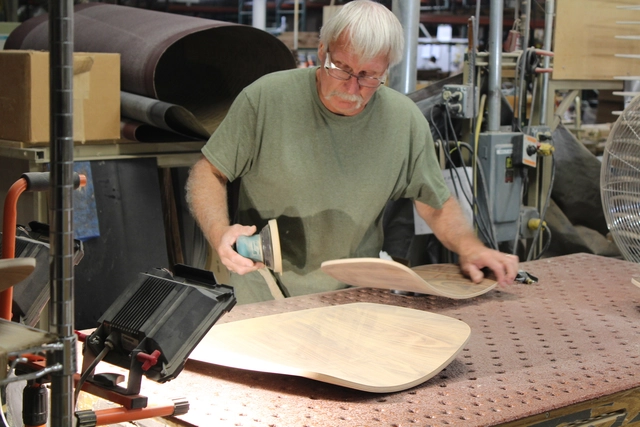
What is the manufacturing process of a chair like?
Our partners at Herman Miller opened the doors of their factories and offices in Michigan, United States, to show us the complex yet efficient design and manufacturing process of their various furniture pieces and products. During a three-day tour, we saw that their production involves a high level of detail and craftsmanship, where the experience and skill of their workers are essential.
Google has launched the Environmental Insights Explorer tool to provide users with access to data and technology that can contribute to the transition toward a lower-carbon world. The information is primarily based on data already available on Google Maps.
The goal is to enable cities worldwide to calculate their greenhouse gas (GHG) inventories to facilitate climate action planning. “The inventory can help prioritize investments in the areas of greatest impact, as it highlights key emission sources or hotspots and can be used as a baseline to measure progress,” the company states on the tool's website.
Yesterday, July 12, a partial collapse occurred at Plaza Artz Pedregal, a high-end shopping mall in southern Mexico City. Designed by the prominent Mexican architecture firm Sordo Madaleno Arquitectos, the collapsed section appears to be an overlapping cantilevered volume, as seen in social media videos of the incident and renderings released in 2016. The cause of the collapse remains under investigation.
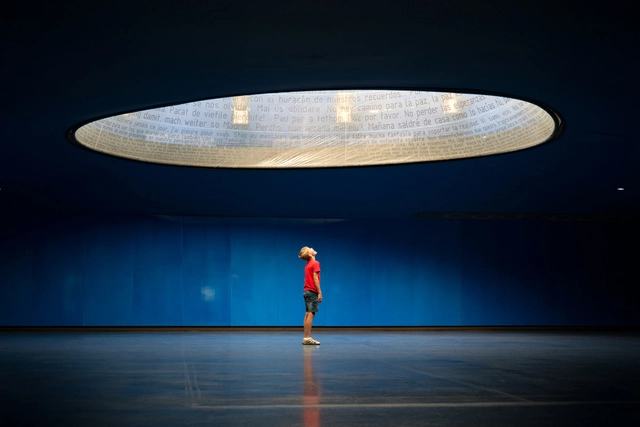
Eleven years after its inauguration, the Madrid City Council has announced a renovation and upgrade plan for the monument to the victims of the March 11 (11-M) terrorist attacks at Atocha Station in Madrid, Spain, as reported by the Spanish newspaper El País.
Designed by Estudio SIC, the monument to the victims of 11-M was inaugurated in 2007, three years after the attacks perpetrated by a terrorist cell on March 11, 2004. The attack consisted of the simultaneous explosion of 10 bombs on four commuter trains, claiming the lives of 193 people and leaving more than 2,000 injured, making it the worst terrorist attack in Spain's history.
https://www.archdaily.com/1114016/madrid-to-renovate-the-atocha-11-m-memorial-in-2019Javier García Librero
With the votes counted, the first round of the presidential election was not enough to determine the country's next political leader; candidates Fernando Haddad, of the Workers' Party, and Jair Bolsonaro, of the Social Liberal Party, will face off once again in the runoff vote on October 28.
Political differences and ideological discrepancies aside, the next president will have, among many other tasks, the responsibility of providing federal support for the development of Brazilian cities—home to about 87% of the country's population. To contribute to the debate and—if it is ArchDaily's place to do so—help undecided voters make up their minds, we have compiled below the proposals of both presidential candidates for the future of cities, based on their respective government platforms, covering topics such as housing, urban development, infrastructure, sustainability, mobility, and the right to the city.
Last Thursday, during the opening of the exhibition featuring the 13 finalist projects – selected from 244 submissions representing 17 Brazilian states and the Federal District – the winners of the 5th Instituto Tomie Ohtake AkzoNobel Architecture Prize were announced.
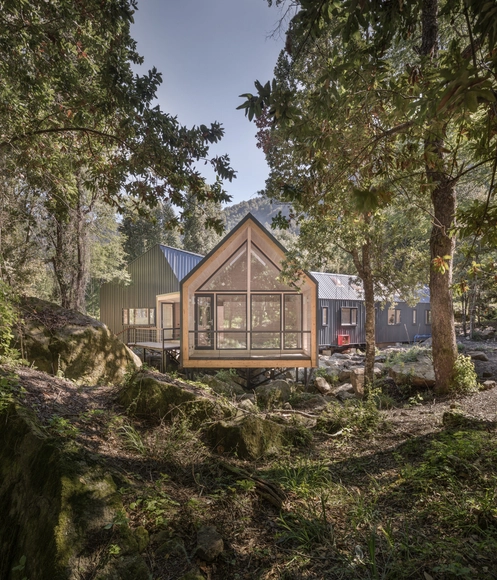
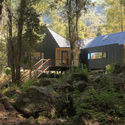
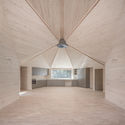
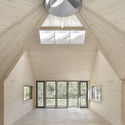
The project Casa sobre las rocas by the Chilean firm Schwember García-Huidobro Arquitectos has been recognized at the German Design Award 2019. The accolade, awarded in Germany by the Ministry of Technology, "identifies and presents unique design trends," according to the organization.
Built in a forest in the town of Cunco, Chile, Casa sobre las rocas received a Special Mention in the Architectural Design Communication category of the competition. The project is a second home that prioritizes communal areas, featuring a Y-shaped floor plan designed to optimize views and natural light.
The restoration of a disused heritage asset, its repurposing, and sensitivity to the surroundings were the key concepts valued by the jury in selecting this winner of the 18th edition of the Clarin-SCA National Award for Architecture Students.
Agustín Ichuribehere, a student at the Faculty of Architecture and Urbanism of the Universidad Nacional de La Plata, guided by professor Martín Villanueva, designed the winning project. The proposal features a building for the Department of Music and Lutherie of the Universidad Nacional del Comahue, integrating an intervention on a heritage site: the former warehouses of "La Reginense" cider factory in Villa Regina, Rio Negro, Argentina.
Learn more about the proposal in the author's own words below.
The California Assembly voted in favor of SB 100, a Senate bill that sets the state on a path toward 100% renewable energy generation. The legislation establishes a new target of obtaining 60% of the state's electricity from renewable sources by 2030 and reaching 100% clean and renewable energy by 2045. Governor Jerry Brown has thirty days to sign the bill.
A project by the Federal University of Technology - Paraná (UTFPR) is cataloging the historical heritage of Curitiba and making all the information available on the website Arquivo Arquitetura. The portal is being gradually updated with all the research conducted since 2011 by more than 560 students, led by architects Giceli Portela and Iaskara Florenzano. In the near future, the goal is to install QR codes on tiles in front of all the buildings, allowing people to access the complete history of each building in real time.
Heritage-listed at both the state and federal levels, Teatro Oficina, designed by Lina Bo Bardi and Edson Elito, is at risk of having its surroundings profoundly altered by the construction of two 100-meter-tall residential towers. The project, led by the Silvio Santos Group, was approved by the National Historical and Artistic Heritage Institute (Iphan) during a meeting on May 29.
The exhibition “10 Exponents of the 21st Century: City, Architecture, and Design” launches the cultural activities at Espacio CDMX, a public space dedicated to promoting architecture, urban planning, and socially responsible design in the city, while also serving as a temporary creative venue and Information Center for World Design Capital CDMX 2018.
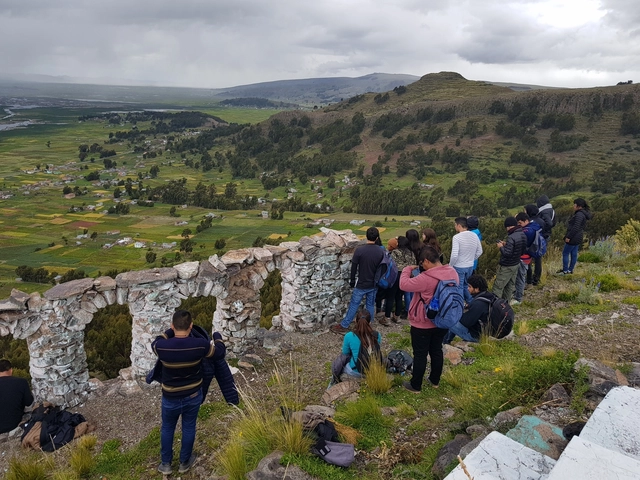
On the shores of Lake Titicaca, nearly 250 students from 15 countries kicked off TSL Puno 2018 in Peru, marking the 15th edition of the Latin American Social Workshop, led by the Latin American Coordinator of Architecture Students (CLEA) and the Peruvian Organization of Architecture Students (OPEA).
Continuing a tradition that began in 2002, architecture students from across Latin America are joining forces with public and private entities, architecture collectives, workshop leaders, faculty, and members of civil society to conceptualize, design, and build public amenities across the Spanish-speaking world.
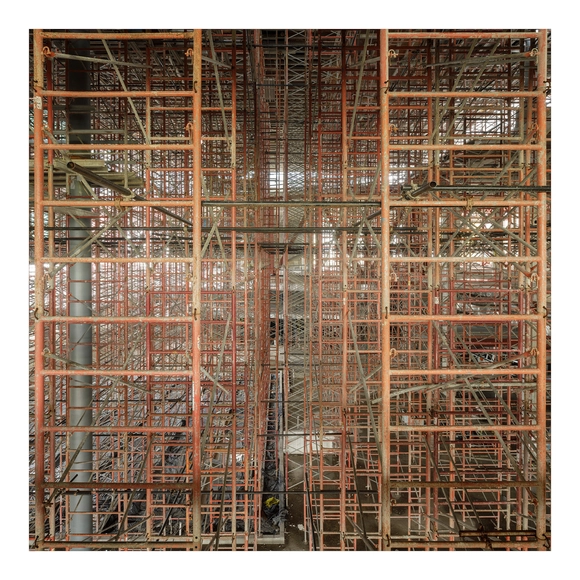
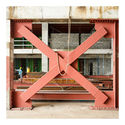
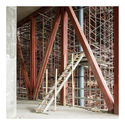
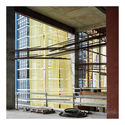
Spanish photographer Fernando Alda explores the construction of the Pacific Center building in Panama, designed by local firm Ventura Arquitectos, in his most recent photo essay. Titled "An Aesthetics of Disappearance," Alda's work was exhibited in the Panamanian firm's pavilion during the inaugural Expo Modii 2018 in Panama City.
Scaffolding, energy dissipators, shoring, electrical installations, and safety netting define the temporary spaces that make up this photo essay. These compositions center on spaces rendered invisible while awaiting the real spaces. "In Pacific Center," writes architect Silvia Escamilla, "he freezes this temporal lapse and the ephemeral elements that inhabit it, those that go unnoticed by us, granting them a new aesthetic value."
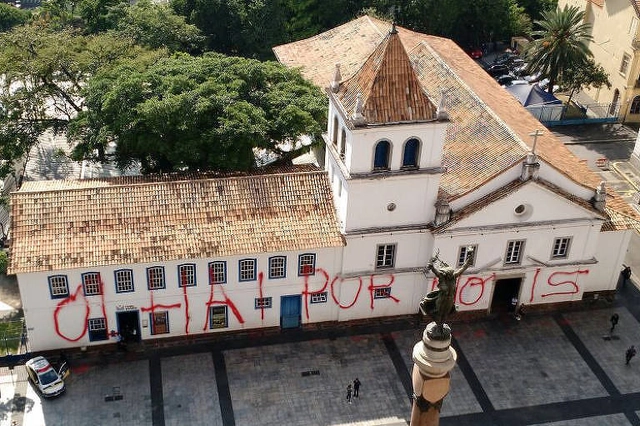
One of São Paulo's primary historical and tourist landmarks, the Pateo do Collegio—the founding site of the state capital—awoke with its facade covered in graffiti. "Olhai por nois" [Look out for us] is the phrase that, in red letters, covers the facade of the Museum of Sacred Art and the chapel of the complex, which belongs to the Society of Jesus.
Under Brazil's environmental crimes law, defacing monuments is a crime, and perpetrators can face up to one year in prison. At the time of publication, those responsible for the act had not been identified by the Metropolitan Civil Guard.
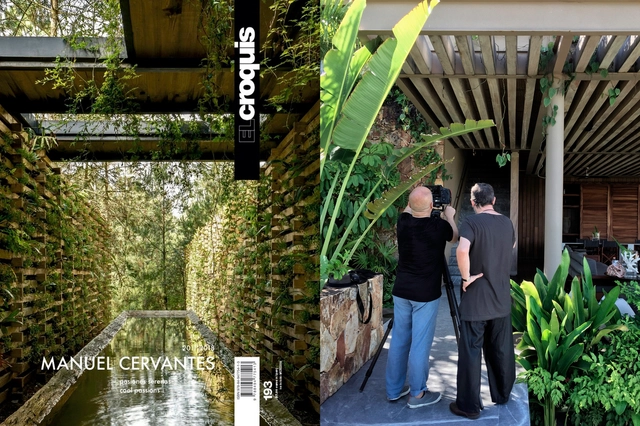
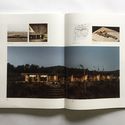
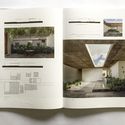
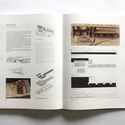
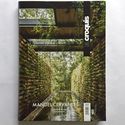
'El Croquis' is one of the most prestigious international architecture magazines, edited by architects Fernando Márquez Cecilia and Richard Levene. Published as carefully curated monographs, the magazine analyzes the work of architects whose careers feature some of the most influential and prestigious projects globally, such as OMARem Koolhaas, Kazuyo Sejima, Herzog & de Meuron, Álvaro Siza or Rafael Moneo. Every two months, a new issue is published with a print run of 35,000 copies, distributed to specialized bookstores in Europe, the Americas, and Asia.
The magazine is published in English and Spanish from El Escorial in Madrid, Spain, and is currently a member of ARCE (Asociación de Revistas Culturales de España) and the Asociación de Editores de Madrid. To date, only 193 issues have been published, the latest of which is dedicated to the career of architect Manuel Cervantes—the first Mexican architect to be featured in 'El Croquis' and the second from Latin America, following Smiljan Radic.
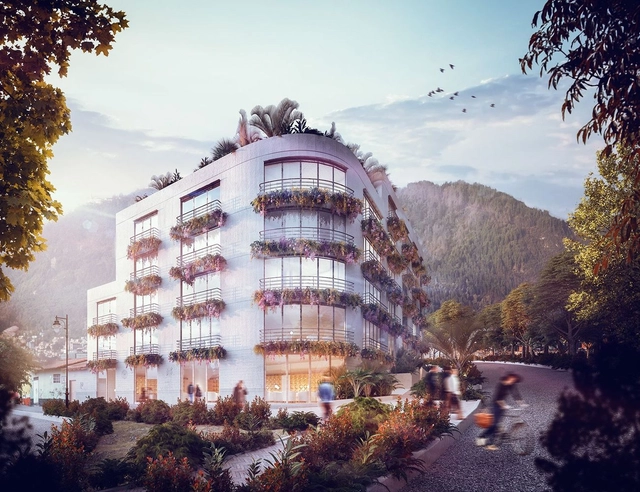
Renowned for his work with guadua bamboo, Colombian architect Simón Vélez will build his first steel project in Bogotá, according to the local newspaper La República.
The project, named La Primera, is a residential building in the La Candelaria neighborhood of the Colombian capital, and will feature 60 one- and two-bedroom apartments. Joining Vélez on the project are the firm A Korn Arquitectos, the construction company Kandelaria, and Geografía Urbana as urban planning consultant.






.jpg?1521471569&format=webp&width=640&height=580)
.jpg?1521471591 "Artista: AkaCorleone. Ano: 2015. Foto de André Santos. Image Cortesia de Undergdogs")
.jpg?1521471603 "Artista: AkaCorleone. Ano: 2016. Foto de José Pando Lucas. Image Cortesia de Undergdogs")
.jpg?1521472289 "Artista: Shepard Fairey. Ano: 2017. Foto de Jon Furlong. Image Cortesia de Undergdogs")
.jpg?1521472210 "Artista: Shepard Fairey. Ano: 2017. Foto de Jon Furlong. Image Cortesia de Undergdogs")
.jpg?1521471569)






.jpg?1536064648&format=webp&width=640&height=580)