
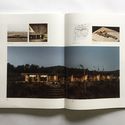
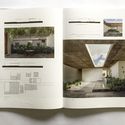
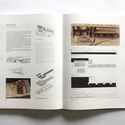
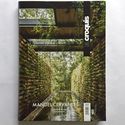

'El Croquis' is one of the most prestigious international architecture magazines, edited by architects Fernando Márquez Cecilia and Richard Levene. Published as carefully curated monographs, the magazine analyzes the work of architects whose careers feature some of the most influential and prestigious projects globally, such as OMA Rem Koolhaas, Kazuyo Sejima, Herzog & de Meuron, Álvaro Siza or Rafael Moneo. Every two months, a new issue is published with a print run of 35,000 copies, distributed to specialized bookstores in Europe, the Americas, and Asia.
The magazine is published in English and Spanish from El Escorial in Madrid, Spain, and is currently a member of ARCE (Asociación de Revistas Culturales de España) and the Asociación de Editores de Madrid. To date, only 193 issues have been published, the latest of which is dedicated to the career of architect Manuel Cervantes—the first Mexican architect to be featured in 'El Croquis' and the second from Latin America, following Smiljan Radic.
Directors Fernando Márquez and Richard Levene, alongside photographer Hisao Suzuki and the entire team involved in this issue, worked tirelessly for over two years to compile the Mexican architect's career into a single volume. The issue features 20 projects arranged chronologically, including Three Climates, Three Projects: Assisted Self-Production Housing in Mexico, Avándaro House, Next Hydroponic Plant, Cuatro Caminos Multimodal Transfer Center (CETRAM), El Mirador House, Donceles 54, El Rosario Multimodal Transfer Center, Villas Finestre.
Below is an interview with Manuel Cervantes exploring the process behind the 'El Croquis' issue, titled: Serene Passions.

AD: How did this project begin?
MC: They wrote to me two and a half years ago. Personally and professionally, I felt the firm was at a point where, after 20 years, we could begin to do interesting work. I received an email from 'El Croquis' proposing a review of our work for a potential publication. I couldn't believe it.
I was very surprised, but we took it seriously. Our first step was to speak with people who had already been featured in 'El Croquis.' Eduardo Souto de Moura shared his experience and some tips with us, so my response to their email expressed my interest in learning all the details—whether there was a contract, if we had to pay for anything, etc. They might have sounded like very naive questions, but for us at the studio, they are fundamental when starting any project.
Fernando replied very concisely, expressing his interest in meeting us to build a more personal connection beyond online communication. By chance, I had a trip to Europe planned, so we met at Café de la Ópera in Madrid. When Sofía and I arrived, they were very surprised—I think they expected to see a 60-year-old couple. It's interesting because they didn't seek me out for who I was, but for my work; they didn't care about my appearance or my age.

AD: What was the publication process like?
MC: From that point on, the entire process was built on a deeply human relationship. They invited Sofía and me to stay at their home—it was a very intimate experience. Toward the end of that trip, I asked them why, with so many incredibly talented Mexican architects, they had chosen me. Fernando replied that they don't have a checklist of architects they feel obliged to publish; instead, they look for those who have created their own world. "Those architects are different from everyone else," he said.
With that, we began a process that would last two years. We started by reviewing the technical work. They ask you to send whatever material you feel best represents your work. Some architects send models, sketches, renderings, floor plans, axonometrics, etc. They aren't very strict about it; they just ask you to express your architecture graphically, and every architect has different formats they identify with.
It is also worth noting that they don't commission specific materials; there was never a checklist. Instead, we deconstructed each project to achieve the magazine's objective, which was not to showcase the architectural object but to create a visual journey that allows you to experience the space. A great example of this is the Studio Mumbai issue of 'El Croquis,' where Bijoy Jain showcases a series of red ink sketches on paper. This says a lot about Fernando and Richard's eye for revealing the architect's world and everything behind it.
Once, during a visit to the Museum of Anthropology, Fernando mentioned he was interested in seeing the codices. We asked about them, and he told me that he believed he had been a chronicler in a past life: "I studied architecture, but I love chronicles; I am fascinated by reading the daily chronicle of civilization." This made me realize that 'El Croquis' is indeed a chronicle. It is not a report or an infographic; it is the chronicle of a studio that observes the world in a certain way, and this 2D perspective they present is the closest thing to actually walking through an architectural work.
Fernando is almost like a film director; he designs a specific walkthrough of the buildings, and every photo and plan relates to how he guides you along this path. When he arrived in Mexico, the first thing he did was pull the plans from his suitcase—he had a route pre-mapped. We traveled by plane, car, and other means; they spent 20 days here. At every project we visited, he would review the plans and ask me to take him to specific spots. He knew exactly where he needed to stand to take each photo because, to him, these are not objects to be photographed—they are spaces. It is a journey that is narrated, lived, and coexists with its context, the landscape, and the economic and social situation.

AD: What did 'El Croquis' bring to your practice?
MC: 'El Croquis' means a lot to me because all those trips took us from subway stations and Infonavit social housing to beach and country homes. There was a deep understanding of our practice, focusing on context, climate, geography, and economics—regardless of how the space would eventually materialize. While the end result is important, what lies behind it is what truly matters.
For me, construction photos are extremely important in the process because of the understanding and opportunities they generate. There are moments during construction that are much more powerful than the final outcome, and that drives you to imagine future projects. That is why we use this resource to express our intentions.
Another important aspect was that I wanted to show them where I came from. When they visited, we went to the Anahuacalli Museum, the Barragán House, the Ortega Gardens, and the UNAM campus. Architecture is not a random whim or a fleeting inspiration; it comes from contemplating all of those references, all of which are reflected in this issue.
We had to redraw the graphic representation of many things to suit the scale of the publication. The technical aspect was highly enriching; we learned and reflected deeply while preparing the documentation. It prompted us to question how we represent and communicate our work, which translated into new ways of presenting projects to new clients. It was a massive learning curve, but the most important growth for me was personal.
Working with such a large and prestigious publisher made me expect a somewhat cold and impersonal relationship, but to my surprise, it was the exact opposite. We shared meals, and our conversations were about connections, not objects. We talked about the people at the office and my experiences with clients. Architecture was taken as a given, and we focused instead on human relationships.
AD: "Life is what happens when you are making other plans."
MC: This is a John Lennon quote, and for me, those trips with Fernando were exactly that. We didn't talk about 'El Croquis' or architecture. We talked about family, food, the city, cinema—the things architects actually should talk about. Rafael Aranda said that if you are able to understand the soul of a place and the soul of your clients, you can produce a work with soul. This process was exactly that: connecting on other levels. Engaging with these levels resulted in something very interesting, and that was the most incredible part of the journey.
We visited Valle, Ixtapa, León, Puebla, Cuatro Caminos, and other places. I was very nervous about showing Fernando the public projects because of the fear we architects have of showing things outside our control—billboards, visual noise, and so on. We have this misconception that projects get 'cluttered,' but Fernando was fascinated. He said these projects had life. It was then that I realized and remembered that architecture is a combination of fundamental things, not just the details we as architects are always obsessing over. Good architecture with a strong, clear line is much more powerful than a project filled with controlled details. The CETRAMs are exactly that: very simple, efficient, and practical works whose essence remains unchanged.
I was so pleased to see projects whose essence remains intact; the gestures and the architecture are still there. In many cases, the clients were present, and once again, the visit was about experiencing the architecture. At the CETRAM transit hubs, we had to hop onto minibuses, listen to the transit barkers, and eat street food. It was fascinating to witness the passage of time and the human presence in the projects. Reading what they saw in our work in this edition is deeply rewarding.

The included essays by Juhani Pallasmaa and Fernanda Canales are important because they barely discuss my work directly; instead, they talk about the background and what shapes what we are doing as architects of this generation. They contextualize our work rather than analyzing it literally.
As architects, we start our careers by taking on whatever commissions come our way, but over time, you become more selective about how you direct your practice. Today, the projects I take on are not about scale, but about what they can teach me. The real luxury is being able to choose what leaves a mark on you, not necessarily what is profitable. Therefore, we try to curate the incoming work to prompt questions with new challenges, themes, and budgets. Every project leaves you with something. For me, that "world" Fernando talks about is a cloud of things that evaporate, come together, and condense into the materialization of something saturated with all of it.
With a publication of this scale, there are always all kinds of opinions. Fortunately, I received support from people I know and from strangers—words of happiness and excitement. I received both positive and negative comments, but in the end, the world is full of opinions, and they are all valid.
I believe this issue comes at a time when the architecture we are producing is generating an impact; the evolution and maturation of our work is what brought 'El Croquis' about. However, the world of architecture is so small that if we were to analyze what is truly needed to improve our living conditions, architecture wouldn't top the list. There are much more critical issues to address, which we could also draw influence from. I do not see this as an award; rather than a source of pride, 'El Croquis' is a commitment to keep producing quality architecture, to not falter.

Of course, it is exciting, but it serves as a push to keep doing impactful work that deserves this kind of documentation. The real recognition comes from the client. Having a client welcome us, invite us to lunch at their home, and tell us how they live in the spaces is the most important thing in our practice.
Interview conducted by Vanessa Vielma, Director of ArchDaily Mexico.
Manuel Cervantes was born in Mexico City in 1977. He earned his degree in architecture from Universidad Anáhuac and is a member of the National System of Art Creators (Sistema Nacional de Creadores de Arte). He founded MANUEL CERVANTES CÉSPEDES / CC ARQUITECTOS in 2004. In 2006, he established a department within the firm dedicated to urban and mass transit projects, initiating research on Multimodal Transfer Centers (CETRAM) and Transit-Oriented Development (TOD). He has worked for Mexican public institutions such as INFONAVIT, as well as urban and architectural projects across the Americas. As an educator, he has taught workshops and lectured at various universities in Mexico, the United States, Brazil, Spain, and Portugal.
This article was written by Mónica Arellano. The translation is powered by AI.


