The VAAD HAJINUJ Educational Corporation, the central body for Jewish education in Chile, invites Chilean and foreign architects (based in Chile) to submit architectural proposals for the new Instituto Hebreo building. The site is located at Chesterton No. 8630 in the Las Condes district, which is part of the current grounds of the Estadio Israelita Maccabi (EIM).
The objective of this competition, sponsored by the Colegio de Arquitectos and the Association of Architectural Offices (AOA), is to obtain an architectural response that is well-suited to the functional and spatial needs of the Instituto Hebreo’s program, as well as the urban and environmental requirements inherent to its site and the building's institutional character.
Now in its third edition, the Mi Parque Foundation and Fahneu Design and Innovation Competition invites students and professionals in design and architecture under the age of 30 to submit proposals aimed at improving the experience of young people in public spaces.
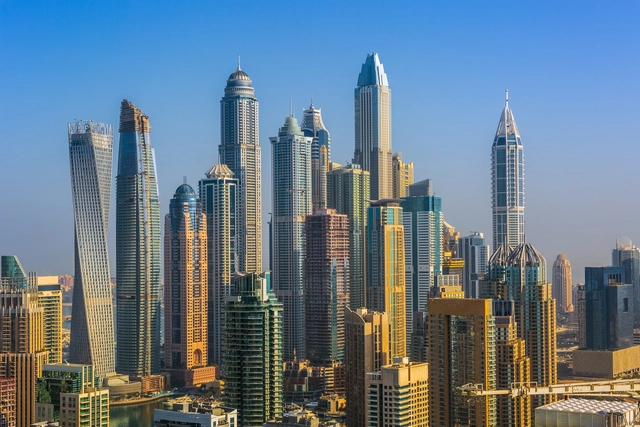
At the request of the Commissioner General, interdisciplinary teams are invited to participate in the competition for the Chile Pavilion at Expo Dubai 2020.
The development and preparation of all architectural, structural, and necessary building systems designs and details, along with the corresponding technical specifications and calculation reports, are requested, as well as the detailed official budget for the design project of the MINVU-SERVIU Institutional Building in the Araucanía Region.
The Chilean Chamber of Construction invites architecture students from universities across the country to envision future Metro stations for the Greater Concepción area and to design an urban-architectural intervention proposal that enhances the urban environment and contributes to public space as a city landmark.
Image: Launch of the Institute for the Promotion of Afro-Brazilian Architecture at the FestA! Festival at Sesc Pompéia in July 2023. Photo: Ana Kan.
Oco is the name chosen for this residency—a name that carries the symbolism of bamboo, a central material in the experience, whose strength and lightness lie precisely in the void that constitutes it. It is from this hollow that sounds reverberate, flows pass through, and possibilities are born.
- The initiative is part of axis 2 of the RS Seguro program, known as RS Seguro COMunidade, launched in December 2023, which provides for the qualification of public community spaces and facilities in five areas.
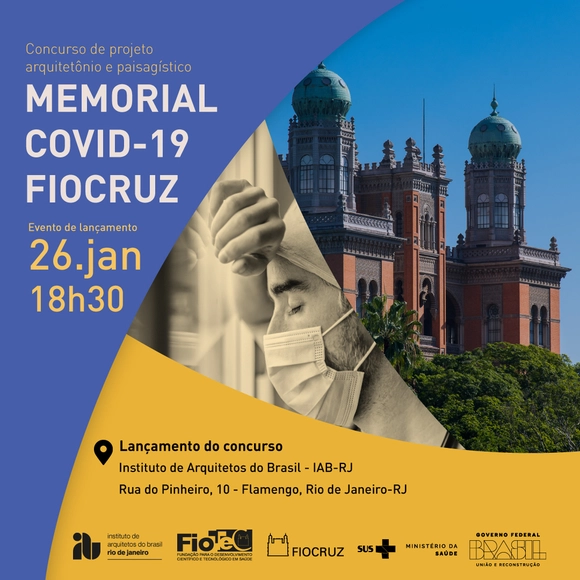
The competition brief for the future COVID-19 memorial will be available starting February 19th
The Oswaldo Cruz Foundation (Fiocruz) announced a national competition on Friday, January 26, for the architectural and landscape design of the future Covid-19 memorial. The competition is organized by the Rio de Janeiro Department of the Institute of Architects of Brazil (IAB-RJ).
The Ministry of Cities, through the National Secretariat for Peripheries, announces the second edition of the Periferia Viva Award. In 2024, the award aims to recognize, value, empower, and reward projects and actions that contribute to addressing socio-spatial inequalities and promoting the sustainable development of Brazilian peripheries.
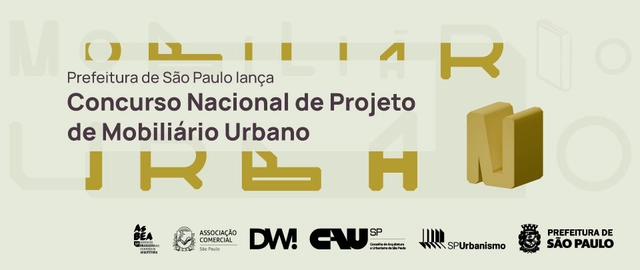
In August, the City of São Paulo, through SP Urbanismo and the Municipal Secretariat of Urbanism and Licensing (SMUL), launched the National Competition for Urban Furniture Design for the City of São Paulo. Open to architecture, engineering, and design professionals nationwide—who may form teams with other specialists—the competition seeks innovative, sustainable, and inclusive proposals to enhance the city's public spaces. The three best projects will be awarded a total of R$ 500,000. Registration opens on September 8 and closes on September 15, and must be completed via the official platform.
Competition to select design for new leisure area at the Clube Central headquarters
The IAB RJ, through its Leste Metropolitano chapter, is organizing a national public competition to select a design for a new leisure space on the terrace of the Clube Central headquarters in Niterói. Registration is now open, with a deadline of September 19.
Registration for the 63rd IAB RJ Awards closes on November 2nd
Registration for the 63rd IAB RJ Awards 2025 is now open, with a deadline of November 2. IAB members in good standing are entitled to one free entry. Additional entries are subject to a fee of R$ 105. Registration must be completed via the online form available on the Department’s website.
The five best proposals will be awarded a total of R$ 130,000 in prizes, in addition to the hiring of the winning project for the full development of the executive designs.
On October 23, Sebrae Rondônia and the Institute of Architects of Brazil (IAB) officially launched a national public architecture and urbanism competition to select the design for the new Sebrae headquarters in Porto Velho.
The Institute of Architects of Brazil (IAB), in partnership with the Urban95 initiative, announces the opening of registration and proposal submissions for the National Public Ideas Competition for Urban Furniture focused on Early Childhood in the City of Salvador. The competition will gather ideas from architecture and urban planning professionals from across Brazil.
- Selected projects will be featured on the Arbo Platform, where public and private sector managers can discover best practices and urban transformations related to early childhood.
The goal of this competition is to generate a conceptual proposal for the construction of a coastal observatory located in the Parque de los Niños in the Autonomous City of Buenos Aires. The coastal observatory will serve as a permanent public intervention dedicated to observing the sky and the river along the Buenos Aires coastline. It is intended to be a space for civic engagement, welcoming people of all ages interested in coastal observation and providing a place to enjoy the Río de la Plata in all its splendor.
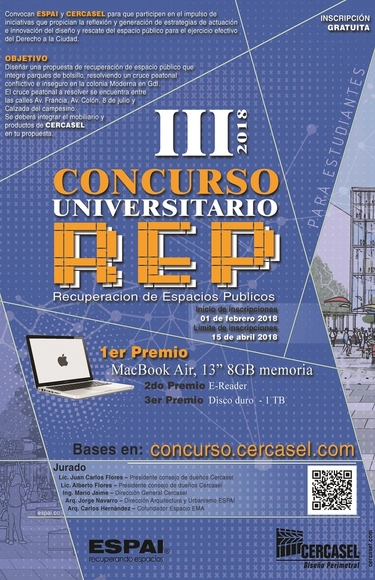
PROMOTIONAL POSTER FOR THE PUBLIC SPACE RECOVERY COMPETITION
ESPAI and CERCASEL invite participants to help drive initiatives that foster reflection and generate strategies for action and innovation in the design and recovery of public space, ensuring the effective exercise of the Right to the City. This initiative seeks to advance the objectives of the 2013-2018 National Urban Development and Housing Policy. Furthermore, through new strategies and initiatives, it aims to contribute to the 2030 Agenda for Sustainable Development adopted by the United Nations—specifically Goal 11, which focuses on "making cities and human settlements inclusive, safe, resilient, and sustainable."
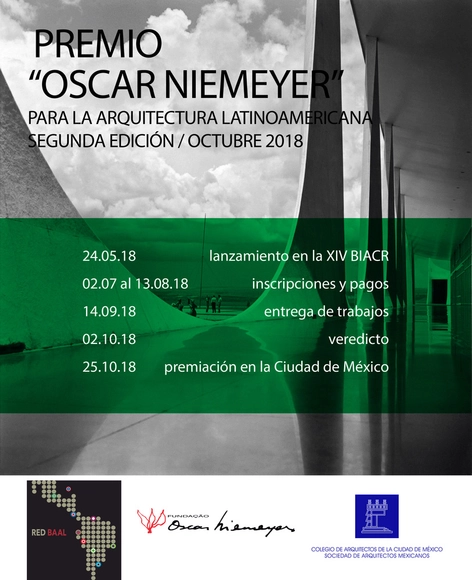
Eligible works for the second edition of the Oscar Niemeyer Award for Latin American Architecture include those recognized by a REDBAAL-member biennial or selected by a national association or college of architects in the aforementioned Latin American countries where no REDBAAL-affiliated biennial exists.
The Association for Strategic Reflection on Architecture (AREA) announces the eighth Latin American Architecture Biennial (BAL), 2023 edition, to highlight the work of young Latin American architects. As in previous editions, BAL aims to showcase the work of emerging professionals in Spain, thereby helping to promote their careers both in our country and their own.
Until March 19, architecture firms from across the country can submit proposals for the Indigenous Women's House (CAMI). This public competition, commissioned by the Ministry of Women (MMulheres), aims to create appropriate, humanized spaces to support Indigenous women who are victims of gender-based violence. The initiative is the result of an agreement between the Ministry and the Women, Architecture, and Territory Laboratory (LAB Mulheres) at the University of Brasília's Faculty of Architecture and Urbanism (FAU-UnB), and is being organized by the Institute of Architects of Brazil – Federal District Department (IAB-DF). The official call for entries was launched on January 26 during a ceremony at the University of Brasília's Multicultural Center for Indigenous Peoples (MALOCA/UnB) in Brasília.
Professional training, along with legal instruments, economic incentives, technological advancements, and public awareness of the value of heritage assets, is a cornerstone in protecting a country's cultural heritage. Indeed, training architecture professionals to act with sensitivity and technical expertise regarding built heritage helps consolidate efforts toward the conservation of these assets and reinforces the contribution that the professional field can make to passing on heritage values to future generations.