With this stifling heat wave New Yorkers are trying to brave, it is hard to take refuge in the city filled with skyscrapers and traffic. This summer, we are flocking to parks along the edge of the Island to relax amidst a sea of greenery, catching some breezes off the water while enjoying the amazing views of the skyline and different bridges. This step marks an important part in our history, as prior to this, as Nathan Ward in an Op-Ed for the New York Times put it, we have shied away from “claiming our waterfront.” In Ward’s article, he outlines the history of the waterfront, explaining that as the ports’ economy slowed down toward the end of the 1900s, the abandoned piers became “a ghost town between landlubbers and the water” where no one wanted to be, let alone live. Within the past few years, we are beginning to discover the potential the waterfront has to offer. And, areas that have been rundown and vacant for years are now getting green makeovers and contributing more and more feet of parkscape for New Yorkers to enjoy.
Whether you are closest to Governors Island, the West Side or perhaps Brooklyn, here’s the scoop on three fairly recent park developments we hope all can enjoy.
The winner will receive a $10,000 award to fund a professional development project in one of the cities of the UNESCO Creative Cities Network, of which Montréal is a member. A promotional campaign will also be organized to raise awareness of the winner among his or her industry peers as well as the general public.
Offices from USA, England, Mexico, Norway and Italy. Out of all of these, in which one would you like to work? Check them all after the break.
Winters Studio / MOS Architects This project explores the idea of creating a space for both painting and drawing set against an intense landscape of shale cliffs, forest and ponds. Overlooking the hills of the Taconic State Park, this isolated site is one of several free standing structures making up a compound for an artist and a curator/writer (read more…)
The Building: Problem or Solution? is hosted by Faith in Place, with support from the Richard H. Driehaus Foundation. It is an architecture competition to inspire new ideas in the design of religious buildings, and greater creativity in the re-use and modification of existing structures. Winning solutions will generate ideas that a congregation will find aesthetically pleasing and inspiring, that preserve a sense of the sacred, and a space for contemplation and worship, but that integrate completely into their communities and that lend themselves to diverse and efficient use in ways that serve those communities. Submissions will be judged for excellence in design, sustainability and quality of presentation.
Nine students studying at the Aarhus School of Architecture, one of Denmark’s premiere architecture universities have transformed the typical college quad into an activated social hub with their temporary pavilion. In a quick ten-day workshop, the students designed and built the pavilion with 420 recycled euro-pallets. “By being built with nothing else but pallets, easily reachable on the site by the closeness of the harbor, the pavilion was basically a short-living vernacular architecture,” shared the students.
Special thanks to Thibault Marcilly, a French student who organized the initiative and shared the project with us. More about the pavilion, including images and a video, after the break.
This just in from the Serpentine Gallery – Jean Nouvel’s pavilion is complete! In honor of the Serpentine’s 40th Anniversary, Nouvel’s pavilion is a bold and strong expression comprised of lightweight materials with dramatic cantilevers. Designing the pavilion allows international architects to experiment with different architectural ideas, and over the years, the commissions’ varied aesthetics have added to the thrill of the exposition. Nouvel’s bright red pavilion is drastically different from SANAA’S subdued silvery curvillinear form of 2009, and its vivid color contrasts the park’s greenery, immediately drawing the eye.
More images and more about the new pavilion after the break.
FORMCities calls for design proposals to address the negative impacts of urban forms and transportation thoroughfares which have created visual, physical, and psychological, barriers that have sorted cities along the lines of race, income, and class.
Erick van Egeraat’s 330,000 m2 proposal for the Dynamo Stadium in Moscow recently placed ahead of four international competitors. Situated on a 116,000-m2 plot in Petrovsky Park, the competition site has been chosen by the Administration of the Stadium and VTB Bank to be developed in order to meet contemporary international requirements to support Russia’s bid to host the 2018 FIFA World Cup. Erick van Egeraat’s proposed “multifunctional urban regenerator” will feature a 45,000-seat Stadium Arena, a 10,000-seat Arena Hall, a Retail and Entertainment complex, restaurants, parking and other facilities. With these various programmatic activities, the proposed design aims to provide a self sustaining model that will be activated continually throughout the day.
More about the awarded project and more images after the break.
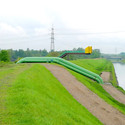
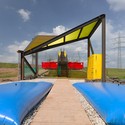
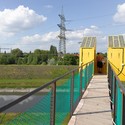
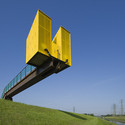
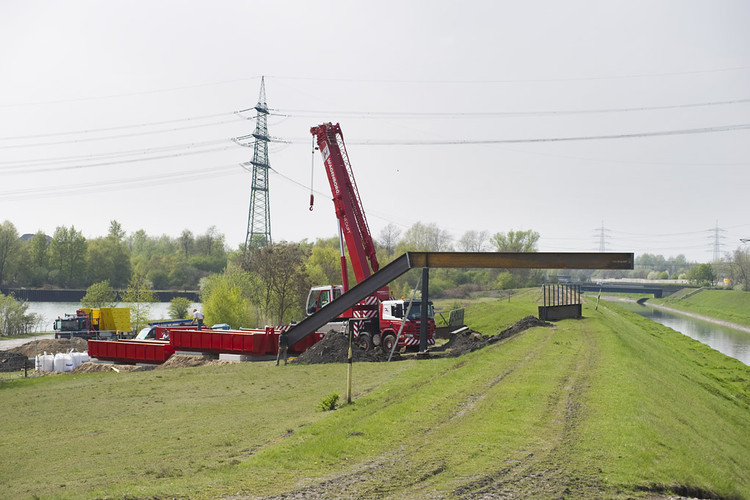
Architects: Marjetica Potrc and Eva Pfannes & Sylvain Hartenberg, Ooze (Paris & Rotterdam) Location: Sturmshfo, Essen-Altenessen, ‘Emscherinsel’ at the previous ‘Mathias Stinnes Hafen’, Germany Team: Florian de Visser, Shilesh Hariharan Areas: 1000 m2 Budget: 200,000 EUR For the event: Emscherkunst.2010 Use: Art installation: Autonomous water treatment Client: Emschergenossenschaft Design Period: 8 months system & community gardens Construction Period: 2 months Completion Construction: May 2010 Photos:Roman Mensing, Ooze, Florian de Visser
When you’re interested in the field of architecture, it basically consumes your entire life from how you look at things, to what you read to even what you watch. Over the years, different films have portrayed some of the inner reflections of architects – there’s a piece on Khan entitled My Architect, there’s Maya Lin: A Strong Clear Vision, and even Sketches of Frank Gehry, just to name a few. Now, as Architectural Record reported, there’s a new film to add to your collection. Filmed by Markus Heidingsfelder and Min Tesch, and produced by Arthouse Films, Rem Koolhaas: A Kind of Architect offers a “thought-provoking portrait of the architect.”
Carving out a gigantic void in the middle of Copenhagen’s City Hall Square, Larry Hill’s conceptual approach for a new metro station calls attention to the activity of passengers as well as the trains. “The project aims to put the public in the City Hall Square, as well as on it. The void and the metro machine is thus a seamless part of the city,” explained the architect.
More images and more about the project after the break.
Just as many other parts of Istanbul, Sishane-Galata needs to redefine itself in a context that keeps on expanding. Well known for its bazaar-like atmosphere and tight social networks, Sishane-Galata is a not-so-global neighbourhood in a city that seems to constantly grow and stretch itself. Just as Istanbul is being celebrated as a global city at the centre of a vast sphere of economic and cultural influence, the same global, regional and metropolitan powers are forcing so many localities to redefine their functions and identities.
An amazing building in progress, a yellow loft, a Japanese institute, a classic building by SOM, and taxes on S-Corporations. That’s our latest selection of every post we had last week, just in case you missed them. Check them all after the break.
In Progress: Shenzhen Stock Exchange by OMA tops out We first heard about the new Shenzhen Stock Exchange (SSE) building by OMA during the peak of the new chinese construction revolution. Then we saw Rem Koolhaas breaking ground together with the Chinese government, and capitalism in China started to have a tangible representation. The new building for the NASDAQ equivalent (730 high tech companies & startups, moving over US$500 billion) has now topped out at 246m (read more…)
Placing ahead of four other proposals, Christensen & Co + Vilhelm Lauritzen Architects were awarded first prize for their design of the Niels Bohr Science Park for the University of Copenhagen. The project, a collaborative effort with Ramboll DK + UK + SE, GHB Landscape ArchitectsandCollin Gordon Associates, includes 45,000 m2 of laboratory and teaching facilities to house math, computer science, chemical and physical disciplines. The building is a functional entity with dynamic student circulation among light filled spaces with access to large greens.
More about the winning proposal and more images after the break.
In 010, the European Centre for Architecture, Art, Design and Urban Studies will inaugurate the first “European Architecture Prize.” The European Architecture Prize is to be given annually to any living architect whose built work exemplifies the highest ideals of European civilization and embodies vision, commitment, and a profound respect for humanity and for the social and physical environment.
This past week, we’ve featured several of Jeffrey Durkin’s videos, such as Lindsay Brown’s ideas for the SD Waterfront and Miki Iwasaki’s philosophy on furniture design, architecture and society. This video highlights Jonathan Segal, a San Diego developer and architect, who focuses on urban projects such as high-density residence, mixed use, and live/work units.
Architecture has always treasured the ideal of the lone creative genius but the reality we all work with today is that architecture is all about the team. Even Wright collaborated with the construction team and Gaudi based much of what he did on information learned from the trades.
Architecture, as always, involves a slew of stakeholders – not only the designers but also owners, operators, builders, colleagues, and partners working on various jobs like structural, HVAC, MEP or sustainability consulting.
Teamwork is the way of the world, so why should our profession be any different? And hey, whatever you think of Twitter and Facebook, this is the era of social communication. Why shouldn’t we get in on the action?
Even while collaborating, we can be architectural icons. We can still maintain our creative integrity. We might even do better work, make more money, and have more time for ourselves.
If you do want to collaborate effectively, start with a Building Information Modeling (BIM) software tool. This gives you not only the basic geometry, but packs spatial relationships, lighting, geography, quantities and properties of building components into the 3D model. The richer the foundation, the more powerful the collaboration.
A few days ago, we introduced Junya Ishigami’s Kanagawa Institute of Technology Workshop, a lightweight studio space with an interesting interior due to 305 slender columns. Our friend, Brandon Shigeta, shared his photos with us that illustrate Ishigami’s technique of using column distribution as a space generator. Although the slender columns appear randomly distributed, the architects’ seemingly scattered order has created defined zones that subdivide the large studio workspace.
More images and more about the columns after the break.
The aim of the project is to encourage reflections about the life in a community, an occasion for graphic designers and architects from all over the world to express, demonstrate and imagine possible solutions for a city, capable to improve the life of its inhabitants.
This design awards program recognizes and honors excellence in architectural design by all New England architects and by architects throughout the world who wish to submit projects in New England. Entry deadline July 27. For more information click here. See at Bustler.
The Open Source House Competition, an initiative of Enviu and architect Vincent van der Meulen, asked participants to provide well designed sustainable housing prototypes for low-income countries. The competition entries were judged according to the following eight principles (listed on the competition’s website): the design must be embedded in the local cultural context; it must address the whole life cycle of materials in terms of dis-assembly and reuse; the design must use its climate to minimize energy consumption; it must adhere to local building standards; structurally, the load-bearing elements must be separated from the demountable building skin; all connections between the components and the structure are dry and demountable; a household organization must be flexible; all designs and ideas will be published and shared on www.os-house.org to inspire others. For the competition, more than 3100 architects participated and over 250 teams from 45 countries submitted their designs. After an intense jury procedure 10 designs where nominated which we will feature after the break.
The urbancanvas Design Competition is a unique opportunity to challenge professional artists and designers to create printed artworks for temporary protective structures at construction sites that will beautify New York City’s streetscape and promote maintenance of these structures. The competition seeks complementary designs for different types of temporary protective structures located on City-owned property: construction fences, sidewalk sheds, supported scaffolds and cocoon systems.
We have told you in the past about Brad Pitt´s Make It Right Foundation. They have been working with a group of international architects to redevelop the Lower 9th Ward in New Orleans, after hurricane Katrina. The name of the foundation addresses the desire of Pitt, architecture enthusiast, to design these houses the best way and not just as a temporary solution, in a process that also included working not only with these renowned firms, but also very close with the community, with a focus on sustainable development.