When I was younger, I had an idea of what “Architecture” is – Architecture with a capital A. I held that idea in front of me throughout my career to serve as a guide, as I worked on my craft. To me, Great Architects were those that refined their concepts and details and forms with each new project. Occasionally, jumping forward with an innovation, but, usually building a career one client at a time, one building at a time. In school I spent hours in the library flipping through a 25 volume photographic archive of everything left in Le Corbusier’s flat files after he passed away. The volumes contained: every sketch, every construction detail, and every project. His whole life was there in light awkward drawings in pencil on translucent paper; all his failures, his incomplete thoughts, his grand gestures, his moments of pure clarity. I was amazed at the craft developed throughout a career; the gentle arc of a man’s life.
https://www.archdaily.com/180775/the-craft-of-architectureJody Brown
Vitra Design Museum recently presented the exhibition, titled Antibodies, which included the works of Fernando & Humberto Campana from 1989-2009. The Brazilian brothers have worked together as furniture designers in Sao Paulo since 1989. Humberto came to the partnership as a self-taught artist with a degree in law while Fernando had been trained as an architect. The first joint work of this unequal pair – brutalistic, surrealistic furniture sculptures – caused a sensation in the Sao Paulo art scene right from the start. Over the past twenty years, they have established themselves among the most well-known and successful designers of our times, implementing their distinctive and individual language of objects in a tremendously wide-ranging oeuvre of furniture, lighting and installations that has been recognized in numerous publications and exhibitions. More images and information after the break.
As a temporary installation at Park Slope, Brooklyn for the Jewish Sukkah holiday, the design by BanG studio for this new sukkah, titled, “In the Field” reflects both the symbolic nature of the design as a pastoral escape to a transitional and temporary space in line with the holiday’s spirit and the in situ design principal where all aspects of the specific development of the form were resolved in the actual assembly. More images and project description after the break.
d3 and Transportation Alternatives are pleased to announce the winners of the “Close The Gap” design competition, which invited architects, landscape architects, urban designers, engineers and students worldwide to envision the completion of the East River Greenway. Submissions from pla.net Architects and the design team of James and Madeline Stokoe were selected by the jurors for their outstanding work. The competition called for proposals that fundamentally transform how people move through Manhattan by filling in a 22-block gap along the East River. More information on the competition awards after the break.
Bates Masi + Architects of Sag Harbor, New York is pleased to announce the receipt of three AIA Long Island Awards and three AIA Peconic Daniel J. Rowen Memorial Architectural Design Awards. The AIA Long Island Awards were presented on October 19th at Oheka Castle, in Huntington, NY. The AIA Peconic Awards were presented on October 22 at an Award Symposium located at the Southampton Cultural Center in Southampton, NY. More information on the awards after the break.
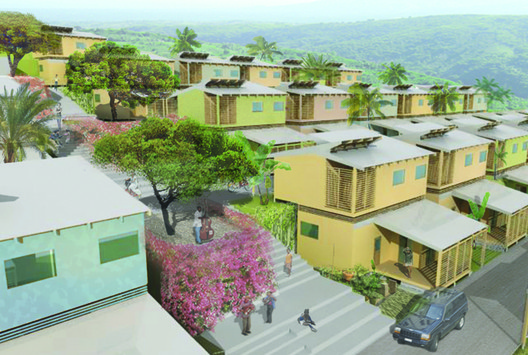
Mark Gilbert discusses redesigning and rebuilding the city of Jacmel, Haiti with Alexander Britell from Caribbean Journal. The architect and his colleagues at trans_city used New Orleans typologies and their concept of rapid-response housing to provide an economical reconstruction proposal that will provide long-term stability to the people of Jacmel.
Shinkenchiku brings you an exclusive inside tour of the contemporary House NA, designed by Sou Fujimoto Architects. Thin, steel poles delicately support the transparent “pile of boxes” at varying heights. In an interview conducted by F.W. Monocle, Sou Fujimoto explains, “In one way the house is like a single space, but each room is also a tiny space of its own. The clients said they wanted to live like nomads within the house – they didn’t have specific plans for each room. The house looks radical but for the clients it seemed quite natural.”
On October 2nd Zaha Hadid Architects launched their much anticipated (to us architecture nerds anyways) iPhone and iPad App, made available through Apple and iTunes. This new App will allow users to browse through ZHA current portfolio of design and architecture. In a future update to the App there will be exclusive access and insight into some of the award winning buildings in the form of interactive guides (coming soon) to be used when visiting Zaha Hadid’s buildings.
The exhibition “Rudolf Steiner – Alchemy of the Everyday” demonstrates that design is linked with many other topics of great relevance to society: from art and architecture, natural sciences and technology up to questions of ethics and spirituality. To this day, the practical implications of this broadly conceived understanding of design have an especially strong presence in the Basel region, which served as the centre of Steiner’s life and work over many years. The Vitra Design Museum embraced this local connection as an opportunity to develop an extensive supporting programme for the “Rudolf Steiner – Alchemy of the Everyday” exhibition. It offers a chance to retrace Steiner’s footsteps in the region, take a good look at his contributions, voice criticism and seek connections to the design and architecture of the present. More information on the event after the break.
In the summer of 2009, we shared Foster + Partners and URS Corporation spaceport project in New Mexico. The structure, which is the first spaceport in history, will host commercial operations by private space travel companies, such as Virgin Galactic. Today, we are sharing an update of the project as the Spaceport enjoyed its dedication ceremony a few days ago. Designed to meet LEED certification, The 110,000-plus square foot facility will feature energy-efficient techniques such as earth-tubes that will pre-condition the air to reduce HVAC costs by 50-70%. The architects explained, “The sinuous shape of the building in the landscape and its interior spaces seek to capture the drama and mystery of space flight itself, articulating the thrill of space travel for the first space tourists.”
Last September, Mateo Arquitectura, together with the French practice Dominique Perrault Architecture, presented a proposal for the project to urbanize Îlot P in Lyon Confluence, to the south of the city of Lyon which was recently named as a finalist. This competition forms part of the process of urban remodeling being conducted throughout the Lyon Confluence area with the aim of leaving behind its industrial past. The project involved the urban development of a city block (Ilôt P), including housing, commercial areas and offices (laid out in two buildings), and landscaping. More images and project description after the break.
Published by CARTOGRAM Architecture + Urban Design, The semiannual journal SOILED has released its second issue, entitled Skinscrapers. It is now available here, where you can order a printed copy from Lulu or download the free electronic version as a PDF . Skinscrapers probes how our bodies interact with the spaces around them and how the spaces we inhabit can become extensions of our bodies. By focusing on the surface of the skin as a natural mediator, Skinscrapers navigates a continuum of scale, starting inside the gut, proceeding to the contours of the body, and culminating in the anthropomorphic city. More images and description after the break.
TRILUX, designed byFuture Cities Lab, is an experimental pavilion constructed out of three vertical wooden lattice structures that will be on display in downtown San Francisco until November 20th . It creates an illuminated beacon anchoring the corner of the site and inviting the neighborhood to participate in the museum activities that take place inside it. More images and project description after the break.
The glorious feeling of winning an architectural competition may quickly diminish after the realization that the achievement was only the beginning of the battle.
Officials have confirmed that Krueck + Sexton’s winning competition entry for the new home of the Chicago Children’s Museum has been removed from the redevelopment plan of the Richard J. Daley Bicentennial Plaza on the northeast corner of Grant Park.
Back from the grave, the first post from The Indicator series by Guy Horton, published in 2010 at AD.
This town, is coming like a ghost town. This town, is coming like a ghost town. This town, is coming like a ghost town. This town, is coming like a ghost town.
- The Specials, “Ghost Town”
When I look back at the events leading up to being laid off, I think of zombies. Of course zombies aren’t real so what I’m really thinking of are movies about zombies. I haven’t seen them all—there are hundreds—so the zombies I’m most familiar with are the pop-locking ones from Michael Jackson’s “Thriller” or the funny ones from “Shaun of the Dead”. I never thought that that part of my subconscious that identifies with zombies would get triggered. But, then again, I never thought I would get laid off. There is a first for everything.
So, how does one identify zombies? As I learned from “Shaun of the Dead”, by the time you know, it’s too late. Remarkable as it seems, the people you least expect to become zombies are suddenly shuffling along shedding limbs and trying to eat you. They are, as it turns out, usually your close friends and colleagues.
When the economy began to falter back in 2007, architecture was one of those fields that began to experience a steady increase in zombie population. There were many rumors about which firms they worked for, whose softball teams they were playing on, whether they were more likely to be associates or principals. What about that Arch II with the mysterious limp and the foreign accent? Then there was the designer who always looked like he had had too many late nights out. Maybe those strange interns.
We recently had the pleasure of having Steven Ehrlich visit our office and give a talk about his work. He is as personable as his work is fascinating. He left us with a recently published book of his work titled Steven Ehrlich Houses. We have featured two of the houses that are covered in the book if you would like a preview of what the book has to offer. (Ehrlich Architects’ projects houses and more) The book, of course, offers a far more in-depth look at the projects including a title page for each project with photographs of what inspired the design. As a world traveler who lived in west Africa for 6 years, Ehrlich’s inspirational photographs are captivating and clearly illustrate the driving force behind each project.
https://www.archdaily.com/179699/steven-ehrlich-housesChristopher Henry
Star architect, Frank Gehry, attempts to survive the decline of U.S. growth by turning to Asia. The Architecture Billings Index illustrates the decreased demand for design serves in America by plunging from 51.4 in August to 46.9 in September. According to the American Institute of Architects, a score less than 50 indicates a decline in billings.
Forget stairs, elevators and escalators, Carsten Höller is bringing a new method of circulation through the New Museum in New York City. It will take visitors down a three-storey, 102-foot tunnel, and may require helmets and elbow pads. What is this innovative invention? None other than the age-old, kid-friendly slide. This insallation is part of a survey exhibition of Höller ‘s work over the past twenty years in which he has explored “such themes as childhood, safety, love, the future, and doubt” in with an attitude towards his work that is “equal parts laboratory and test site.” [New Museum.org] Höller’s pieces explore human sensory experience and perception by creating environments and experiences that over-stimulate or deprive us of our senses. Read on for a preview of what to expect at the New Museum.
The aim of this International competition, hosted by [AC-CA], is to design an Iconic Pedestrian Bridge in the Heart of Amsterdam. The architecture of this new structure should reflect contemporary design tendencies. The proposal must not only attend to the specific function but the design should also take into consideration the urban insertion and impact geared towards creating a new architectural symbol for an European capital city. More information on the competition after the break.
Check out this trailer for what promises to be an awesome documentary on the Eames. This painter and architect duo carved their niche into the history of design, beginning with their famed lounge chair and ottoman, continuing with graphic design, photography, architecture, and visionary ideas for companies such as Westinghouse, Boeing and Polaroid. Directed by Jason Cohn and Bill Jersey, the documentary will run in New York at the IFC Center on November 18, and will have its broadcast premiere December 19 as part of the PBS American Masters series. Narrated by James Franco, Eames: The Architect and the Painter is the first film dedicated to these creative geniuses and their work. As the clip explains, ”They were introducing people to look at the world differently.” Enjoy!
As part of As part of the series of Architectural Workshops by Architects and Designers series by Ajman University of Science & Technology, Eric Owen Moss will be presenting a workshop titled, ‘Who Says What Architecture Is?’ from November 14-17.
Sir Peter Cook is 75 and to celebrate the iconic British architect and Archigram co-founder’s birthday, 75 established and emerging international artists have produced a portrait of Sir Peter to auction for charity Architecture for Humanity aiding post disaster relief in Haiti and Japan. Both the auction and exhibition started on October 26th and runs until November 9th. The online art auction can be found at The Adam and Eve Projects while the exhibition is up at Space, Fortitude Valley, Brisbane, Australia. More images are included here after the break.
Inspired by the spirit of the place and our time, the first prize winning concept by SAGRA Architects creates a place that is rooted in the original structure of the square but still up-to date. Aiming to strengthen the connections of the square to its surroundings, their main ambitions were to balance the historical and modern elements and connect the existing and new elements of the square in harmony. More images and architects’ description after the break.
Alumni descriptions of the architectural education experience can often range from frustration to admiration. The article Creative Education? An Analysis of Existing Architecture Education in Singapore, written by a fourth year student attending the National University of Singapore, is a collection of thoughts and observations based on this individual’s experience. The article primarily focused on particular frustrations. However, these same frustrations are comparable to those commonly voiced throughout many institutions across the United States.






![[AMSTERDAM] Iconic Pedestrian Bridge Competition - Featured Image](https://images.adsttc.com/media/images/55f7/2a4d/203e/c8a9/5b00/0064/medium_jpg/acca_mainbanner_amsterdam4.jpg?1442261553)


