April is Autism Awareness Month, and ArchDaily would like to draw your attention to the architectural coverage we have done on the topic. Autism Spectrum Disorders (ASD) are developmental disorders that affect 1 in 88 children. The spectrum is large and diverse. It ranges from individuals who can be socially withdrawn, have extreme learning difficulties and little to no communication to individuals who can be highly intelligent but socially awkward. Each individual, however, exhibits, to varying degrees, impairments in social interaction and communication, and restricted and repetitive behavior. ArchDaily’s coverage looks at the various approaches architects have taken when designing for individuals with autism. We hope to get your feedback on the articles and your help in spreading autism awareness.
https://www.archdaily.com/222315/architecture-for-autism-autism-awareness-monthChristopher N. Henry
The design intent of Lemay Associés for the Stinson Transport Center in Montreal was to achieve a seamless weaving of the project into the surrounding urban fabric. They then did thus through the introduction of a new dialog element: an interface which will serve as a catalyst for the renewal of the surrounding industrial sector. Characterized by simple and contemporary volumetrics, the project is based on functional principles which give it its geometric singularity. More images and architects’ description after the break.
The sports center’s concept byCôté Leahy Cardas Architects rests on the alteration of the site on which it will be implemented. A site which has been metamorphosed from an industrial field (a quarry) into a landfill and will now be transformed into a park and environmental complex. By its shape, and its feature, its adaptability to the site, by its suggested trails and visual links, the project expresses the whole transformation, the evolution towards a huge environmental park, opened on research and experimentation. More images and architects’ description after the break.
Filmed in 1921, Manhatta reveals a typical day in Lower Manhattan in the early part of the 20th century. Painter Charles Sheeler and photographer Paul Strand created this silent film to discover the relationship between film and photography, while exploring their love to the City. Just as it is today, the City is amidst endless chaos.
Koen Olthuis’s Dutch practice, Waterstudio, has been preparing for the environmental impacts on architecture for ten years now – building a practice on the assumption that a new solution for inhabitation is on the water. Having lived in Amsterdam, Olthuis has intimate experience with the battle against water that people have posed for themselves. In an interview with Jill Fehrenbacher for Inhabitat, Olthuis describes how Amsterdam was settled, what it means to have a city built upon water and the maintenance required. Olthuis’ desire to colonize the oceans is not new, but his techniques, which he touches upon in this TEDx Talk in Warwick, focus on a refined and innovative way of approaching this strategy that is progressive in that it requires far less maintenance.
The starting point for ECDM Architectes in their design for the Cité municipale de Bonneuil-Sur-Marne is the context in which the new city hall will be located. Here more than elsewhere, the town hall will articulate, unify urban landscapes of great diversity, contribute to the implementation of a new polarity high symbolic value in a heterogeneous urban environment. The intersection of two major pathways of Bonneuil-sur-Marne, between the Avenue de Verdun and the provincial road 19 is a strategic crossroads at the edge of urbanity strong and gives our response as an interface between the different territories of the city. More images and architects’ description after the break.
gmp Architekten just won the first prize with their design for the new buildings of the Karlsruhe Medical Centre. The competition focused on the 2015 master plan and was open to 15 selected practices. The briefing called for the construction of a new central building in order to give more structure to the hospital precinct – which consists of older buildings from the nineteenth century as well as later additions – and to improve the logistics of the centre by constructing a new central catering facility and new institute buildings. More images and architects’ description after the break.
The design for the Citadel Skyscraper by Victor Kopeikin and Pavlo Zabotin is a symbiosis of a skyscraper and a residential tank creating a defensive shield to protect the island from the inside against external natural and anthropogenic influences. The project provides carrying the residential functions of cities in the land out to self-supporting residential units located in the sea (residential skyscrapers, citadels).These citadels interact with each other on the shoreline, forming a single closed defensive chain that operates both on the surface and underground. Thereby proceeds the mastering of new territories for the human life. More images and architects’ description after the break.
It is hard not to want to pick up this book and start reading with the project displayed on the front cover. Fantastic! This book grapples with the issue of how to marry old buildings with new design. The book offers a wide range of projects that should challenge architects and planners working at any scale. The text is tremendously accessible while being sophistically insightful.
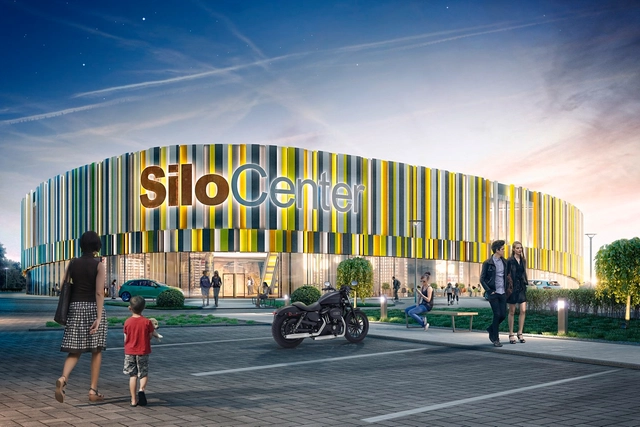
The inspirations for the design and character of the SiloCenter building, by Neostudio Architekci + BPT Jedlinski, were open minds and the creation of new challenges for people who are looking for an active lifestyle. The design dynamics underline a positive attitude to change, which will stimulate a positive body and mind culture, which is realized in the building. More images and architects’ description after the break.
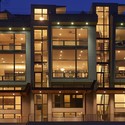
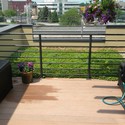
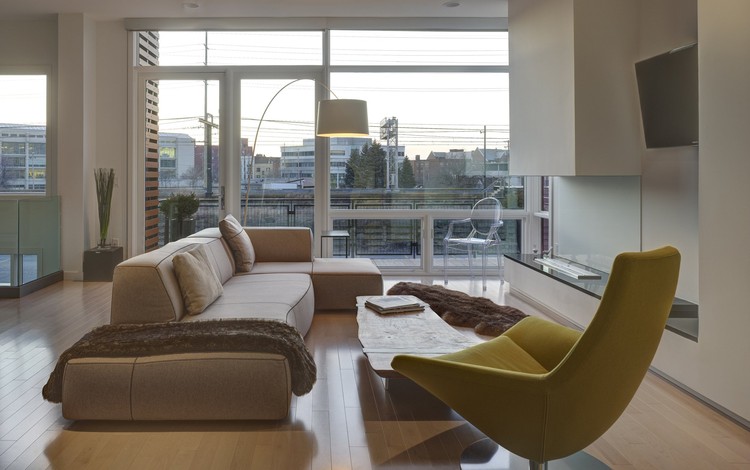
Dimit Architectshave developed twenty-seven Townhouses in Cleveland, Ohio within Little Italy in a reclaimed inner-city area, providing buyers with homes that are composed of sustainable and locally-produced materials, private outdoor space and beautiful vistas of the surrounding neighborhood. The design strategy of the homes will give the owners the power to customize their spaces with complimentary interior design consultations from a selection of leading firms, including Dimit Architects.
Anne Lindberg’s recent work essentially redefines space using thread. Bordering the definintion of architecture and sculpture, Lindberg allows color and light to manipulate the hundreds of millimeter-thick strands to create a web – a three-dimensional volume affixed to the architecture. Each of her pieces is specific to the place in which it is situated, no two identical based on the architecture, its lighting conditions and the space’s use. The pieces are architectural in so far as they are “contextual and integral to the space”, she says. The exhibition of drawn pink (watch the video after the break) ends today at Bemis Center for Contemporary Arts in Omaha, Nevada, while andante green will be on exhibit at the Nevada Museum of Art until July 15th.
ArchDaily asked Anne Lindberg a few questions about her work. Read the responses and find out more about her installations after the break.
Live Between, a concept design by HKS Architects, is a newly launched hotel experience for guests who enjoy the extreme. Their design seeks out urban cities to set up short-term residency between existing buildings. As it moves from city to city, it is designed and installed specific to its temporary inhabitance. Taking on various forms from a spider’s web to a constellation, the hotel formation is ever changing and always evolving. More images and architects’ description after the break.
Serving Guangzhou, China as a distinctive emblem of China Southern Airlines’ global leadership, the winning proposal by Woods Bagot is a bold reinterpretation of the corporate campus model. A 400-hectare, mixed-use development, the three-precinct master plan integrates business, manufacturing, residential, and cultural amenities within a comprehensive open space network that supports recreational opportunity and bolsters ecological vitality. More images and architects’ description after the break.
Out of a collaboration between the Emergent Technologies and Design program (EmTech) of the Architectural Association (AA), London, and the Chair of Structural Design at the Swiss Federal Institute of Technology (ETH), Zurich, a temporary light timber construction has been designed that functions as sun shading for parts of the grand stairs in front of the architecture department of the ETH. Based on bending behavior under the self-weight of over-sized sheets of plywood of up to 11 x 2.5 m, the design activates the material properties as the defining element in the transfer of forces. More images and architects’ description after the break.
The new campus of Universidad del Isthmo is located on a beautiful hillside in the rapidly growing community of Santa Isabel near Guatemala City, Guatemala.Sasaki Associates designed the 49-hectare site, and the first phase of the plan, which consists of the heart of campus, is currently undergoing implementation. The university aims to enroll approximately 6,200 students in successive stages of implementation over 20 years. The educational objectives and mission of the university include a strong focus on the individual and the community within the learning environment. More images and architects’ description after the break.
David Chipperfield, Stirling Prize-winning architect and director of the 13th international Venice Biennale, has been commissioned by the Prussian Cultural Heritage Foundation (PCHF) to renovate the Neue National Gallery. The 20th century icon was designed by the legendary Ludwig Mies van der Rohe, who celebrated his 126th birthday this week.
Hermann Parzinger, president of the Prussian Cultural Heritage Foundation, said: “With David Chipperfield, I know this icon of modern architecture in the best hands. In working with him on the Museum Island, I learned the sensitivity in dealing with the architectural heritage and the conceptual clarity of his approach is greatly appreciated.”
Last June we announced the zHome community designed by David Vandervort Architects, a target zero-energy community in Washington that is one of many springing up across the country, changing the way communities are planned and developed. Since World War II spawned the era of suburban living, the Levittown model has been the trajectory along which so many communities across the country have gone. Now with sustainability and ecologically conscious design being at the forefront of many architects’ practices, it makes perfect sense for whole communities to take the leap as well. But what does that mean for the lifestyles of its residents? And does this make an exclusive neighborhood where only some are willing or able to comply. Follow us after the break for more.
Professors, students and practitioners such as Peter Orborn at AEDAS participated in the above video to give a perspective on a reality for the practice of bridging entrepreneurship and architecture on the Master in Architectural Management and Design at the Architecture Venture Lab at IE University.
Stop right there. Before I begin this post with a cliché dictionary definition, I direct you to what’s usually overlooked in these openings: the part of speech.
Without reading the definition, we know. Design is the act that connects the human being to the object outside him: the way in which intentions, thoughts, concepts take form.
On a basic level, design connects human beings through the shared experience of said object – be it functional or purely aesthetic. But it’s not just the object which connects us – it’s the idea that inspired it. On another level, and perhaps at its purest, design connects by inaugurating us into a collaborative spirit of innovation.
The AIA’s latest Design Conference, Design Connects, has invited bloggers to reflect how design connects us in a way that will build a better future. We at ArchDaily, biased as we may be, think we have the answer (it’s in the invitation): the Bloggers.
To read how design and the Internet connect us to thousands of elementary school kids, the sci-fi dsytopias of a NASA scientist, and a poverty-defying advocate looking to change the world - all in 24 hours – keep reading after the break.
WAI Architecture Think Thank has completed a study for an architecture, urbanism and spatial politics laboratory in the center of Beijing. Conceived as an avant-garde institution for the education of environmental and spatial design, their design creates an educational center based on the principle of open learning and cross-disciplinarity. The building arranges the multiple programs in a sequence of open spaces and sloping floors that together form a continuous loop of learning experiences. More images and architects’ description after the break.
Addicted to checking your favorite site, like ArchDaily, for constant updates, or checking in with Facebook or Foursquare? Don’t worry – you’re not alone, and Columbia’s Spatial Information Design Lab can prove it. In addition to sharing your whereabouts with friends, your geographic mark provides valuable insight in examining the psycho-geography and economic terrain of the city.