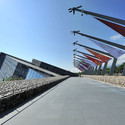
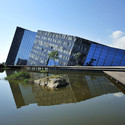
Designed by Bernheimer Architecture for Syracuse University, the football practice facility along with a larger strategic masterplan for the Lampe Athletic Campus situated about 3 miles south of the Main Campus seeks to create an identity for this new “middle campus” by making an assemblage of disparate buildings into a strong collection. By creating an environment that would enhance the practice session, the architects stay true to one of Vince Lombardi’s favorite quotes, “Practice does not make perfect. Perfect practice makes perfect”. More images and architects’ description after the break.
We’ve finally passed the 75,000 photos in our Flickr pool! Keep sending them, so we can celebrate the 100,000 milestone. Remember you can submit your own photo here, and don’t forget to follow us through Twitter and our Facebook Fan Page to find many more features.
The photo above was taken by hansn in Copenhague, Denmark. Check the other four after the break.
Prior to becoming a Pritzker laureate, Italian architect Renzo Piano was commissioned to design the Menil Collection in a quiet inner-city neighborhood of Houston, Texas. Since celebrating its opening in 1987, the museum has expanded, adding Renzo’s second commission, the Cy Twombly Gallery (1995), along with the permanent, site-specific installation at Richmond Hall by minimalist sculptor Dan Flavin and the Byzantine Fresco Chapel (1997-2012) by owner Dominique de Menil. Surrounded by ample amounts of open space, the long-term master plan of the museum’s campus has been under the review of architect David Chipperfield.
Now, after an extensive international search to select the architect for the campuses new major addition that will house the Menil Drawing Institute (MDI), the architecture selection committee has announced the four architects under consideration. Once completed, MDI will be the first freestanding facility in America dedicated to modern and contemporary drawing, and one of the most advanced in the world.
Continue after the break to find out the finalists.
With the guidance of their instructor Matthias Hollwich, students Andreas Tjeldflaat and Greg Knobloch from University of Pennsylvania’s School of Design have proposed an alternative to the traditional prisons seen throughout the United States. The innovative high-rise penitentiary acknowledges the fact that nearly two-thirds of the 14,000 inmates released annually from New Jersey correctional facilities will return to prison within five years. 499.SUMMIT offers a solution that intends to reverse that statistic and help inmates successfully transition back into society.
Breaking Ground: Chinese American Architects in Los Angeles (1945-1980) at the Chinese American Museum (CAM) is an exhibition that focuses on four Chinese American architects that have transformed parts of Los Angeles with iconic buildings and distinct design styles. The work will be on display until June 3rd 2012 and feature architects such as Eugene Choy,Gilbert Leong, Helen Liu Fong andGin Wong.
Breaking Ground is part of Pacific Standard Time, a collaboration created by Getty in which sixty cultural institutions will tell the story of the birth of LA art scene over the course of six months beginning October 2011. Breaking Ground at CAM LA tells the story of the skyline and the changing built environment through the perspective the four prominent Chinese American Architects.
I once saw a video of David Hockney discussing a Chinese landscape scroll. A provocative little art-geek film (or so it seemed at the time) entitled, ”A Day on the Grand Canal With the Emperor of China (or Surface Is Illusion but So Is Depth)”.
On the surface, the film’s subject is a 17th-century Chinese scroll painting. The depths, however, are personal and make the film more about the artist himself, a target for his projection. So, if surface is illusion but so is depth, then what we have is an interesting problem.
In this sense, he wasn’t trying to lay down any absolute truth or theory about Chinese landscape painting, or even himself. But merely his understanding at that moment in time—a moving target exploring another moving target. What would Hockney say about the scroll now?
When I first noticed Mobyblogging about architecture, this film, long-buried in my art history memory, was one of the first reference points that came to mind. Like Hockney with the scroll, Moby is seemingly unrolling Los Angeles and winding his way through it’s weird little buildings and spatial complexities. The hills–and one does not always associate hills with Los Angeles–are uncannily similar to the hills in the Chinese scroll.
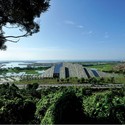
Designed by GRAFT Architects, Vertical Village is a residential, hotel and entertainment development in Dubai that harnesses the most powerful renewable energy source in the desert, the sun. Organized to reduce solar gain and maximize solar production, the buildings are massed as self-shading slabs at the north of the site on the east-west axis to reduce low-angle sun penetration. At the southern end of the site, a vast solar collector array optimally angles itself toward the sun and faces the main public strip as a potent gesture to the developments sustainable intent and minimum LEED Gold rated performance. More images and architects’ description after the break.
The aim of Enforma and AIM Studio in their design of the Salt Tower, located in Budva, Montenegro, was to carefully analyze the specific location and the possibilities that this place offers to the users. Inspired by the old town of Budva, while integrating energy efficient strategies, their transformation from rectangular form to a tall crystal grain reflective structure on the Mediterranean coast justifies the project’s name. More images and architects’ description after the break.
The proposal for the Kyiv Urban Wildlife Park by Katya Larina, Yevgeniya Pozigun, Irina Klixbull, and Roman Pomazan responds to what the place means for the thousands of people who cross the area which is nestled between two fast developing banks. Therefore, the design becomes a development of a decision-making instrument which is intended to guide the future development of Kyiv Islands. More images and architects’ description after the break.
The proposal by BudCud for the Osiedle Przyjaźń 2.0 is an innovative university campus located in the center of Bemowo district in Warsaw. Founded in the1950s as a habitat of small wooden houses, filled with an abundance of green areas, the campus is a crucial factor for city development. It is an element, which significantly affects the attractiveness of a district or even a whole city. While retaining its small scale character, their urban arrangement is clearly divided into function zones. Each zone works as a separate unit of a bigger network – sustainable, modern and pro-social estate. More images and architects’ description after the break.
From now until October 7th, the southeastern Netherlands city of Venlo will be hosting the Floriade 2012 World Horticultural Expo. Covering 66 hectares, the expo invite visitors to experience nature in a variety of ways through the creation of five unique themed worlds. Wandering through wooded areas, the visitors discover each world and all they have to offer.
Swiss architectural photographer Thomas Mayer has shared with us images of unique pavilions and structures found throughout the expo. Each innovative pavilion is meant to educate and inspire. Continue after the break to view the Floriade 2012 pavilions.
Below is the Hollywood Reservoir. I’m two hours early for this interview because, as usual, I’ve guessed the traffic incorrectly. You see, I’m not really from LA. Have never considered myself from here. I’ve lived here most of my life, but I’m not from LA. Being from or not from here usually goes unspoken. It’s typically assumed you are not from here…and never will be.
I park at a trailhead. I’m in dress shoes. Black dress shoes. Black shirt. But I have a scarf and a jacket to fight the wind. Rain coming. The sky is a neapolitan of grays, blues, and whites, laid out horizontally with little light filaments touching down. The canyon is absolutely quiet even though I can see some bulldozers crawling up and down the side of a precarious ravine in the distance. They remind me of the sandcrawlers from Dune. This seems just the type of place where famous LA murders would have taken place. The fact that Ray Manzarek lives in this neighborhood somehow makes it seem more eerie.
I imagine Moby watching from his tower window, watching me turn away from the house and down the dusty trail in my black dress shoes. I’m obviously early. He might think I’m intentionally heading out for a hike. Like I worked this into my itinerary because I knew there was a trail here. Actually, I had no idea. I have never been in this neighborhood and rarely come to this side of town. Just like I have no idea what I’m going to ask him. At this point, I’ve lost almost all interest in architecture, buildings, and the reasons he’s blogging about these things.
“I have practised Architecture at a time when Architects were full of hope and optimism. At a time when we felt that the changes in Planning and on Architecture would change living conditions and improve the world. A time when there was great hope for the future.”
The panel has cited Hadid’s many accomplishments (she was the first female architect to win the Pritzker Prize, designed the Sterling Prize-winning MAXXI Museum in Rome and the Guangzhou Opera House in China) as evidence that she ”has broken the glass ceiling more than anyone and is practically a household name. Her achievement is remarkable.”
However, the choice of Hadid, always a controversial figure, brings into question the aim of the Prize, and forces us to explore what is really needed to improve the state of women in Architecture today.
Read More on Hadid and the controvery surrounding the Prize after the break…
The curvaceous Absolute Towers of Mississauga, a suburb located in the Greater Toronto Area, is a residential landmark many of you may be familiar with. Also known as the Marilyn Monroe Towers, the 56-story condominium tower serves as a gateway into the city and is known for its unique curves that correspond to the surrounding scenery. Residents are offered 360-degree views with continuous balconies that wrap the entire building, eliminating vertical barriers that are typically seen in conventional high rise architecture.
Absolute Towers were the first international win (2006) for the Beijing-based MAD Architects. First seen on Design Intelligence, this video shares with you the entire story behind this project. Want more? Follow these links to check out the towers in progress and more photos of them nearing completion back in June of 2011.
The ‘Now Boarding: Fentress Airports + The Architecture of Flight’ Exhibition, taking place July 15 – October 7 at the Denver Art Museum, will allow visitors a rare opportunity to explore the evolution of airport design and to discover the creative processes that lead to their functionality and beauty. The exhibition takes visitors on a journey through the history of airports aided by film, digital art, animation, models, drawings, photographs, and full-scale architectural elements. Visitors will travel through six airports designed by Denver-based Fentress architects: Denver International Airport, South Korea’s Incheon International Airport, Seattle-Tacoma International Airport, Mineta San Jose International Airport, Raleigh-Durham International Airport, and Los Angeles International Airport. For more information, please visit here.
Either something’s in the water, or the spirit of Jefferson (our only architecturally-inclined president, turning 269 this Friday) has floated down to Utah, because two of its architects are running for Congress.
https://www.archdaily.com/225255/citizen-architects-running-for-officeAmber P
A powerful and expressive design it itself, Ludwig Mies van der Rohe’s Neue Nationalgalerie in Berlin is still admired as a concrete, steel, and glass landmark today. Dedicated to culture and the fine arts, the building will be going through a major renovation, which will be overseen by British architect, David Chipperfield who has recently worked extensively in Berlin, finishing work on the war-ravaged Neues Museum on the Museum Island complex in 2009. The renovation will start in 2015 and last three years, during which time the museum will be closed. The building, completed in 1968, is Mies van der Rohe’s only work in Germany after World War II and is in need of thorough modernization after 40 years. Restoration of the glass facade, stone terrace and concrete and steel structure, along with new security and fire technology are included in the project.
A complementary and mutual beneficial partnership, Hong Kong and Shenzhen will join the globalization as an integrated image and get benefit. With intimate collaboration, the proposal for the Hong Kong-Shenzhen boundary control point by WAU Design will serve as a symbol of close communication. The scheme concept comes from “link”: many single units can be twisted into a solid and integrated form. This scheme, a twisted link, indicates multi-level and deep cooperation between Hong Kong and Shenzhen on economic, cultural, and multi-faceted levels. More images and architects’ description after the break.
Mecanoo architecten, in cooperation with local partner Cafer Bozkurt Architecture, shared with us their proposal, one of the competition’s three winning proposals, in an international design competition for Yenikapı Transfer Point and Archaeo-Park Area in Istanbul, Turkey. Yenikapı, ‘New Gate’, consists in a railroad and maritime transfer centre that connects Europe with Asia, as well as the inner city with the surrounding megapolis and the rest of the country. More images and architects’ description after the break.
Despite being awarded the 2011 Pritzker Prize, Portuguese architect Eduardo Souto de Moura has admitted difficulty in finding work. In a recent interview with El Mundo, the 59 year-old, Porto-based architect stated that he would prefer to work in his homeland, or even nearby in Spain, but the current economic crisis has him extending his search to other parts of Europe, mainly Italy and France.
Currently immersed in the worst crisis in recent history, Portugal became the third country within the 17-country eurozone in need of financial rescue to avoid bankruptcy, following Greece and Ireland. In February, the country’s unemployment rate reached new heights at 15 percent. Meanwhile, as Souto de Moura pointed out, Spain seems to be struggling even more with the possibility of becoming the fourth member of the eurozone in need of a bailout. Spain’s astonishing 23.6 percent unemployment rate has Bloomberg Businessweek referring to it as the greatest European country in danger. Continue reading for more.