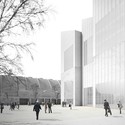
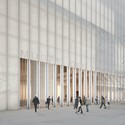
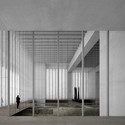
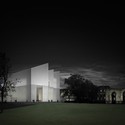
The city of Colmar, France is undertaking the expansion of The Unterlinden Museum with the annexation of an Art Nouveau building that once housed the city’s municipal baths. The 1906 building stands just meters away from the current museum. Its addition will bring the current museum to an area of 8,000 square meters, which will allow works that are currently stored in the museum’s vaults to be displayed to the public. The design team is led by Herzog & de Meuron and is scheduled for completion in September, 2013.
During the summer months, The Municipal Art Society will be leading over two dozen urban design and architecture tours throughout New York. MAS is a non-profit membership organization committed to making New York a more livable city through education, dialogue and advocacy for intelligent urban planning, design and preservation. Since 1956, MAS has been offering such tours as a way to share knowledge and spread appreciation for New York’s varied cityscape. The tours are conducted by architectural, urban, and art historians, urban geographers, architects, teachers and writers, and offer a way to explore historic, evolving and “renewed” neighborhoods, the waterfront and specific residential and commercial projects. The tours will explore some neighborhoods we have featured on ArchDaily, such as Gansevoort with a look at apartments designed by Asymptote, the High Line and the construction site for the new Whitney Museum of American Art. And, even older gems such as New York’s Art Deco buildings from the 1950s.
Well known for their visionary architecture that people love to visit and go back to time and again, The Jerde Partnership has set out to attract more people through a realistic framework by transforming Atlantic City into the preferred coastal resort destination of the Northeastern United States. By creating a clean, green, safe city that pays homage to its storied history and takes advantage of its unique island setting, the new Atlantic City Tourism District master plan will offer a wide range of attractions and experiences for all ages. By promoting a strategy for redevelopment, phasing, and district-wide improvements, the master plan will serve as a catalyst for Atlantic City’s economic and social uplift. More images and architects’ description after the break.
In cooperation with engineers LB Consult, CEBRA recently won the competition for 48 new student housing units in Esbjerg, Denmark’s 5th largest city. The eye-catching proposal consists of 26,910 sq. ft. apartments spread across ten floors and outdoor areas with terraces and activity zones such as a street basket field. The project is commissioned by the housing association Ungdomsbo and they expect that the first students can move in in January 2014. More images and architects’ description after the break.
As part of the cycle of competitions, Think Space is calling for entries in its Blur Building themed competition. “It is too soon to know whether Blur was a barometer of early 21st Century sentiment or a neutral response to the conditions of the site. The lack of program allowed us to make our own which had nothing to do with a World’s Fair and everything to do with our own practice. It allowed Diller and Scofidio to bridge the worlds of high art, installation art, and architecture, continue to research threads significant to the practice at the same time it presaged the change of the firm name from D+S to DS+R.” – Charles Renfro. More on the juror’s description of the project for the competition after the break.
Heroic. Contemplative. Grieving. Victorious. The rebirth of the former World Trade Center site in lower Manhattan has engendered significant public reaction and reflection. With implications as complex as they are profound, it is not surprising that it has taken more than a decade to heal the urban scars of September 11, 2001.
I had the rare opportunity to sit down with three architects working on the site, Santiago Calatrava, David Childs, and Daniel Libeskind, at the recent American Institute of Architects convention in Washington, D.C., where they were honored along with four others, as “Architects of Healing.” We discussed their experience of reshaping one of the most culturally significant sites in the history of the United States.
This week we will propose the first documentary of the list within our section of Films & Architecture. There is not much to say about the figure of Kahn, since it has been worldwide recognized. Nevertheless this is a film that captures in a magnificent way the greatness of Kahn’s work through his son’s journey. I guess everyone related somehow with architecture will feel touched by this extraordinary recording. Let us know in the comments what is (or was) your experience watching the film.
In the design industries, sustainable ratings are too often parsed for single structures. What makes this approach inefficient is precisely that it fails to account for a more comprehensive approach to promoting sustainable strategies. Moreover, what comprises “sustainable” in one rating system may be completely ignored by another. Rather than implementing such piecemeal methods, the design and building industries need to consider a ratings system that accounts for categories ranging from resource allocation to quality of life issues.
Enter the Zofnass Program for Sustainable Infrastructure at Harvard’s Graduate School of Design. It grew out of a studio from 2008, but the program has long since grown beyond its original vision. The program has created Envision, a voluntary certification system. Envision helps cities and infrastructures deploy sustainable strategies “for the design, delivery, and operations of large-scale urban developments and infrastructures.” To help users navigate all its features, there is a downloadable manual.
Arising from the historic town fortifications, David Chipperfield Architects’ new Musée des Beaux-arts is situated on the periphery of a long green space in between the old and new parts of Reims, France. The Gallo-Roman gate and the modernist market hall, located in its vicinity, are evidence of Reims’s architectural history from antiquity to modern times. Clad with marble slabs and glass ceramic panels, the translucent Musée des Beaux-arts building shares a site with an excavation area filled with mediaeval findings.
Continue reading to learn more about the Musée des Beaux-arts.
The general wisdom is that the Olympics create billions in revenue, an incalculable amount of publicity, and an excuse to get massive urban renewal projects off the ground. Cities invest millions – and that’s just to be considered by the Olympic Council. And yet, more often than not, the Olympics engender debt, questionable planning decisions (like razing poor neighborhoods to the ground), and massive, expensive structures that end up vacant and unused when the Games end.
Jon Pack and Gary Hustwit have decided to undertake a photography project to capture post-Olympic cities – both the successes and the failures. From the auditorium turned Korean Mega-Church in L.A. to the weeded, empty venues in Athens, The Olympic City, currently fundraising on Kickstarter, will chronicle each city’s post-Olympic “rebirth or decay.”
For us, the project raises some interesting questions: What choices can cities make to make urban rebirth an inevitable Olympic consequence? Or, at the very least, how can cities avoid the fate of post-Olympic decay?
Sydney is once again illuminated by the fourth annual Vivid’s Festival of Light 2012 that celebrates the creative industries with light shows, music, design ideas conferences and entrepreneurship conferences. The seventeen-day festival, which started on May 25 and will run until June 11th, features light shows and graphics projected on buildings, concerts, lectures and conferences. This round of light projections will have over 50 installations and includes cityscapes, street furniture, monuments and emblematic buildings like the Sydney Opera House.
The new Yongsan International Business District (YIBD), which will be the new heart of Seoul, will be comparable only to a few other city centers on the global stage. As part of the district, the Block C1-20 building, designed by Tange Associates, is a metaphorical expression of the dynamic energy created by the Retail Valley and the building’s own diverse program. More images and architects’ description after the break.
Taking place June 8-28 at the Korean Cultural Center in Los Angeles, the ‘Inside Out: 7 Architectural Thoughts’ exhibition features seven progressive Korean architectural designers bringing up a challenging topic about ‘Koreaness’ to the Korean American community. With their cultural usages incongruent at times in multi-cultural communities of the United Sates, they are trying to make the cultural usages more suitable for current circumstances and create an indigenous cultural entity that is in harmony with diverse ethnic and cultural circumstances. Personally or communally driven, this effort has been performed not only by the Korean American community but also other ethnic groups. More information on the exhibition after the break.
The proposal for the Yashiki Mori competition by HOLDUP elaborates on the Yashiki-rin housing typologies as a protection from environmental aggressions: windbreak forest (hot summer wind, cold winter wind, sandblast), barrier against fire, sunshade, air-purifier (carbon dioxide absorber and oxygen provider), sound-proof shield, etc. This natural eco-system composed of hedges and high trees circling the house could preserve wildlife, supply bamboo or lumber as construction material, fuel or fertilizer. It perfectly fits today’s concerns, i.e. keeping some distance with the surroundings but preserving openness at the same time. More images and architects’ description after the break.
Chosen for its outstanding construction management techniques and environmental sensitivity, the North Las Vegas City Hall and Civic Plaza was recently named 2012 Project of the Year by the American Public Works Association (APWA). Designed by Fentress Architects, the project was completed $17 million under budget in 2011 and as a result of a downtown revitalization effort, North Las Vegas’ new City Hall successfully consolidates the city’s departments into a one-stop-shop offering convenience, efficiency and ease of navigation for both city staff and residents. More architects’ description after the break.
Since it’s opening on May 22, the Tokyo Skytree has already experienced an overwhelming amount of visitors. As reported by the Council on Tall Buildings and Urban Habitat (CTBUH), the 634-meter (2,080 feet) structure has surpassed the previously tallest communications tower, Canton Tower in China, by 34 meters. The Tokyo Skytree took four years to construct and is double the height of Japan’s 333-meter Tokyo Tower.
Tokyo Skytree’s name and design concept is described by the developer as, “The creation of city scenery transcending time: A fusion of traditional Japanese beauty and neo-futuristic design”. Continue reading for more.
The London Festival of Architecture is a city-wide celebration of architecture and architectural talent in the UK capital. It brings architects and communities together to examine how we make London a better place. The theme of the 2012 Festival – ‘The Playful City’ – responds to the presence in London of the Olympic and Paralympic Games.
Powerhouse Company, an office that focuses on the fields of architecture, urban design and research, was recently awarded the Nykredit Motivation Prize 2012. The prize of over 13.000 euros was handed out by the Danish Minister for Culture, Uffe Elbæk, at a ceremony held at Nykredit’s headquarters in Copenhagen. A practice established by architects Nanne de Ru and Charles Bessard with offices in respectively Rotterdam and Copenhagen, they are an example of one of the new global-Danish architectural practices starting to mark its presence on the Danish architectural scene. More information after the break.
Hosted by the New York Chapter of the National Organization of Minority Architects, and sponsored by Urban Office and GGI, this summer event involves a fun evening of networking, cocktails, and hors d’oeuvres. You will have the opportunity to follow design, architecture, development, real estate, and construction professionals at the beautiful midtown offices of Urban Office. The event will be held at the Urban Office Showroom in New York on June 28 from 6:30pm-9:00pm. For more information, please visit here.
Open to students and professionals worldwide in architecture, planning and urban design studios, the Architecture at Zero 2012 challenges participants to design a zero net energy (ZNE) student housing or administrative office building design for the University of CaliforniaMerced in Merced, California. As part of the challenge, entrants will also be asked to create a diagrammatic district energy plan for the Bellevue Gateway development. Organized by the American Institute of Architects (AIA) San Francisco chapter and the Pacific Gas and Electric Company (PG&E) Zero Net Energy (ZNE) Pilot Program, in partnership with the University of California, Merced, this unique event explores the cutting edge of energy efficient design. The deadline for submissions is October 1. For more information, please visit here.
Designed by Olson Kundig Architects, the Foss Waterway Seaport, Puget Sounds premier maritime heritage, education and recreation center began undergoing historic rehabilitation and adaptive re-use. When building rehabilitation is completed, the new 45,000 square foot public facility will feature an expansive maritime heritage museum, compelling indoor program spaces (including a K-16 marine science and environmental education center), a heritage boat building shop and the “Discovery Wharf” childrens learning center. More images and architects’ description after the break.
In continuing with our coverage of the research of the GRASP Lab based out of the University of Pennsylvania, this recent TEDTalk 2012 outlines some of the unique opportunities that can be explored and possibly implemented in the near future with robots that fly. From an architectural and construction perspective, a wide variety of tasks can be accomplished. While still only on a small scale, the demonstrations in the video showcase a myriad of diverse abilities that are achievable. The quad rotor robots are able to navigate complex geometry through the use of onboard laser scanners and cameras. The video also demonstrates the ability of these robots to work together in swarms for tasks such as assembling a scale building based on a programmable blueprint. Watch the video to see what the future may hold for a fully automated construction site.