The AIA is joining numerous other city agencies in the promotion of healthy communities through intelligent design choices. A new document: Local Leaders: Healthier Communities through Design is a series of guidelines that offer architects and designers specific methods for the design of buildings and communities that encourage healthy lifestyle choices.
In collaboration with Carlo Ponti, Jean-Luc Godard, one of the main representatives of the 60′s French film movement La Nouvelle Vague, adapted the Alberto Moravia novel Il disprezzo (A Ghost at Noon), written almost 10 years before, into Contempt. The result is a film where each scene is a composition in terms of colour, proportion, and contrast. And as an extra gift for us architects, most of the story takes place in and around the Villa Malaparte in Capri island, a stunning house on a rocky coast.
We invite you to enjoy this classic and let us know your ideas about the movie, this amazing house and the relationship with the surrounding landscape. More after the break.
Designed by EFFEKT + Rubow, the Mixed Use Sports Complex, in connection with the urban school, combines the planning of the new school district with the transformation of existing historical buildings and new plazas into one united and modern project. Located in Helsingør, Denmark, the idea is to create an open, integrated and modern educational environment that’s both educationally visionary and creates a new and attractive urban district for the city and its inhabitants. More images and architects’ description after the break.
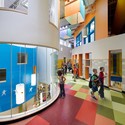
Never is the value of architecture so poignant, as when it becomes a tool to facilitate learning, development and exploration. Inspired by this video, which presents three new schools in Concord, New Hampshire that physically embody the educational philosophies of independence, collaboration, and creativity, we spoke with HMFH Architectsto delve further into this vital question: how can architecture help children develop the early skills, creativity and inquisitiveness needed to become the independent and inspired adults of future generations? Find out after the break.
In terms of both the cityscape and its symbolic significance, the proposal by WEAVA Architects + SWAN Architectes for the Helsinki Central Library will represent a modern and dynamic image of an urban public facility for the citizens of the city. Their ONYX concept forms seamlessly into the planned draft proposal of the Töölönlahti area, responding to the surrounding buildings, infrastructure and urban fabric. It is an iconic cultural landmark in its own right, but also respectful of its place as part of a greater master plan. More images and architects’ description after the break.
Hosted by Architecture for Humanity, the Guerrilla Green Sustainable Showdown is a youth empowerment challenge for all US students. Using a ‘March Madness’ bracket system, they are putting the top 8 school teams from different regions against each other, to turn a great idea into a solution that can be scaled throughout the campus. If you can come up with a way to improve your school by making any space or program in your school more eco-friendly, now is the opportunity to win cash to hack your school green. Submissions are due February 1st. For more information, please visit here.
Through their concept of turning a traditional library inside out, Tanni Lam, Johnny Chiu, and Adrian Lo started with a simple architectural question: Why can’t we turn this inside out, have the users surround the books, thus huge openings, views, ventilation, visual dialogue, can be exchanged between inside and outside? All great libraries in the world have the books surrounding them, covering the space, but this design is a living library, a library that opens up new vistas for us, adding depth to our perception. More images and architects’ description after the break.
Adaptation: Architecture, Technology and the City is a publication that is a result of the collaboration between INABA and Free that brings interviews and art works into a conversation about the advancement of digital technology and its place in the built environment. The publication is a fascinating study into the dialogue between technological advancements in transportation and communications and the tangible environment with which is inextricably linked.
As a follow up to our recent post on the recent win by Boltshauser Architekten for their Basel Aquarium design in Switzerland, we wanted to share with you the other entries by Zaha Hadid Architects, David Chipperfield Architects and Caruso St John Architects. Zaha Hadid’s ‘Blue Cave,’ while praised for its excellent quality, was criticised for its thin visitor aisles; the jury felt the “dynamic” styling of the building’s interior would have been in competition with the aquariums, and so the project came in third out of the 15 shortlisted entries. More information and images on the other entries, after the break.
The Gold Coast, Australia’s sixth largest city, recently announced their global design competition to develop it’s ‘cultural heart and soul’in the 17-hectare Evandale site. Designers are being invited to form multi-disciplinary teams ready for the two-stage competition, to be launched in March 2013 by Gold Coast City Council. The will be to create compelling design concepts that reflect the Gold Coast’s quintessential character while demonstrating worlds best practice in landscape, urban and architectural design. Registration begins in March. For more information, please visit here.
Awarded by the Brick Development Association (BDA), BOLLES+WILSON recently received the ‘Brick Award 2012′ for their Raakspoort – City Hall and Bioscoop project in Haarlem, Netherlands. The jury headed by BDA-Chairman Bob Allies commended a wealth of innovation in brickwork details throughout the building’s intelligent design and its character, which is clearly responding to its contextual surroundings. Out of about 300 projects from across the globe, with 84 shortlisted, this project won the international category ‘Worldwide Brick’. More information after the break.
On the occasion of Wolf D. Prix’ 70th birthday, the Architekturforum Aedes in Berlin is devoting an exhibition to Coop Himmelb(l)au entitled “Wolf D. Prix & Partner: 7+ Projects, Models, Plans, Sketches, Statements”. The event began on December 12 and ends January 24. The event highlights 70 years, 7 projects, the 7 lives of an architect as the magical number 7 has been integrated into the exhibition concept in a variety of ways. This show, which opened just one day before the 70th birthday of Coop Himmelb(l)au founder Wolf D. Prix, begins with a backward glance at the founding year of 1968 and the theoretical roots of this architectural partnership. For more information, please visit here.
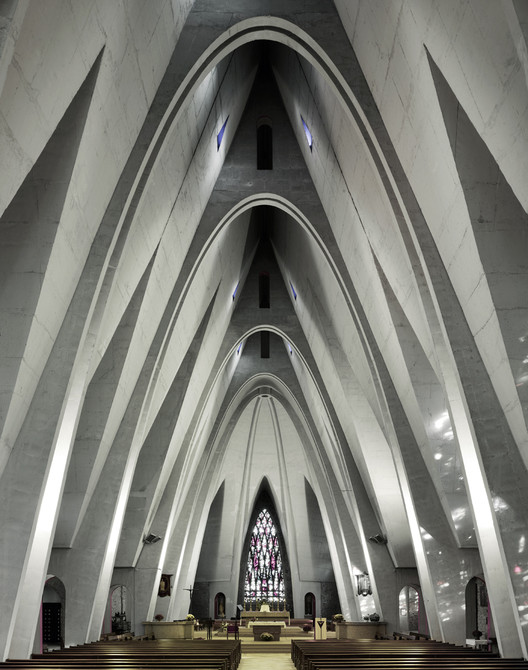
As Europe recovered from the death and destruction of World War II, countries got back to the business of rebuilding their communities and, of course, their churches. The need to make sense of the madness of the War was palpable - as was the need to express this modern-day spirituality in a form that broke from the past and embraced this new world.
The result was a bevy of European churches that - although often misunderstood by practitioners - represent some of our best-preserved examples of Modernist architecture. Photographer Fabrice Fouillet made it his mission to photograph these beauties in a series he calls "Corpus Christi." You can see the images - as well as Fouillet's description of the work - after the break...
The New York Public Library has a plan to save millions of dollars, improve efficiency, and reverse the cutbacks that have been plaguing it. How? By sending little-used resources off-site (after all, most people use the library for its online resources these days), the Library will consolidate three libraries into one Mid-Manhattan branch, renovating the building with a streamlined, efficient design - courtesy of Foster + Partners - to create "the largest combined research and circulating library in the country."
It sounds like a wonderful, modern solution. Ms. Alda Louis Huxtable would beg to differ.
The former New York Times architecture critic and current critic for the Wall Street Journalhas come out swinging against the plan. First, she builds on the critique that others have made, that by moving volumes off-site (to New Jersey, or "Siberia, as she puts it) to make room for more modern amenities, the library will devalue its primary purpose (making resources readily accessible). To put it another way, as Scott Sherman did in his article for The Nation, it would turn the library into “a glorified internet café.” Then, Huxtable makes her own argument: that removing the current, intricate system of stacks would be an enormously complex, expensive, and hopelessly misguided structural challenge.
But, ultimately Ms. Huxtable’s argument comes down to the intrinsic architectural and cultural value of this Beaux Arts Masterpiece: “You don't "update" a masterpiece.”
More on the Ms. Huxtable incendiary critique of The New York Public Library’s Central Plan, after the break...
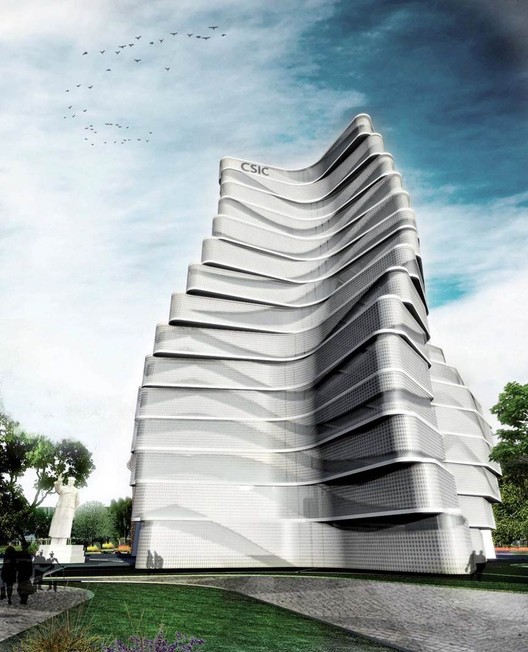
Designed for a marine based company, the design by ACID (Advanced Construction Information Development Co., Ltd) + AaL (Advance Architecture Lab) + Studio méta- creates an iconic architectural representation of their day to day business. The architects were interested in a frozen expression of twisting water and the idea of this movement with relation to the core business of their client. More images and architects’ description after the break.
The Gwangju Swarms installation by NADAAA was designed as part of the Urban Folly Exhibit, 2011 Gwangju Design Biennale. The installation site is characterized by a road crossing with a diverse set of scales and building types that anchor each corner, a site in transition. Inhabiting this corner, the installation is chameleonic; encrytped within the logic of the branches, a seemingly animated structure floats overhead, peeking around the corners giving body to the space that was once occupied by the city wall. More images and architects’ description after the break.
The hotel concept for the five-star hotel in Tianjin, China incorporates the traditional hotel amenities such as conference rooms, restaurants, and fitness areas with a vibrant gallery for art and changing exhibitions showcasing local and international artists. Designed by HAO/Holm Architecture Office, the building orients the building mass to create better views towards downtown Tianjin while curving back part of the volume to create a covered area for the hotel entrance and drop-off. More images and architects’ description after the break.
Spread across 1156 acres, the proposal for the Trans Ganga Masterplan by Studio Symbiosis is envisioned as an iconic city on the banks of Ganga, aimed at being a self sufficient sustainable city. Developed as a mixed use project, this will provide the most influential and dominant context for the master plan. More images and architects’ description after the break.
Both Robert Greenstreet, Intl. Assoc. AIA, and John D. Anderson, FAIA, have won prestigious AIA award. The Board of the American Institute of Architects (AIA) and the Association of Collegiate Schools of Architecture (ACSA) named Robert Greenstreet as 2013 recipient of the Topaz Medallion for Excellence in Architectural Education. In addition, the AIA Board of Directors elected John D. Anderson as the 2013 recipient of the Edward C. Kemper Award in recognition of his many leadership roles within the AIA at the state and national levels. More information on their awards after the break.
FXFOWLE Architects shared with us their custom-design for the inaugural Miami Project art fair. Their installation, known as the ‘FXFOWLE Lounge’, features a free-standing architectural pavilion housed within a well-appointed lounge and bar area. The pavilion – which pairs technologically-sophisticated scripting software with simple museum board – comprises 180 varying segments that, together, take the form of complex structural geometries. More images and architects’ description after the break.
All are invited to participate in the challenge to create proposals for the public use of an overhead transmission line corridor (a.k.a. hydro corridor) in midtown Toronto. This design competition aims to demonstrate the potential of the particular hydro corridor site and also to foster a discussion on public use of other similar spaces in North American cities. The ideas will not be built, but they are meant to get the communities who live, study and work near the site to start thinking about its future. Submissions are due no later than February 4. Among the competition’s many organizers and sponsors are Workshop Architecture Inc., Davenport Neighborhood Association, Canada Council for the Arts, and Ontario Association of Architects. For more information about the competition, please visit their official website here.
With more than 25 years of AIA participation and holding many leadership roles, Mickey Jacob, FAIA, managing principal at Urban Studio Architects in Tampa, Florida since 1989, was inaugurated as the 89th president of the American Institute of Architects (AIA). The announcement was made during ceremonies held on December 7th at the Ronald Regan Building and International Trade Center. He succeeds Jeff Potter, FAIA, in representing over 80,000 AIA members. A native of Windsor, Ontario, Canada, Jacob graduated from the University of Detroit in 1981 and began practicing in Tampa, Florida where he was licensed in 1986. More information after the break.
Team Shishka shared with us their 1st prize winning proposal in the International Art Residence Design Concept Competition in Nikola Lenivets, Russia. As stars in the cosmos, buildings and residences are spread on the site while connected with basic infrastructure. This system takes maximal advantage of the landscape, yet has minimal impact on nature. Within the flexible framework of plan, Nikola Lenivets can be experienced during every moment of the day, the whole year long. More images and the team’s description after the break.