Placed in the southern part of the project area in continuity with the ancient church, the proposal for the New Church of Våler by Francesco Fiotti architects attempts to recover not only the orientation of it, but also the memory. Their design makes reference to the boat as a symbol of Christianity that welcomes and protects within it the faithful; the Drakkar as tribute at the exploratory tradition of the Norwegian people. More images and architects’ description after the break.
Photo note: The artist, Alfredo Jaar, in a 2006 interview, regarded Terragni’s Casa del Fascio as the “perfect memorial to Gramsci.” Jaar used the building’s blank right facade (originally left uninterrupted for propaganda) as a canvas for projecting a sequence of images about Gramsci. As Jaar noted: “Here, the fascist building is transformed into Gramsci’s grave. My trip is thus complete, the circle closed, and Gramsci’s indomitable faith in humanism and the hegemony of intellect is still alive. People were, I think, touched and empowered by my concept of transformation of the former headquarters of Fascism in Como into a commemoration and celebration of Gramsci. It was hopefully a true manifestation of everlasting resistance to tyranny and death.”
The Indicator is back!
In reading Gramsci’s Prison Notebooks I am struck by his lack of irony and pretense. It is not a resistance to humor per se. It is a restraint. A will to power that puts everything in the urgent light of sincerity.
Thus, stylistically, it reads as somehow awkward and formal in our post-post times. It has me thinking about how we write about architecture…how we write architecture.
True. He was writing from prison. But it’s more than that. He was writing what he believed. There is no escape valve of irony in his text. He was, and is when you read him now, in your face, holding you and daring you to veer away. What he is writing is not to be taken with a wink. He commands humor in his language but the humor drives a sustained sincerity, a concern for humanity—including his own humanity.
German architect Johann Bierkandt has shared with us his second-place winning proposal in the Classic Siftung Weimar international competition for the New Bauhaus Museum. His concept was praised by the jury for its clever integration into Weimarhallenpark through a series of small-scale pavilions that differentiates the museum from the surrounding context. Bierkandt‘s proposal is one of the final four designs still competing in the two-stage competition. The jury is expected to announce the winning design this summer. More images and architects’ description after the break.
Many of you may already be aware that Paul Rudolph’s iconic Orange County Government Center is at risk of being demolished. Leaky roofs and a damaging flood have convinced Orange Country executive director Eddie Diana to favor this dreadfully mundane neo-colonial office building over Rudolph’s Brutalist landmark. Cost is not an issue, as the price tag for the new building exceeds the cost to renovate the historical icon, and many understand the immense cultural value of preserving a legacy; however, this battle is nearing a loss and only solidarity will save it.
The World Monuments Fund (WMF) has launched a petition to oppose the demolition. With the Orange County Legislature deciding the fate of Rudolph’s building next month (May 3), it is important you sign the petition now. WMF needs to collect 20,000 signatures. Sign the petition here.
Based on 2010 Census results, the nation’s most densely populated urbanized area is Los Angeles/Anaheim/Long Beach, California, with nearly 7,000 people per square mile. Surprised? Not only did the Los Angeles area rank first, but of the ten most densely populated urbanized areas, nine are in the West, with seven of those in California. Continue reading for more.
To combat the harsh reality of the extreme air pollution caused by urban sprawl in Tehran, CAAT Studio proposed building up, locating massive skyscrapers within the city to house masses of residents centrally. Demolishing unimportant old buildings will create space both for the two legs of the large tower, which is connected above ground to create a wide building expanse, and for green space that will make the urban expanse as a whole more livable. More images and architects’ description after the break.
Martin Klaeschen & Carl Ray Miller shared with us their first place winning proposal for the Noble Square Park in the Eckhart Park Design Competition. Their design focused on a donor recognition wall with an earthen mound that would act as both stage and seating for park activities. More images and architects’ description after the break.
Oyler Wu Collaborative, in collaboration with Michael Kalish, shared with us their video, reALIze, which documents the development and fabrication of the 2011 reALIze installation, a tribute to the life and cultural significance of Muhammad Ali. The project is aimed at exposing a new generation to this larger than life character by building an appreciation for the nuanced emotional, aesthetic, and technical principles that collectively form experience – a concept that holds true as much for human persona as it does for architecture.
The monograph 2G presents a new way of approaching Chilean architecture. In the wake of the interesting publications of Mathias Klotz (2G 26, 2003), Smiljan Radic (2G 44, 2007) and Cecilia Puga (2G 53, 2010), now comes that of Pezo von Ellrichshausen, a firm that has proven itself around the world for its consistently outstanding, contemporary works (you can see some examples here).
https://www.archdaily.com/219446/2g-pezo-von-ellrichshausenAmber P
Located in central Singapore, the top tier business hotel and office in a garden project at Hong Lim Park, designed by WOHA, demonstrates how they were able to not only conserve greenery in a built-up high-rise city center, but multiply it vertically in a manner that is architecturally striking, integrated and sustainable. Undergoing construction with scheduled completion in this year, the project has achieved Singapore’s Green Mark Platinum score, the nation’s highest environmental certification. More images and architects’ description after the break.
Driven by the desire to find safe, carbon-neutral and sustainable alternatives to the incumbent structural materials of the urban world, Michael Green, Principal at Michael Green Architecture, has shared with us this highly-anticipated feasibility study, The Case for Tall Wood Buildings. The 200-page document encourages architects, engineers and designers to push the envelope of conventional thinking by demonstrating that wood is a viable material for tall and large buildings and exposing its environmental and economic benefits.
Co-author Michael Green explains, “To slow and contain greenhouse gas emissions and find truly sustainable solutions to building, we must look at the fundamentals of the way we build – from the bones of large urban building structures to the details of energy performance. We need to search for the big picture solutions of today’s vast climate, environmental, economic and world housing needs.”
Rotterdam-based practice BUBE has shared with us their third-place winning proposal in the Classic Siftung Weimar international competition for the New Bauhaus Museum. Three translucent cubes are clustered together in an effort to maximize open space and reorganize the site with a focus of intensifying the interactions between park and museum visitors. BUBE’s proposal is one of the final four designs still competing. The jury is expected to announce the winning design this summer. More images and architects’ description after the break.
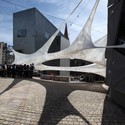
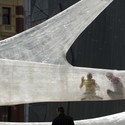
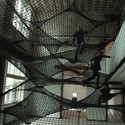
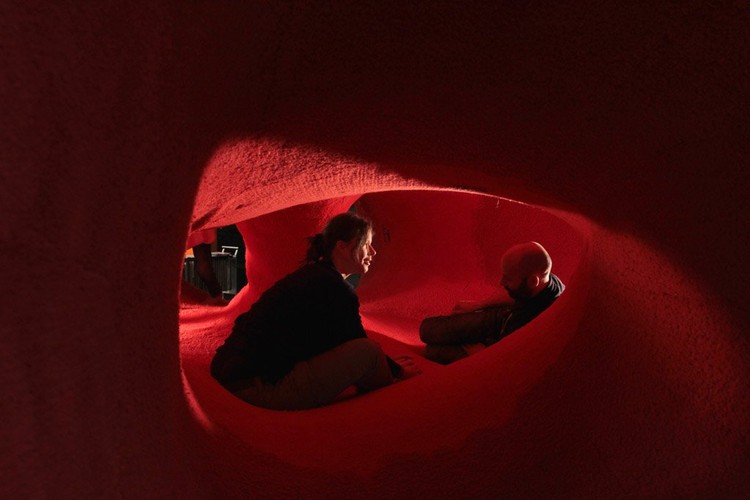
The Croatian/Austrian Design Collaborative Numen/For Use blends architecture and public installation art. The sculpture-like pieces are large in scale and take over whole public spaces while also reinventing them, changing the way in which they can be occupied and changing the experience of the interactions between participants. Numen/For Use has shared with us three of their recent works. Tape, which was actualized in Florence, Italy and Melbourne, Australia; Tuft Pula, a more permanent version of Tape installed in the middle of the former church in Pula; and Net, built in Z33 high spaces. Tape and NET take a material that is ephemeral and non architectural and turn it into one that has architectural capacity. Join us after the break to read more about these projects!
Today we celebrate the 126th birthday anniversary of Mies van der Rohe! The German-born American architect and educator convinced us all with his glass-and-steel buildings that “less is more“. Mies helped defined modern architecture and is known as one of the 20th century’s greatest architects.
PLUSRchitecture – IoannisKarrasArchitectureStudio shared with us their proposal for the Amsterdam Iconic Pedestrian Bridge competition, put on by [AC-CA]. Their concept consists of one single architectural object which, through its morphological simplicity will create a new urban dialogue between man and urban environment. Through the reconsideration of the circular form which clearly symbolizes the unification of the two opposite banks, we suggest an additional urban promenade and a totally new urban recognition, in comparison to the typical straight passing-through connection. More images and architects’ description after the break.