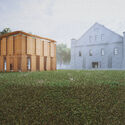
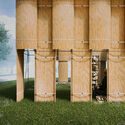
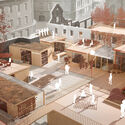
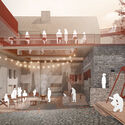
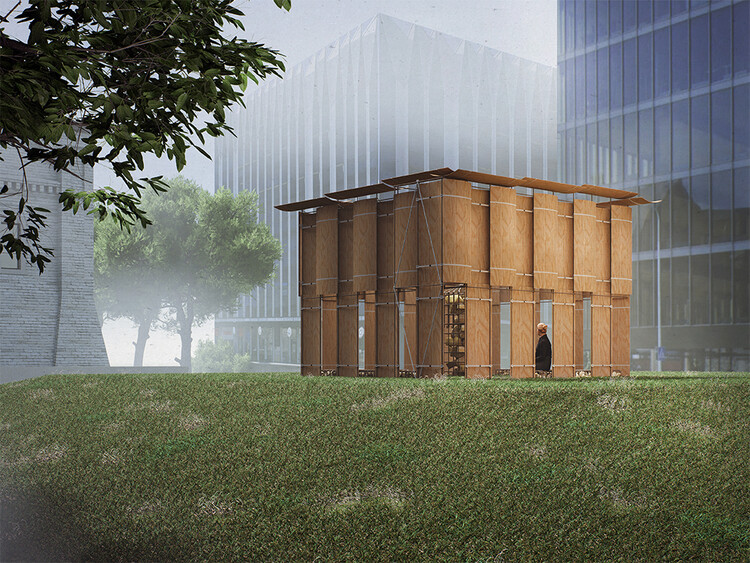
Architects, designers, and multidisciplinary teams across Europe: this is your opportunity to help shape the future of sustainable construction. At revalu, we are launching an open call for innovative projects that prioritize lower-carbon architecture through the use of local, bio-based, and environmentally responsible materials.
THE GARDEN OF UNIVERSITY HOUSE, BUCHAREST INTERNATIONAL DESIGN COMPETITION
The Romanian Order of Architects (OAR) and the Contracting Authority – the University of Bucharest, are glad to announce the official launch of "The Garden of University House, Bucharest" International Design Competition.
Videos
Innovation District NOI Techpark view on Piazza (Ivo Corrà)
It concerns the construction of a permanent pavilion intended above all to foster a new form of cooperation between different disciplines (art & science), and to offer radically new, method-driven approaches to such collaboration. Conceived as a kind of laboratory and prototyping space, it is meant to be a place for new forms of experimentation.
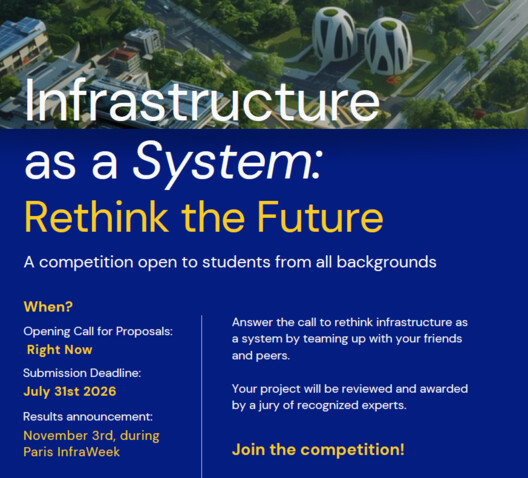
Following the success of last year's edition, InfraVision, the Think Tank founded by Vauban and Altermind, is pleased to announce the 2nd edition of its international student competition in 2026.
International Architectural Competition Christo and Jeanne-Claude Centre for Contemporary Art
Though fleeting, Christo and Jeanne-Claude's projects left iconic afterimages in dozens of natural and urban landscapes, creating, as they themselves put it, "gentle disturbances."
The 8th edition of the Tallinn Architecture Biennale 2026 (TAB 2026) has announced the winners of its Installation Programme Competition and Vision Competition, both developed within the curatorial framework titled "How Much?". Organized by the Estonian Centre for Architecture, the biennale will take place from September 9 to November 30, 2026, with its Opening Week scheduled from September 9 to 13. Curated by Stuudio TÄNA, Mark Aleksander Fischer, and Mira Samonig, TAB 2026 explores the role of money, affordability, and resource allocation in shaping architecture and the built environment, while examining how contemporary practice negotiates economic constraints and cultural value.
Enter the Kinderspace: Architecture for Children's Development #4 Architecture Competition now! 10,000 € in prize money! Closing date for registration: October 28, 2026
Introducing the Kinderspace: Architecture for Children's Development competition / Edition #4, an architectural challenge dedicated to crafting innovative educational spaces that enhance early childhood learning. As young children navigate their formative years, the environment in which they learn plays a pivotal role in their cognitive, emotional, and social development. Traditional educational settings often do not fully cater to the dynamism of early childhood, potentially stifling creativity and exploration.
Have you ever traveled along such a coastline—where the mountains are low, yet cascade gently toward the sea; where the ocean is never far, yet unfolds anew with every turn? Have you ever noticed the villages scattered between bays and tidal flats, sustaining a slow and steady rhythm shaped by tides and monsoons?Have you ever truly seen the night sky— when artificial lights recede, and the sea and the sky nearly merge as one? Have you ever imagined, along this coastal road, a small station called "Zi · Pillowing the Stars"— and, stepping inside, what kind of encounter might unfold?
A journey through mountains and sea, unfolding alongside time—begins here.
https://www.archdaily.com/1041254/global-call-for-proposals-huizhou-twelve-shichen-two-hour-segments-amid-mountains-and-seas-themed-coastal-stations韩爽 - HAN Shuang
For this issue of Dearq, "Tectonic Matter," we are seeking contributions that treat tectonics not as a style or a fetish of detail, but as a rigorous field in which architecture's material realities, its sourcing, craft, labor, structural systems, fabrication protocols, and performance criteria become inseparable from how space is perceived, inhabited, and understood. Who can submit: We welcome submissions from architects, historians, theorists, engineers, educators, and researchers. Interdisciplinary and context-specific approaches are encouraged, provided they remain anchored in tectonics as a conceptual and practical field of architectural invention. The editors invite submissions of research articles, case studies, visual essays, and projects will be accepted, provided they are original and unpublished and comply with the journal's editorial policy. Guest editors: Nader Tehrani (The Cooper Union, USA) Julián Palacio (The Cooper Union, USA) Rafael Villazón (Universidad de los Andes, Colombia)
ArchDaily is looking for a Projects Team Lead to guide the curation and strategic development of one of the platform's core content pillars: built projects. This role sits at the intersection of editorial and architectural judgment, data-driven strategy, and team leadership, shaping how architecture is selected, presented, and amplified to a global audience.
The Projects Team Lead will oversee the direction, performance, and evolution of project content on ArchDaily. This includes defining curation standards, supporting a distributed team of curators, and aligning editorial output with broader platform goals.
The competition was launched on March 20th 2026 following a landmark agreement between the City of Zagreb and the Croatian Government. This €224 million joint investment aims to replace aging infrastructure with a world-class, integrated sports precinct. The organisers invite visionary designs for a 35,000-seat stadium and a 'City of Sport' that honours the site's historic character while meeting 21st-century athletic needs.
The Museum of Architecture, the Great Exhibition Road Festival and Dr Neal Shasore have launched an open international design competition to rethink the Crystal Palace for contemporary society, considering what it might look like, how it would function and who it should serve.
Submissions are open to the Drawing of the Year Awards 2026! The seventh annual, global Awards are free to enter and celebrate excellence in creative imagery, drawings and visual representations.
The subject of this competition arises from the need for the Zabjelo neighborhood in Podgorica to obtain a Local Community Center that will, through its program, contribute to improving the social quality of life of its residents. More precisely, its content will support the long-term development of the Capital City through principles of spatial planning, along with social and economic development and environmental protection.
Call for Pecha Kucha - 6th biennale svizzera del territorio - Handle with care
Participation is free of charge. The winners of the call will be announced by August 2026. The selected Pecha Kucha presentations will be included in the programme of the 6th biennale svizzera del territorio. Selected contributors will be entitled to free accommodation and full access to all three days of the biennale.
The Estonian Academy of Arts Faculty of Architecture invites abstract submissions for the upcoming EKA Arh Conference 2026: To Be Continued…, a biennial international peer-reviewed conference held as a satellite event of the Tallinn Architecture Biennale.
The Urban Design Lab (UDL) announces the fourth edition of its international Thesis Publication, inviting submissions from undergraduate and postgraduate students in urban design, architecture, landscape, and planning disciplines. Conceived as a global academic platform, the initiative curates and disseminates exemplary thesis work that engages with contemporary urban challenges through design, research, and critical inquiry.
The 15th edition of MEDS Workshop will take place in Brussels, Belgium, focusing on Kuregem within the Brussels Canal Zone marked by strong contrasts, cultural diversity, and pressing urban challenges.