

Climate risk is a shared global condition, marked by intensifying heat, water scarcity, flooding, and ecological loss that no border can contain. In 2025, these pressures sharpened a collective awareness that government pledges and international agreements are not keeping pace with lived realities. Across geopolitical contexts, the tension is immediate and structural, revealing gaps between policy ambition and material change. This moment has exposed a growing reliance on disciplines outside formal structures to respond quickly, intelligently, and with accountability.
Architecture increasingly occupies this space as a mediator between ecology, culture, and technology, translating environmental constraints into spatial, material, and social responses. Over the past year, the profession has indicated a clear shift away from mitigation alone toward strategies of climate adaptation and performance-driven innovation. Buildings and landscapes are active systems that manage heat, water, energy, and biodiversity while remaining culturally grounded. In this transition, architecture reclaims its capacity to operate at multiple scales, from the detail of a façade to the resilience strategies of urban environments.
This editorial is structured around six project categories that emerged from close observation of recurring design strategies across regions and contexts. These categories reflect shared priorities around resilience, adaptability, and ecological integration, rather than isolated stylistic or technological trends. While presented as distinct lenses, they intentionally overlap, revealing how contemporary projects often operate across multiple environmental and social objectives simultaneously. Together, they form a practical tool for action, offering designers, planners, and environmental advocates a framework for translating climate optimism into built work and providing a collective foundation for unapologetic optimism for healthy, sustainable spaces.

Building With Regional Traditions: Local Materials at the Factory Canteen Agrocel, Dhordo
Factory Canteen Agrocel Dhordo / Studio Dot

Building with local materials underscores that climate resilience is inseparable from cultural, regional knowledge, material economies, and vernacular construction practices. In 2025, projects rooted in local materials and traditions gained renewed relevance as architects respond to supply chain instability, rising embodied carbon, and the limitations of standardized building systems. Locality should be framed as a climatic and ethical strategy, one that leverages materials already adapted to their environments and techniques refined through generations of use. The result is architecture that performs environmentally while remaining legible to the communities and landscapes it serves.
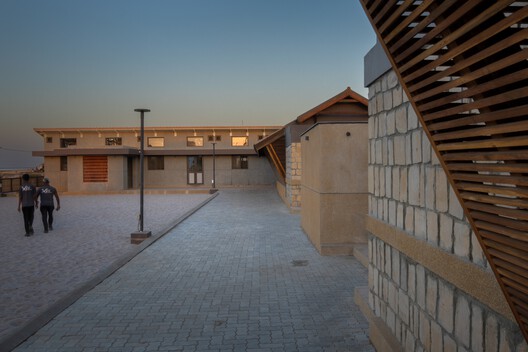
In the white expanse of the Rann of Kachchh, near Dhordo village, a resilient, sustainable canteen offers a pause for the staff and contract workers of Agrocel Industries. Located within the plant premises, the building responds directly to the region's extreme climatic conditions, where heat, aridity, and exposure define daily life. Rather than relying on mechanical intervention, the project is shaped by an understanding of climate as a design generator, producing a space that is both functional and restorative within an industrial setting.
This project demonstrates explicitly how regional intelligence can be translated into contemporary architectural performance without abstraction or excess. Material choices and construction methods are grounded in local availability and climatic logic, allowing the building to regulate temperature, light, and air through passive means. At the same time, the project strengthens local economic and craft networks, reinforcing the relationship between architecture and the communities that support its construction. It stands as an example of how building with place can serve as a precise, scalable response to climate conditions, in which environmental performance, social responsibility, and material economy are inseparable.

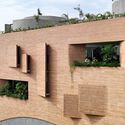
The roof, a key element of the design, is constructed from upcycled timber salvaged from ship-breaking yards. This sustainable approach extends the lifecycle and repurposes valuable materials. The roof features an innovative mud roll insulation system, a testament to the project's commitment to environmental responsibility. The mud rolls, composed of wool, discarded jute bags, clay slip, lime, and upcycled wooden battens, provide exceptional thermal performance, mitigating the harsh desert heat. The use of wool helped promote local shepherds and create a renewed demand for their product, supporting a struggling regional industry. The mud rolls not only provide insulation but also add a beautiful, handcrafted texture to the roof with pastel earthy hues. Horizontal wooden jaalis, fabricated from scrap timber sourced at local sawmills, clad the exterior of each dining bay. These breathable screens shade the interior, promote natural ventilation, and create a calm, comfortable environment.
Rewilding Dense Urban Core: Biodiversity in the Oriente Green Campus
Oriente Green Campus / LJ-Group Landscape Architecture + Saraiva + Associados + Kohn Pedersen Fox (KPF)

Rewilding density reframes the contemporary city as a potential ecological system rather than an environmental compromise. In 2025, projects that embed biodiversity within dense urban environments signal a shift away from ornamental green space toward landscape as active infrastructure. These works recognize that climate resilience in cities depends on restoring ecological processes that regulate temperature, manage water, and support multi-species life, and that this should extend beyond emissions reductions.
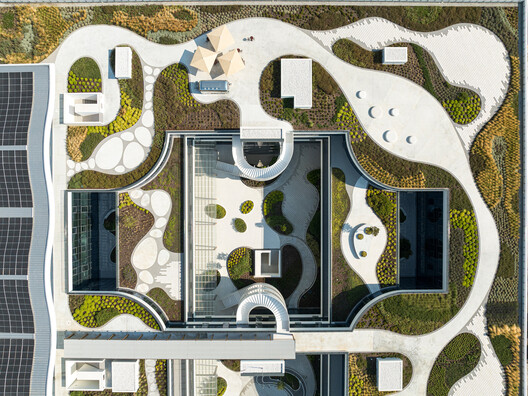
Set on a 3.7-hectare site with 42,000 m² of built area and over 19,000 m² of green surfaces, the campus redefines the relationship between architecture and landscape in urban rehabilitation. It turns flat rooftops, terraces, and patios into immersive outdoor environments that support biodiversity, social interaction, and sustainable living.

Rather than treating the landscape as a residual condition surrounding buildings, Oriente Green Campus positions it as the project's organizing logic. Vegetation, water management, circulation, and the program are interwoven to create a continuous ecological gradient across the site, thereby allowing biodiversity to coexist with academic, commercial, and civic activities. This approach reflects a broader disciplinary shift toward designing cities that function as habitats, in which human use and ecological performance reinforce rather than undermine one another.
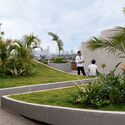
The landscape defines the identity of Oriente Green Campus. From ground level to rooftop, vegetation flows between indoor and outdoor spaces, establishing a strong biophilic connection that enhances well-being and creativity. The result is a living framework that fosters belonging. Students, employees, and locals share open, accessible outdoor areas that adapt to evolving needs—hosting cultural events, coworking spaces, or everyday leisure.
The Value of Existing Sites: Adaptive Reuse in OLA Palermo
OLA Palermo Mixed Use Project / ODA

Adaptive reuse has emerged as one of the most consequential climate strategies in contemporary architecture, reframing existing buildings as critical resources rather than obstacles to development. In 2025, the growing urgency to reduce embodied carbon has accelerated a shift away from demolition and replacement toward transformation and reinvention. Projects that prioritize reuse recognize that structural remnants, urban memory, and material investments already embedded in cities carry environmental and social value that cannot be replicated through new construction.
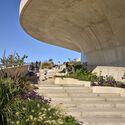
Buenos Aires–based ODA announces the unveiling of its first large-scale mixed-use project in the city with OLA Palermo, a transformation of a decaying parking structure into a public park and Class A office building. The project replaces the inert concrete shell with cafés, restaurants, retail spaces, an open-air promenade, offices, and a sheltered parking lot, repositioning an underperforming piece of infrastructure as an active civic destination.
Beyond its programmatic mix, OLA Palermo demonstrates how adaptive reuse can operate at the scale of urban repair. By retaining and reworking the existing structure, the project significantly reduces construction waste and accelerates delivery in a dense urban context. The intervention is as much about reconnection as reuse, bridging two previously separated neighborhoods and reintroducing permeability, public space, and pedestrian continuity into the urban fabric.
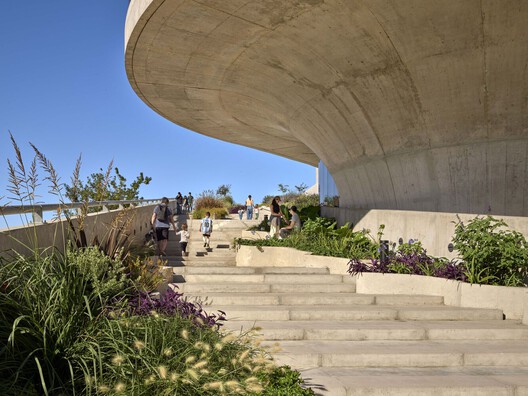
This sustainable design recycles 80 percent of the original structure to create 160,000 square feet of building that bridges the two previously separated neighborhoods. The project includes more than 40,000 square feet of public terraces and open green spaces carved with pedestrian paths, alongside a 250-car parking facility. Through strategic subtraction and selective addition, OLA Palermo illustrates how adaptive reuse can simultaneously reduce carbon impact, expand public life, and redefine the role of infrastructure in contemporary cities.
Landscape Approaches: Large-Scale Urban Regeneration of Cloud 11 Creative Park
Cloud 11 Creative Park / Snøhetta
Landscape-based urban regeneration reframes climate adaptation as a spatial and ecological process rather than a singular architectural gesture. In 2025, large-scale projects increasingly rely on the landscape as the primary organizing system for managing heat, water, air, and biodiversity across entire districts. This approach recognizes that urban resilience depends on continuity, porosity, and long-term environmental performance, especially in cities facing intensified flooding and extreme heat.
As a development supporting national and global climate goals, Cloud 11 Creative Park employs a sustainable, landscape-based approach to offset the environmental impact of large-scale urban development. Drawing from Bangkok's layered urban fabric, the project's massing responds to local climate conditions through iterative wind and solar engineering. In contrast to the city's dominant vertical towers, the 250,000 square meter development is conceived as an architecture of horizontality, deliberately blurring the boundaries between architecture and urbanism.

Rather than imposing a single form, the project uses the landscape to structure movement, programming, and environmental performance across the site. Horizontal massing allows green systems to extend continuously, enabling passive cooling, air filtration, and social space to coexist within a dense urban context. This strategy reflects a broader shift toward regenerative urban models that prioritize environmental processes over iconic form, positioning landscape as a critical driver of spatial experience and climate resilience.
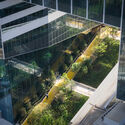
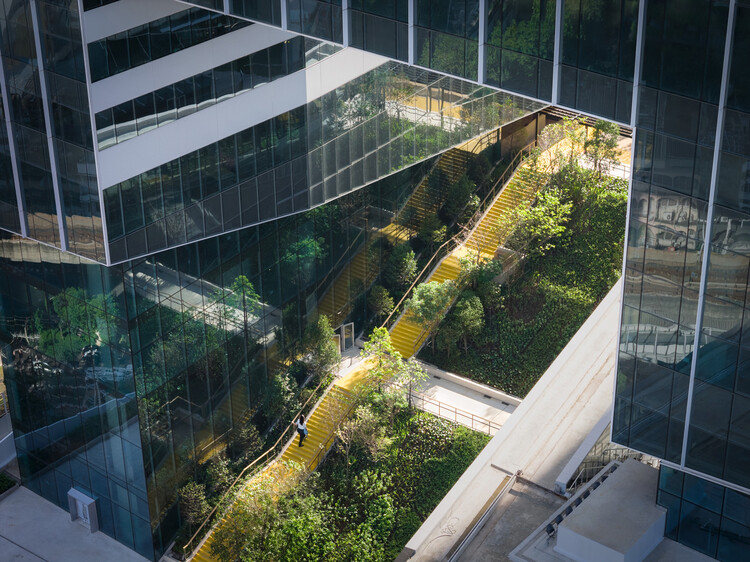
Nestled between the tower and podium, the elevated courtyard serves as an innovative response to Bangkok's flood-prone, heat-intense climate, providing passive shading and natural ventilation. Acting as an urban lung, the elevated landscape filters air, mitigates heat, and supports biodiversity. Carefully curated planting strategies transform the green spaces into active contributors to public health. Layered with diverse species, the vegetation produces cleaner air, while shaded corridors with dense foliage reduce the urban heat island effect and create a comfortable microclimate. Strategically distributed soil and planting patches serve as ecological stepping stones, encouraging wildlife and enhancing urban biodiversity.
Architecture That Breathes: Passive Cooling Systems of the Sagehaus Office Garden
Sagehaus Office Garden / RAD+ar (Research Artistic Design + architecture)

Architecture that breathes repositions passive cooling as a primary driver of form, space, and experience rather than a secondary environmental layer. Projects constructed in 2025 that rely on natural ventilation, shading, and thermal mass have become increasingly critical in hot and humid climates, where mechanical cooling intensifies energy demand and exacerbates urban heat island effects. Passive cooling, in this context, is not a constraint on design expression but a generator of spatial character and environmental performance.
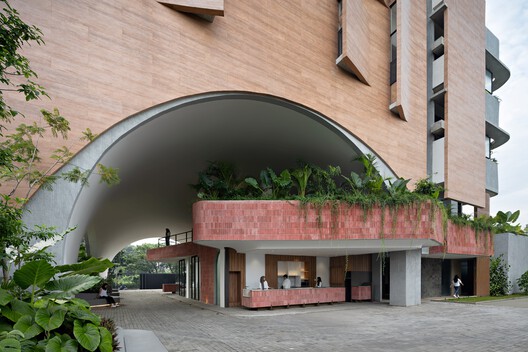
Sagehaus Office is a "Dome for Wind," a reversed carved space designed to channel and intensify Jakarta's gentle breezes through shaded, sheltered gathering and social spaces, creating a pleasant and safe environment for all staff activities. The enclosed breezeways between the blocks are designed for maximum comfort and interaction, offering spaces for groups of various sizes to engage and relax. This wind-directing design has proven to be both successful and extremely comfortable, providing constant cooling breezes despite Jakarta's high humidity.
Sagehaus Office Garden exemplifies this approach by treating airflow as a spatial resource and social catalyst. The project is shaped by an understanding of Jakarta's climate, in which high humidity and heat require continuous air circulation rather than enclosure. By organizing the building as a series of interconnected volumes rather than a single, sealed volume, the design enables free air circulation through shared spaces, reinforcing interaction while maintaining comfort throughout the day.

The design sought to integrate architectural strategies that ensure efficient energy performance while establishing the building's character. The public space at the core of the site was treated as a carved monolith to provide sufficient thermal mass.
At the detail and section scales, the project integrates multiple passive strategies into a cohesive system. Thermal mass, façade articulation, and controlled openings work together to temper heat gain and support ventilation without sacrificing daylight or programmatic flexibility.
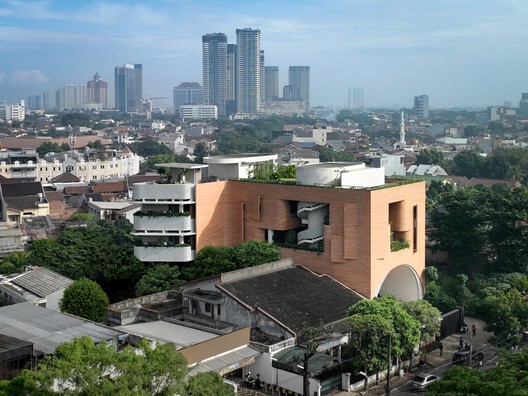
In terms of the facades, large openings were carved to minimize direct heat from the sun while still allowing ample natural light through the slices and punctures of the facade. All recessed and indirect openings were carefully designed to avoid direct solar radiation and, consequently, the greenhouse effect.
Architecture as Energy Producer: Expanding Clean Energy Systems through the 5TRACKS Mixed-Use District
5TRACKS Mixed-Use District / Shift Architecture Urbanism + Powerhouse Company

Architecture as an energy producer reflects a broader shift in the built environment from consumption to contribution. In 2025, buildings and districts are increasingly conceived as active components of energy networks, capable of generating, storing, and distributing power at multiple scales. This approach moves beyond efficiency toward systemic integration, in which renewable energy infrastructure is embedded directly within architectural form and urban organization. By aligning spatial design with energy performance, these projects demonstrate how the transition to clean energy can be technically robust and spatially legible.
Energy systems further reinforce this sustainable foundation. A geothermal energy storage system provides heating and cooling for apartments, offices, and the hotel, drawing partly from the ground and partly from outside air. On the rooftops, solar panels generate renewable electricity, supporting the energy supply for shared facilities and strengthening the project's sustainable infrastructure.

At 5TRACKS, clean energy systems are treated as integral elements of the district's spatial and operational logic. The combination of geothermal storage and rooftop solar enables the project to meet diverse programmatic demands while reducing reliance on centralized, fossil-based energy networks. At the district scale, this integration supports long-term resilience by allowing residential, commercial, and hospitality functions to operate within a shared energy framework. The project illustrates how architecture actively participates in the energy transition, transforming buildings into productive infrastructure to support environmental goals and everyday urban life.
Building Optimism: Lessons from a Year of Climate Adaptation
Climate optimism in architecture is no longer rooted in speculative futures or singular technological breakthroughs, but in the steady accumulation of built evidence. The projects highlighted from 2025 reveal a profession increasingly comfortable operating within constraints, drawing strength from locality, existing structures, landscape systems, passive intelligence, and renewable energy infrastructure. Together, they demonstrate that adaptation is not a retreat from ambition but a redefinition grounded in performance, care, and long-term responsibility. At a time when political timelines falter and environmental pressures intensify, architecture's capacity to act across scales offers a quiet yet credible form of optimism. These works suggest that the path forward is already under construction, shaped by designers who understand that resilience emerges not from singular solutions, but from integrated systems that align ecological realities with cultural and spatial intelligence.
This article is part of the ArchDaily Topic: Year in Review, proudly presented by GIRA.
GIRA sets the standard where architectural design meets intelligence. From the defining moments of 2025 to the innovations shaping 2026, we create smart solutions that elevate living and working environments with timeless aesthetics. Join us in shaping the future of architecture and interior design — where vision becomes reality.
Every month we explore a topic in-depth through articles, interviews, news, and architecture projects. We invite you to learn more about our ArchDaily Topics. And, as always, at ArchDaily we welcome the contributions of our readers; if you want to submit an article or project, contact us.


