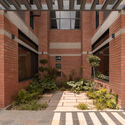
Gairola House / Anagram Architects

Architects: Anagram Architects
Location: Gurgaon, Haryana, India
Site Area: 299 sqm
Project Area: 523 sqm
Project Year: 2008-2009
Photographs: Asim Waqif
South Asian Human Rights Documentation Centre / Anagram Architects

Architects: Anagram Architects
Location: New Delhi, India
Design Team: Vaibhav Dimri & Madhav Raman
Client: South Asian Human Rights Documentation Centre
Site Area: 50 sqm
Project Area: 172 sqm
Project Year: 2005
Photographs: Courtesy of Anagram Architects
Woodwalk / Vir.Mueller Architects

Architect: Vir.Mueller Architects
Location: Kotla Market, New Delhi, India
Partners in Charge: Christine Mueller, Pankaj Vir Gupta
Project Managers: Harshvardhan Jain, Kai Pedersen
Project Team: Saurabh Jain, Sarah Gill, Everett Hollander
Carpentry Supervisor: Ghanshyam Sharma
Project Area: 920 sq ft
Design Year: 2009
Construction Year: 2010
Photographs: Courtesy of Vir.Mueller Architects
Taj Hotel Competition Entry / Yazdani Studio

LA based architects Yazdani Studio shared with us the Taj Lands End Hotel competition entry in Mumbai, India.
In a single sweeping gesture, the “wave” gathers the multitude of public and private spaces within the new hotel into a seamless composition, immediately iconic against the rectilinear skyline of Mumbai. This graceful arc also echoes the form of multiple bays that make up the city’s western edge, and makes visual reference to the new Sea Link Bridge adjacent to the site.
PARENTHESIS / CHA:COL
Our friends from CHA:COL shared with us their urban strategy, PARENTHESIS, with us. When the New School of Planning and Architecture decide to relocate an institution, CHA:COL imagined this new school as an interconnected whole where the plan connects disparate structures with the natural environment. Set in India, the country already has a rich history of education that synthesizes the exterior with the interior, so CHA:COL’s strategy enforces this pedagogical mentality.
More about Parenthesis after the break.
House 42 / DesignQ

Architects: DesignQ
Location: Banashankari, Bangalore, India
Client: Mr. & Mrs. Prashanth
Structural Engineer: Arunachala.K.S
Civil Contractors: Sristi Constructions
Site Area: (4.5meters. X 10.5meters) 47.25 sqm
Built up area: 144 sqm
Budget: Rs. 25 Lakhs
Project Year: 2009
Photographs: Sri & Max / designQ
ACE Pavilion / Sameep Padora & Associates

Architect: Sameep Padora & Associates
Location: Mumbai, India
Client: Galeecha India Pvt. Ltd.
Design Team: Sameep Padora, Shashank Srivastava
Cost: 3,500 USD
On-Site Assemblage: 36 hours
Drawings: Shashank Srivastava
Project Year: 2009
Photographs: Raju Shukla
Satish Nayak Residence / The Design Firm
Architects: The Design Firm
Location: Kengeri Satellite Town, Bangalore, India
Project Head Architects: Sujit Muralidhar & K Krubha Karan
Project Architect: Phanindra, Antony Justus
Client: Mr.Satish Nayak
Models: Dinesh G
Structural Consultants: Sigma Consultants, Mr. Satish Shanoy
P H E Consultants: P K Consultants, Mr. Prasanna Kumar
Contractors: Vivek and Co.
Site Area: 204 sqm
Project Area: 279 sqm
Budget: Rs.35 lakhs
Project year: 2009
Photographs: The Design Firm
Pearl Academy of Fashion / Morphogenesis
Architects: Morphogenesis
Location: Jaipur, India
Client: Pearl Academy of Fashion
Design Team: Sonali Rastogi, Rudrajit Sabhaney, Anna Kristiana Bergbom, Shruti Dimri, John Alok Decruz
Structure: N M Roof Designers Ltd.
Electrical: Integral Designs
Plumbing: Tech Consultancy
HVAC: Design Centre
Landscape: Oracles
Contractors: R G Colonizers Pvt. Ltd.
Project area: 11,745 sqm
Project year: 2008
Photographs: Andre J Fanthome and Edmund Sumner
Weekend Pavilion / Architecture Paradigm
Architects: Architecture Paradigm
Location: Bangalore, India
Design team: Vimal jain, Sandeep.J, Manoj ladhad , Chinmayee Ananth
Client: Mr. Manoj jain
Project Area: 170 sqm
Photographs: Architecture Paradigm
Perkins Eastman proposal for Kohinoor Design Competition
As one of five international architecture firms invited by Kohinoor CTNL Infrastructure Co. Ltd. to participate in a design competition to create a mixed-use urban development in Mumbai, India, Perkins Eastman submitted two bold approaches-one, a singular 33-story, 1.16M sf (108,000 sm) high-rise tower and two-story retail base; the other, a low- and mid-rise, 750,000 sf (69,700 sm) two building scheme. Each is a visionary catalyst for smart, green urban development that establishes an iconic sense of place amid juxtapositions of traditional and modern India.
Both schemes incorporate sustainable elements to create an indoor environment that is healthy to occupy and cost-effective to operate: intelligent facade design, harnessing alternative energies, harvesting and recycling rainwater, and incorporating smart technologies such as solar chimneys and abundant facade plantings to filter and improve air quality.
In each, colored glass and richly colored terra cotta contrast with cool sleek aluminum elements amid verdant landscaping. Both schemes utilize a bright and energizing palette of materials that integrate the colorful aspects of Indian culture with an unwavering commitment to a more sustainable environment.
More images after the break.
CHA:COL’s Fairwood Building

Los Angeles based husband-wife studio, CHA:COL (Chinmaya+Apurva Collaborative), recently designed the Fairwood Building as part of a proposed Infrastructure City for hi-tech services in western India. The towers, that aim to replicate interconnected figures, will benefit the growing commercial district with their programmatic elements.
Further project description and more images after the break.
Incremental Housing Strategy in India / Filipe Balestra & Sara Göransson
Aerial collage: the new archipelago of incremented kaccha houses rising from a context of well built permanent homes in a typical slum.
The problem with social housing has been how to give the most with less money. We have very good examples in Europe, but the constrains are way different than the ones in developing countries. In these countries, almost all the constructions are done by anyone but architects. Clearly, in these countries architects can do something way better than just designing or constructing, developing strategies together with communities to achieve housing solutions that not only address today´s necessities, but that can also be extended over time as families grow, once again by themselves and without architects.
A good example on this is Elemental, lead by Alejandro Aravena, which has been changing not only design aspects of social housing, but also public policy. Currently, they have built and on going projects in Chile, Mexico and more countries.
But also, there´s the work that Filipe Balestra and Sara Göransson have been doing in India, invited by Sheela Patel and Jockin Arputham from SPARC to develop an Incremental Housing Strategy that could be implemented anywhere.
Vidyalankar Institute of technology / Planet 3 Studios Architecture

Architects: Planet 3 Studios Architecture
Location: Wadala, Mumbai, India
Client: The Vidyalankar educational trust, Wadala-Mumbai
Design Team: Kalhan Mattoo, Santha Gour Mattoo, assisted by Jainish Jani
Structural Consultant: S.N. Bhobe & Associates
Contractor: Nagarjuna Constructions
Service Consultant: Sunil Services
Construction Year: 8,826 sqm
Project Year: 2004-2006
Photographs: Mrigank Sharma – IndiaSutra
361°: The Design Conference
Indian Architect & Builder’s biannual conference series: 361°- The Degree of Difference is back. In its third cycle it offers five tracks, over 3 days of the weekend, that aim to cover the relevant arguments which shape design and construction practices today. Adding significant value to the Conference venue will be the exhibition “Masterstrokes: The Architecture of Fumihiko Maki” which showcases some of the Pritzker laureate’s projects over his illustrious career since 1965.
For details on the tracks – ICONS, Earth Matters, Imagining Urban Futures, Rebels and Foundations or to register click here. The conference will take place this weekend in Rang Sharda, Bandra, Mumbai.
Learning from the slums (1/2):literature and urban renewal
“Slumdog Millionaire” is the movie of the year. Its story of a young guy from Mumbai’s slum of Dharavi, who manages to change its destiny through the “Who wants to be a Millionaire” game has charmed many people, including the Oscars’ jury, who awarded the movie with 8 prizes.
At the same time, the movie has created a debate around slums and how the movie portrays them. “Slumdog Millionaire” follows the mainstream vision of slums, described in the XIX century by writers like Daniel Defoe or Charles Dickens: dark, dirty places, with people packed in small rooms with no water facilities. In slums, riots are frequents, and police can hardly enter: the perfect place for criminals to hide and plan their threats to the society, and the perfect incubator for all sort of diseases.
Residence at Punkunnam / LIJO RENY architects

Architects: LIJO RENY architects
Location: Thrissur, Kerala, India
Interior & Landscape Design: LIJO RENY architects
Project year: 2007
Constructed Area: 255,5 sqm
Client: Dr. Cijo Jos and Dr. Thushara Cijo
Photographs: LIJO RENY architects