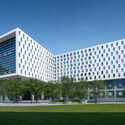
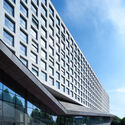
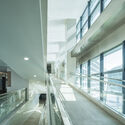
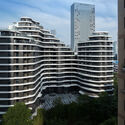
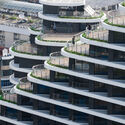
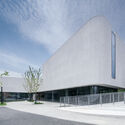
Hangzhou South Railway Station / gmp Architekten

Following their success in winning first prize in an international competition, gmp Architekten hs been commissioned to design the new southern railway station in Hangzhou, China. The project involves the conversion and extension of the station in the Xiao Shan district to the south of the Qiantang river; after the eastern and main railway stations it will be the third largest railway station of this metropolis. More images and architects’ description after the break.
Grey Brick Galleries, Red Brick Galleries, Three Shadows Photographic Centre by Ai Weiwei at Cao Chang Di, Beijing

Architect: Fake Design, Ai Weiwei
Location: Cao Chang Di, Beijing
Photographs: Li Shi Xing, Andrea Giannotti
Beijing urban expansion _
The fast and enormous urban development of Beijing has transformed the city into a metropolis made of suburban residential compounds, abandoned industrial plants, community housing blocks from the 70s-80s and popular self-grown villages. A mix of high rise residential areas, business districts, impressive infrastructures enclosing spontaneous house areas surviving the demolition and renovation dictated by the construction market. The population has grown from 1 to 18 millions in 60 years, and the size of the city has reached 5 times the ancient capital within the walls – the 2nd Ring Road.
The urban expansion, mostly based on imported urban models and low quality constructions, has been exploding in the past 30 years, and it is rooted with political and economical decisions, as well as local culture and history. Briefly, Beijing is a stunning showcase of urban consequences happening in the world’s first growing economy, during an explosive industrial revolution.
Shanghai Terminal / Frank Repas Architecture

Architect: Frank Repas Architecture
Location: Shanghai, China
Structural Engineering: Weidlinger Associates, Inc. (New York)
Environmental Engineering: ARUP – Hong Kong
Glass Facades: RFR Paris, Stuttgart and Shanghai
Photographs: Antoine Duhamel
Hallway House / NL Architects

Hallway House, a radical residential project designed by NL Architects, has been conceived within the framework of a ‘match making’ program set up by the Dutch Architecture institute (NAi), together with Housing Corporation VANKE. As a Sino-Dutch collaboration in social housing, NL Architects has created a new concept for high-quality affordable housing on a site in Huilongguan, Beijing. More images and architects’ description after the break.
Yungang Grottoes Museum in Datong / Do Union Architecture

Architects: Do Union Architecture – Dapeng Cheng
Location: Beijing, China
Completion: 2011
Total: 9,939.46 sqm
Materials/products: VMZINC
Photographs: Do Union Architecture
7th International Strawberry Symposium / DADA Architectural Design + Planning

Architect: DADA Architectural Design + Planning
Location: Changping District, Beijing, China
Design Architect: DADA- Principal: Wu Hua; Design Partner: Zhao Zhao
Project Managers: Duan Gong, Li Gang, Project Architect: Jonathan Kan
Parametric Design: Zhou Difeng
Design Team: Jessica Strandell, Yao Cong
Architect of Record: ZJHJ
Completion:
Budget: 300M CNY ( US$47.6M )
Built Area: 50,000 sqm
Site Area: 28,760 m
Photographs: Courtesy of DADA Architectural Design + Planning
Starry Night Dining / Panorama International Limited

Architects: Panorama International Limited
Location: WuXi, China
Area: 700 sqm
Completion Date: Jan 2012
Client: Star Food Service (Suzhou) Inc.
Design Team: Horace Pan, Alan Tse, Ardy Tsoi
Photographs: Ng Siu Fung
Pool At Fragrant Hill / Zephyr Architects

Architects: Zephyr Architects
Location: Beijing, China
Client: Private
Project Area: 123 sqm
Project Year: 2011
Project Team: Zhao Zhonggui, Yang Ching-Chyi, Xu Xiaoye
Landscape Architect: Fang Musheng
Photographs: Shu He
Tsinghua University Law Department Library Proposal / Zhubo

Seeking to improve their outdated and overcrowded department library, the intention for the design of the Law school library aims at housing their growing book collection and creating a central focus for the school. After numerous studies and surveys indicated that students and faculties in Tsinghua hunger for open and easy-communication space, Zhubo based their concept on a people-oriented idea instead of a formalistic one. At the same time, they hoped for an eye-catching library that enlivens the campus, creating a destination that attracts both students and teachers. More images and architects’ description after the break.
Tea House / Archi-Union Architects

Architect: Archi-Union Architects
Location: No. 1436 Jungong Road, Yangpu District, Shanghai, China
Area: approx 300 sqm
Construction: August, 2010 – May, 2011
Chief Designer: Philip F. Yuan
Design Team: Alex Han, Fuzi He
Photographer: Zhonghai Shen
Hong Kong Alternative Car Park Tower / Chris Y. H. Chan + Stephanie M. L. Tan

The Hong Kong Alternative Car Park Tower, designed by Chris Y. H. Chan + Stephanie M. L. Tan, is an alternative building typology that could fit for a city with very limited land resources. At the same time, they are critiquing the current developments of most metropolitan cities: growing rapidly without vision and preparation for our human future. More images and architects’ description after the break.
Plot 6 & Tea House in Jiangsu Software Park / Atelier Deshaus

Architect: Atelier Deshaus (Liu Yichun/Zhuang Shen/Chen Yifeng)
Location: Jishan, Jiangnin Developed District, Nanjing, China
Project Team: Chen Yifeng, Liu Yichun, Zhuang Shen, Chen Juan, Tang Yu
Building Area: 20000 sqm
Site Area: 24238 sqm
Project Year: 2007
Photographs: Shu He
Dragon Skin Pavilion / Emmi Keskisarja, Pekka Tynkkynen & LEAD

Architects: Emmi Keskisarja, Pekka Tynkkynen, Kristof Crolla (LEAD) and Sebastien Delagrange (LEAD)
Location: Kowloon Park, Hong Kong
Collaborators: Gilles Retsin, EDGE Laboratory for Architectural and Urban Research, Tampere University of Technology, UPM Kymmene
Built Area: 16 sqm
Project Year: 2012
Photographs: Pekka Tynkkynen, Emmi Keskisarja
Night Club Hotel in Hong Kong: Extremely Negative / YS Groundwork

We have already introduced you to the Night Club Hotel: Bubble X (2nd place) and Elevated Night Club (3rd place) winning entries for the Night Club Hotel in Hong Kong by vGH Company and Urbanplunger respectfully. We now unveil the first place proposal, submitted by Hong Kong based architecture firm YS Groundwork. Extremely Negative is concerned with distancing itself from the typical design solutions that produce mega-structures and commercial towers. Instead, the team decided to invert the structure creating a void below grade that can be occupied at multiple levels with programs such as an open air disco, a hostel and a monastery.
More images from this proposal after the break!
Spiral Gallery Ⅱ / Atelier Deshaus

Architect: Atelier Deshaus (Liu Yichun / Chen Yifeng)
Location: Tianzhu Rd, Jiading New Town, Shanghai, China
Project Team: Chen Yifeng, Liu Yichun, Li Jun
Project Area: 560 sqm
Project Year: 2011
Photographs: Shu He, Yao Li, Su Shengliang
Night Club Hotel in Hong Kong: BUBBLE X / vGH Company

As we have recently shared with you the third place winner of the international competition to design a Night Club Hotel in the dense city of Hong Kong, we now present to you the second prize winning proposal. Designed by the young, Marseille-based architecture firm vGH Company, BUBBLE X is an object of desire that promises “the existence of a carnal place where sensuality, eroticism and exhilaration prevail.”
Continue reading for vGH Company’s project description.
Xiayu Kindergarten, Shanghai / Atelier Deshaus

Architect: Atelier Deshaus (Liu Yichun/Zhuang Shen/Chen Yifeng)
Location: Huale Rd, Qingpu, Shanghai, China
Project Team: Chen Yifeng, Liu Yichun, Zhuang Shen, Fan Minji, Tang Yu
Site Area: 17070 sqm
Building Area: 6328 sqm
Project Year: 2009
Photographs: Zhang Siye
More photos of Wang Shu’s work by Iwan Baan

From Iwan Baan‘s website we are bringing you two more projects by 2012 Pritzker laureate, Wang Shu: The Ceramic House (Coffee House) in the Jinhua Architecture Park, where Ai Wei Wei, working as the curator, brought together 16 architects from around the world to create a pavilion-city along the banks of the river Yiwu; and the Zhongshan Road renovation in Hangzhou.
Some more photographs after the break, and the complete photoset on Iwan’s website.
‘Calling of the Sea’ – Exhibition Hall for Yantai Development Zone Blueprint / Origin Architect

‘Calling of the Sea’, the proposal for the exhibition hall for Yantai Development Zone Blueprint by Origin Architect, will be not only a space to exhibit the blueprint of Yantai City, but also present an attitude itself and the possible future of the coastal city, as well as the visions experienced directly. The starting point for the entire design derives from cherishing and respect to unique land conditions. It makes an attempt for common development and symbiotic relationship of urban architectures and nature, protect and develop natural resources, and restore hangovers from the past. In the end, it can make the city’s single coastal environment thriving. More images and architects’ description after the break.
Wang Shu’s Work – 2012 Pritzker Prize

Today, Wang Shu from Amateur Architecture Studio has been announced as the 2012 Pritzker Architecture Prize laureate.
Here you will find a selection of his recent projects, such as the New Academy of Art in Hangzhou, the Ceramic House and the Ningbo History Museum.
Ordos Art & City Museum / MAD Architects

Architect: MAD Architects
Location: Ordos, Inner Mongolia, China
Directors: Ma Yansong, Yosuke Hayano, Dang Qun
Design Team: Shang Li, Andrew C. Bryant, Howard Jiho Kim, Matthias Helmreich, Linda Stannieder, Zheng Tao, Qin Lichao, , Sun Jieming, Yin Zhao, Du Zhijian, Yuan Zhongwei, Yuan Ta, Xie Xinyu, Liu Weiwei, Felipe Escudero, Sophia Tang, Diego Perez, Art Terry, Jtravis B Russett, Dustin Harris
Client: Municipality of Ordos
Site Area: 27,760 sqm
Building Area: 41, 227 sqm
Building Height: 40 m
Completion: 2011
Photographs: Shu He