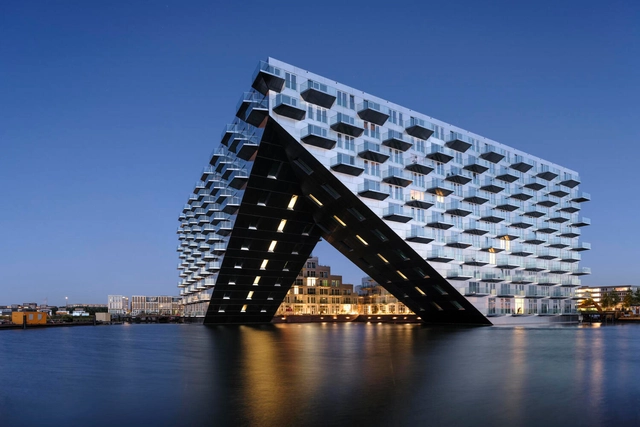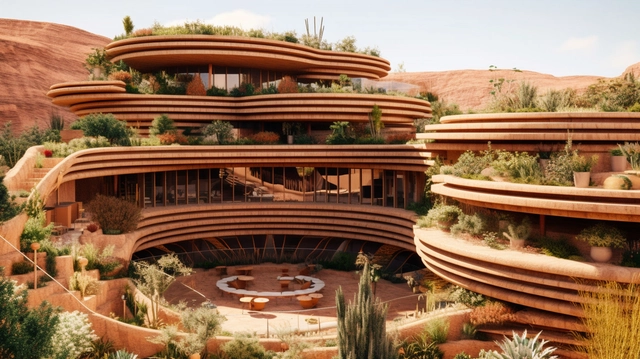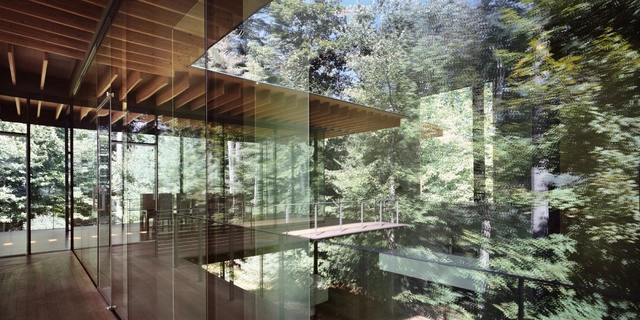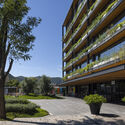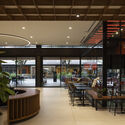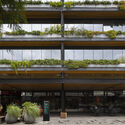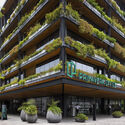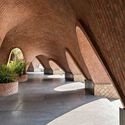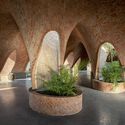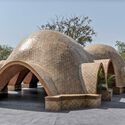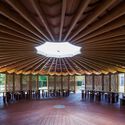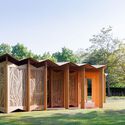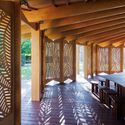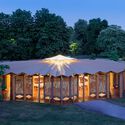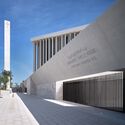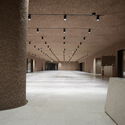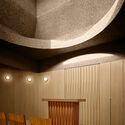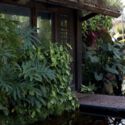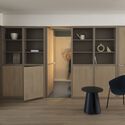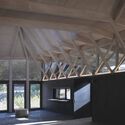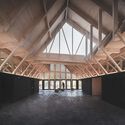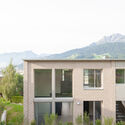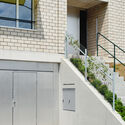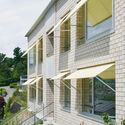
Armann Sports Club / PK Arkitektar
Architects: PK Arkitektar ehf
Location: Reykjavík, Iceland
Client: Reykjavík City / Ármann
Design team: Pálmar kristmundsson and Andrew Burgess
Consultants: Conis Engineers / VGK Engineers / RTLS Engineers / Línuhönnun Engineers
Constructed area: 7,725 sqm
Project year: 2007
Photographs: Rafael Pinho
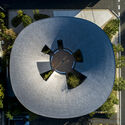
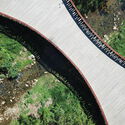
Bruggen de President / Drost + van Veen architecten
Architects: Drost + van Veen architecten
Location: Haarlemmermeer, The Netherlands
Project Architects: Evelien van Veen, Simone Drost
Client: Gemeente Haarlemmermeer
Structural Engineer: ABT Delft
Project year: 2006
Photographs: Jeroen Musch
BIG seeks Russian-speaking Project Leader for Kazakhstan Presidential Library
BIG is looking for a Project Leader to head up the BIG team responsible for developing the new Presidential Library in Astana, Kazakhstan, which we previoulsy featured in ArchDaily and got many comments from our readers.
The new library, named after the first President of the Republic of Kazakhstan, encompasses an estimated 33.000m2. Being one of the future cornerstones of Kazakh nation-building, and a leading institution that will represent the Kazakh national identity, the library goes beyond a mere architectural challenge.
The new Presidential Library in Astana, Kazakhstan’s new capital since 1997, shall not only accumulate history but also provide a foundation for new futures. It will serve as an intellectual, multifunctional and cultural center with the primary goal to reflect the establishment and development of Kazakhstan, its political history, and the Head of the State’s activities and roles in the development of the country.
Requirements after the break.
CASSA / TEN Arquitectos
Renowned mexican architect Enrique Norten (TEN Arquitectos) has been working in NY since a few years ago, with One York already built at SOHO & Tribeca. And with CASSA, his new 43-stories tall residential tower, he joins the city’s skyline.
The project includes 57 luxury residences and 166 hotel rooms, with interiors by Cetra/Ruddy, along with a 5 star restaurant, a spa, a private terrace and lounge, and other additional services.
The tower doesn´t look to find its place at the NY skyline with any “fireworks”, just a rigorous orthogonal volume with a character given by the punctured rhythm of its windows.
More images after the break.
NORD Architects wins new healthcare center competition

The young office NORD Architects has won the competition for a new healthcare center for cancer patients in Copenhagen, Denmark. The winning design is founded by principles of healing architecture and at the same time it suggests aesthetics which are in contrast with that of a conventional health institution.
The design is an elaboration on the recognizable contour and scale of a house. At the same time the design becomes an iconographic building, as the small individual houses are interconnected by a sculptural roof structure. The building is enriched by the close relation to the surrounding landscape consisting of an inner courtyard, several terraces and themed gardens.
The design will be realised in collaboration with Hellerup Byg, Bravida Danmark, Wessberg Ingeniører and Metopos Landscape. More images after the break.
Songzhuang Art Museum / DnA
Architects:DnA
Location:Songzhuang town,Tongzhou distant,Beijing, China
Program:Museum
Project year:2005-2006
Photographs:Savoye/Ruogu Zhou
Fishermen warehouses in the port of Cangas / Irisarri + Piñera
Architects: Irisarri + Piñera / Jesús Irisarri Castro & Guadalupe Piñera
Location: Cangas, Pontevedra, Spain
Client: Portos de Galicia
Engineer: Juan Antonio Rodríguez Pardo
Builder: C&C
Master Builder: Eva Fernández
Project area: 897 sqm
Urbanization area: 3,920 sqm
Design year: 2003
Construction year: 2005-2007
Photographs: Manuel Gonzalez Vicente
Slit House / EASTERN Design Office

Designed for an 80 year old woman, EASTERN Design Office’s Slit House, a reinforced concrete residential project, “presents her both a life space with a soft light and an interesting experience of scale unlikely in a house.” Situated in an old Japanese city on a site 50 meters by 7.5 meters, the home has long slits that run along a 22 centimeter thick wall, making the interior space open, while providing enough privacy.
More about the home and more images after the break.
CCA + SCU win 2009 Solar Decathlon, Architecture Contest

I just saw that the house designed by Team California, a multidisciplinary team from CCA + SCU, that we featured a few months won the Architecture Contest (1 out of 10 contests) at the US Department of Energy Solar Decathlon 2009.
By reading the jury’s comments, the project was highly acclaimed by two aspects: the inside/outside integration and the high quality of the project documentation.
On this integration, the house offers 700 square feet of decking that includes a large central courtyard and strategically placed openings which extend each living space to the outside, contributing to the overall feeling of spaciousness.
Clerestory windows and large sliding doors contribute to this integration, and is also part of the energy strategy, by bringing a high amount of natural daylight inside the house, minimizing the electric load. The interiors incorporates materials and products from individuals and companies that have demonstrated their dedication to sustainable practices, and others such as a lamp made from plastic drinking straws. Reclaimed California redwood rainscreen covers the house’s exterior, providing a warm hue and varied texture.
You can see more photos of the house at their CCA + SCU Refract House Flickr page, and read the full description of the project on our previous feature.
Low2No Competition: Helsinki’s sustainable future
City as Living Factory of Ecology, winning entry by ARUP, Sauerbruch Hutton, Experientia and Galley Eco Capital.
In my opinion, the best sustainable projects have been in small scales. Urban scale projects have been more difficult to get going, due to the their inherent complexity.
But I am confident that recent initiatives are about to make the step forward, specially the ones that are being produced on countries that have the have their governments focused on this.
On of this examples is the recently awarded Low2No design competition, organized by Sitra (Finnish Innovation Fund) and the City of Helsinki, to find a on design a large building complex on a reclaimed harbour at the western edge of Helsinki’s central business district.
Given that the repertoire of sustainable urban development models is still in its infancy, the question of “who & how” is our question of first order. WHO: We believe that identifying the best team and approach is the key factor impacting the robustness of the final solution. HOW: Our competition is designed to seek approaches for four central objectives applied at the scale of a city block:
- low- and one day no- carbon emissions
- energy efficiency
- high architectural, spatial and social value
- sustainable materials and methods
The finalists included top practices and consultants such as ARUP, Sauerbrunch Hutton, Space Syntax, Transsolar, ARO, REX, Front, BIG, among others. The award went to C_Life by ARUP, Sauerbruch Hutton, Experientia and Galley Eco Capital.
Videos and boards for the winning and finalists entries after the break.
Vertical Village / Graft Lab
Graft Lab’s latest addition to Dubai, entitled Vertical Village, is a cluster of mix-use buildings that emphasize reducing solar gain and maximizing solar production. The buildings are self-shaded on the northern side and on the east-west axis to reduce long-angle sun penetration. Solar collectors on the south end automatically pivot to maximize solar-energy aggregation. The multi-use building, which is expected to earn a LEED Gold Certificate, offers an appealing aesthetic which will easily make its mark 0n Dubai’s dynamic skyline. The “futuristic” angular forms create a shared central space with large pools, while the compositional assemblage of the individual buildings form a cohesive whole.
More images after the break.
2014 Incheon Asian Games Main Stadium / Populous
The competition-winning design of the main stadium for the 17th Asian games in Incheon, in South Korea, illustrates a new level of sustainable design in stadia in Asia. The stadium will hold 70,000 people for the main event in 2014 and will reduce down to a single sided grandstand for 30,000 afterward as a People’s Park for the city of Incheon. The global architecture firm, Populous, formerly HOK Sport Venue Event, is designing Incheon stadium with local firm Heerim Architects and Planners.
More information at Bustler. More images after the break.
UN Memorial / ACME

London-based architecture firm ACME was awarded third prize in a recent competition to design a United Nations memorial. Initiated by the city of Chungju in South Korea, the selected memorial will rest in the city’s UN Peace Park. ACME’s proposal is comprised of a 1,500 seating assembly, two conference halls, a theater and exhibition spaces. The organization of the memorial is metaphorically modeled similarly to the United Nations, where many parts make up the whole.
More about the memorial after the break.
Hye Ro Hun / IROJE KHM Architects
Architect: HyoMan Kim – IROJE KHM Architects
Location: Gwangju, Jeonnanam-do, Korea
Design team: SuMi Jung
Site area: 594 sqm
Bldg. area: 168.63 sqm
Gross floor area: 269.07 sqm
Photographer: JongOh Kim
Gjerdrum Secondary School / Kristin Jarmund Architects
Architects: Kristin Jarmund Architects
Location: Gjerdrum, Akershus, Norway
Principal in Charge: Kristin Jarmund
Project Architect: Geir Messel
Project Team: Line Strand int.arch. , Arild Eriksen siv..ark. MNAL, Francis Brekke siv..ark. MNAL, Nora Müller Dipl. Ing Arkitektur, Karin Anton Dipl. Ing. Arkitektur
Building Type: Secondary School
Client: Gjerdrum Kommune
Project Area: 3,900 sqm
Project year: 2009
Photographs: Rune Stokmo, Sonja Middelhuis
T-Clinic / Suppose Design Office
Architects: Suppose Design Office
Location: Kure city, Hirosihima, Japan
Program: Clinic
Site area: 228.74 sqm
Building area: 172.50 sqm
Total floor area: 498.33 sqm
Photographs: Toshiyuki Yano from Nacasa&Partners Inc.
Aurora Pavillion for Shanghai World Expo 2010
Chinese jade culture through its 8,000-year history will take center stage at the Taiwan-based Aurora Group’s Expo 2010 Pavilion. Jade symbolizes the national character such as gentleness, perseverance and the pursuit of peace, and the Expo will provide a platform to help promote such hopes, Tan Baijuan, deputy director of the pavilion, said yesterday while unveiling the design.
The pavilion will feature rare exhibits such as a piece of 2.5-ton jade and Beijing Olympic medals made of fine jade from the Kunlun Mountains in Northwest China’s Qinghai Province.
The theatre inside the pavilion will show Chinese myths and about 30 rare jade relics from the Aurora Museum will also be exhibited. The biggest challenge now is to squeeze the soul of jade’s history spanning thousands of years into a short journey of 20 minutes, said Tan. More images after the break.
NZI Centre / Jasmax
Architects: Jasmax
Location: Auckland, New Zealand
Client: IAG New Zealand
Building Owner: M6 Investments
Project Area: 9,250 sqm
Project Completed: 2009
Photographer: Simon Devitt
AD Interviews: Michael Kubo on Architectural Publishing
For the past month, Boston’s experimental design exhibition space Pinkcomma Gallery has hosted Publishing Practices, an exploration of architectural publishing throughout the last century. Designed by architect and editor Michael Kubo in conjunction with gallery directors (and fellow architects) Mark Pasnik and Chris Grimley, the exhibit provides an in-depth look into the relationship between reading, writing, and design.
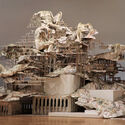
I spoke with Michael Kubo about the exhibit and its history.
Designing Learning Environments to Rebuild Urban America
Rebuilding national infrastructure will drive U.S. economic recovery, and architects are critical to the effort to build and modernize our most basic source of future intellectual capital: our schools. “Designing Learning Environments to Rebuild Urban America” will explore the best opportunity in generations to strengthen educational facilities—with architects at the forefront.
New York City schools will be our living laboratory to examine history, trends, and innovations—both in construction and in educational theory and practice. Design professionals and educators will explore common ground and emerge with strategies to create learning environments that are both practical and inspiring. School tours will further inform our findings and help to foster a continuing dialogue.
Seen at Bustler. For more information, click here.