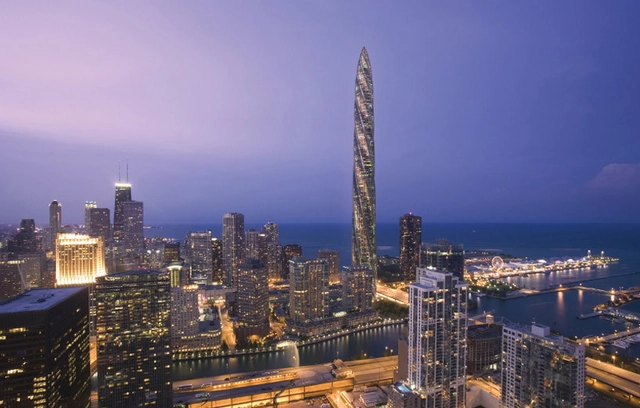
Cloaked in financial woes, what was intended to be the tallest skyscraper in the Western Hemisphere has remained a stagnate hole in the Chicago cityscape since the height of the crisis. However, the fate of the Santiago Calatrava-designed luxury condominium may be about to change, as developer Garrett Kelleher is actively seeking court approval to reinstate the project with a $135 million investment from Atlas Apartment Holdings LLC. More on Chicago's 2,000-foot “twisting" spire latest update here on the Chicago Tribune.
Videos
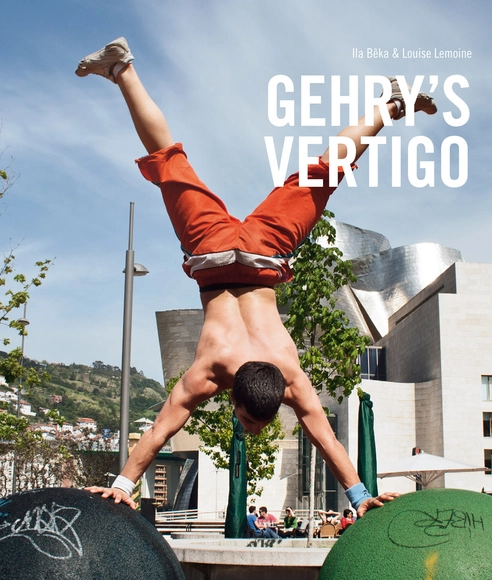
Gehry's Vertigo. Image Courtesy of Living Architectures
This time last year we published our 30 Architecture Docs to Watch in 2013featuring a fantastic range of films telling the tales of some of the world's greatest unsung architectural heroes. We now bring you eleven more for 2014, looking past the panoply of stars to bring you more of the best architectural documentaries which will provoke, intrigue and beguile.
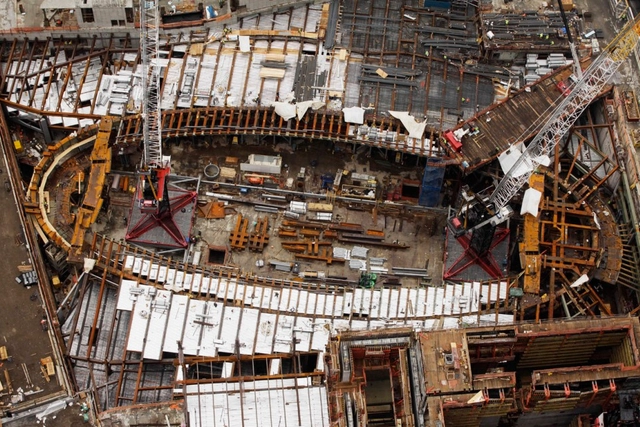
Slowly, and surely not lacking critique, Santiago Calatrava's transport hub rises $2 billion over budget, SOM's Freedom Tower — now, more mundanely referred to as 1WTC — is recognized as the tallest building in the western hemisphere and there is still a considerable amount of development yet to be done on the World Trade Center. Read Edwin Heathcote's article on the Financial Times regarding the good, the bad and the ugly: "Rebuilding the World Trade Center: A Progress Report."
https://www.archdaily.com/466153/world-trade-center-progress-report-the-good-the-bad-and-the-uglyJose Luis Gabriel Cruz
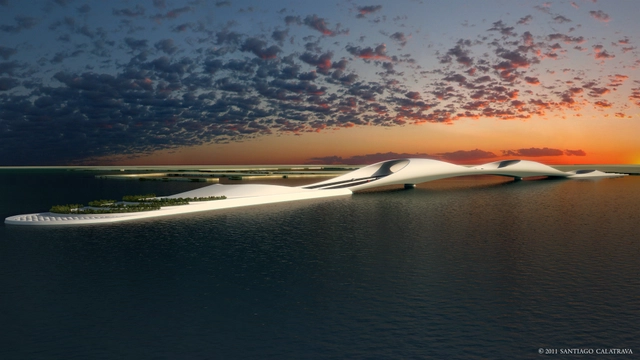
Located in Doha, Sharq Crossing is a set of three interconnected bridges spanning almost ten kilometres in the Doha Bay. Designed by the famed architect Santiago Calatrava, the bridge will connect the city's cultural district in the north to Hamad International Airport and the central business district in West Bay. The bridges, which are designed to accomodate as many as 2,000 vehicles an hour per lane, are also flanked by a series of subsea tunnels to manage and direct the flow of traffic across the bay.
https://www.archdaily.com/461793/calatrava-s-sharq-crossing-planned-for-doha-skylineKatherine Allen
The Grand Opening of the Santiago Calatrava: The Metamorphosis of Space exhibition took place on Wednesday, December 4th in the monumental spaces of the Braccio di Carlo Magno. The exhibition will be open until February 20, 2014.
The exhibition, sponsored by the Vatican Museums and the Pontifical Council for Culture, and curated by Micol Forti (Curator of the Collection of Contemporary Art of the Vatican Museums), presents a collection of approximately 140 works of art to the public, showing the complex and multiform artistic productions of the famous Spanish architect and engineer.
The selected core of architectural models is accompanied by the corresponding preparatory studies, but also by watercolor paintings, which were generated by a creative inspiration completely independent from the genesis of the same projects. In addition, there is a rich anthology of sculptures, both monumental and in a more reduced size, made out of bronze, marble, alabaster, and wood.
The combination of works pertaining to different artistic codes, although closely related, directs the observer's gaze to different levels of interpretation of the architectural volumes, and of the vision of space and shapes, typical characteristics of Calatrava's artistic path. More after the break.
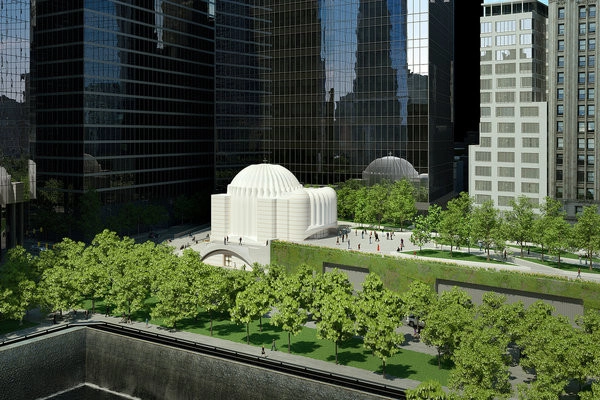
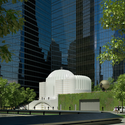
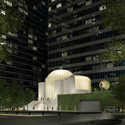
The site of 9/11 has seen significant change in the last decade, from the addition of David Childs’s redesign of the One World Trade Center to Santiago Calatrava’s PATH station. It looks like the site’s transformation is set to continue - Calatrava recently revealed images of the new St. Nicholas Greek Orthodox Church, to be rebuilt across Liberty Street from Handel Architects’ September 11 Memorial. The images, showing a distinctly Orthodox Christian design, have already begun to attract criticism in the debate over placing religious institutions around the World Trade Center.
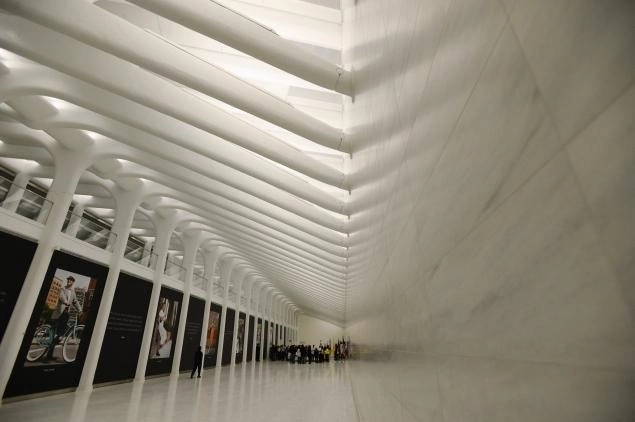
A portion of Santiago Calatrava’s $4 billion PATH station has opened. According to NY Daily News, the Western Concourse will now relieve New Yorkers from “cramped sidewalks and temporary bridges” crossing West St. with a 600-foot underground passage lined in “bright white marble” that connects the World Trade Center to the neighboring office complex formerly known as the World Financial Center. Once complete in 2015, the controversial transit hub will double as a massive shopping and retail complex, which aims to “transform” the cultural experience of lower Manhattan.
The World Trade Center Complex in Lower Manhattan is slowly progressing, now more than a decade after 9/11. The Memorial was unveiled on the ten-year anniversary of 9/11, while the Freedom Tower is well on its way to completion, proudly displaying the spire that was mounted just a few weeks ago. The site still is - and will be for many years to come - a maddening array of construction equipment, scaffolding and cranes that are working busily at the various components of WTC's rebuilding. Yet while all this development is moving forward, the cost of the construction is ballooning.
According to an article in The Observer, the site now boasts one of the most expensive office buildings in the world - the Freedom Tower - and one of the most expensive parking garages in history - the Vehicle Security Center. And to add to this grandiose display of New York City's perseverance over tragedy, Santiago Calatrava's Transit Hub - Port Authority's PATH station to New Jersey - has become an exceedingly controversial point of contention for its skyrocketing budget, now reported at $3.47 billion still two years away from completion. This may be one of the most expensive transportation hubs in the world, considering that its passenger volume does not justify this expense as much as its location might.
The architect and engineer Santiago Calatrava has once again made the headlines of Spanish papers - and, once again, for less than favorable reasons.
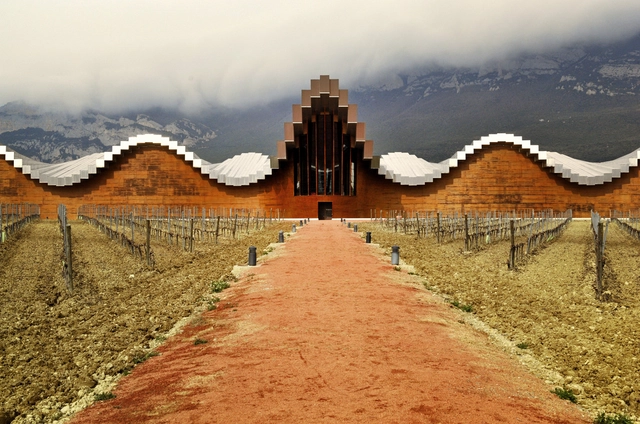
Calatrava's latest controversy is a lawsuit filed against him by the famous Bodegas Domecq winery, property of the Ysios Laguardia in Rioja, Spain. Both the Valencian architect as well as those involved in the winery's construction are being asked to pay two million euros to the winery, a sum that should help cover a renovation as well as the costs the winery has incurred over the last two years fixing the structure's leaky roof. The owner claims that the leaks have been creating a damp atmosphere (in a building where moisture control is critical for the quality of the wine) and thus damaging his business.
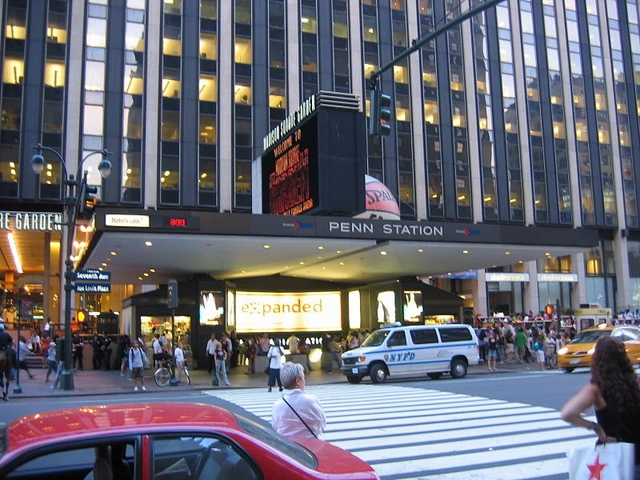
In an effort to “unlock people’s imaginations” about Penn Station and Madison Square Garden, the Municipal Art Society (MAS) of New York has challenged Santiago Calatrava, Diller Scofidio + Renfro, SHoP Architects and SOM to propose four new visions that exemplify the potential of the highly disregarded area.
The challenge comes amidst a heated debate on whether or not the city should restrict Madison Square’s recently expired special permit to 10 years, rather than in perpetuity as the arena’s owners - the Dolan family - has requested. This would allow time for the city to “get it right” and come up with a viable solution for the arena and station that would not only “improve the safety and quality of life for millions of people but also benefit the economy”. Think Kings Cross in London. With a thoughtful mix of public and private investments, the crime-ridden transfor station was transformed into a thriving cultural destination.
Praised for his masterful blends of architecture and engineering, yet criticized for rarely sticking to a budget, Valencia-native Santiago Calatravais no stranger to controversy. His latest project making headlines is the largest landmark in Valencia and the second most-visited cultural complex in Spain: the City of Arts and Sciences.
We live in the world of a sad separation that began some five hundred years ago when art and science split apart. Scientists and technicians live in their own world, focusing mostly on the “how” of things. Others live in the world of appearances, using these things but not really understanding how they function. Just before this split occurred, it was the ideal of the Renaissance to combine these two forms of knowledge. This is why the work of Leonardo da Vinci continues to fascinate us, and why the Renaissance remains an ideal.
So why did Santiago Calatrava, now one of the world’s elite architects, decide to return to school in 1975 for a civil engineering degree after asserting himself as a promising young architect?
With last year’s opening of the 9/11 Memorial at Ground Zero and the near-completion of the World Trade Center One, Daniel Libeskind’s vision for the World Trade Center site is close to presenting the future of NYC’s downtown financial center, 11 years after the attacks. Studio Daniel Libeskind was selected to develop the master plan for the site in 2003, and since has been coordinating with NYC’s numerous agencies and individual architects to rebuild the site. The project, in Libeskind’s words, is a “healing of New York”, a “site of memory” and “a space to witness the resilience of America”.
Follow us after the break for more on the elements and progress of the master plan.
The London 2012 Olympics start today, and once again architecture is on the spotlight. With a big focus on reusable and adaptable structures, the lineup includes renowned architecture firms such as Wilkinson Eyre Architects, Hopkins Architects, Populous and Zaha Hadid Architects.
Today marks the opening of world-renowned architect, Santiago Calatrava’s unprecedented exhibition at the State Hermitage Museum in St. Petersburg, Russia. Not only will Calatrava become the first contemporary architect to have a retrospective exhibition at the Hermitage, but this will also be one of his largest and most extensive exhibitions to date. Curated by Cristina Carillo de Albornoz and Ksenia Malich, the exhibition will examine Calatrava’s innovative style through his various artistic realms. From never-before-seen paintings and sculptures to celebrated architectural models and sketches spanning Calatrava’s 30- plus year career, the exhibition will give individuals a unique opportunity to explore the inner workings and creative process of this celebrated artist. More images and information on the event after the break.
Heroic. Contemplative. Grieving. Victorious. The rebirth of the former World Trade Center site in lower Manhattan has engendered significant public reaction and reflection. With implications as complex as they are profound, it is not surprising that it has taken more than a decade to heal the urban scars of September 11, 2001.
I had the rare opportunity to sit down with three architects working on the site, Santiago Calatrava, David Childs, and Daniel Libeskind, at the recent American Institute of Architects convention in Washington, D.C., where they were honored along with four others, as “Architects of Healing.” We discussed their experience of reshaping one of the most culturally significant sites in the history of the United States.
Designed by renowned architect, Santiago Calatrava, the new Innovation, Science & Technology building at Florida Polytechnic University will establish the design scheme for all other structures within the campus’ master plan, which Calatrava is also responsible. Until the other structures within the master plan are built, the new Innovation, Science & Technology building, which just broke ground in March will also need to function as the campus itself; being able to accommodate various events and functions. More images and architects’ description after the break.




.jpg?1361402796)


