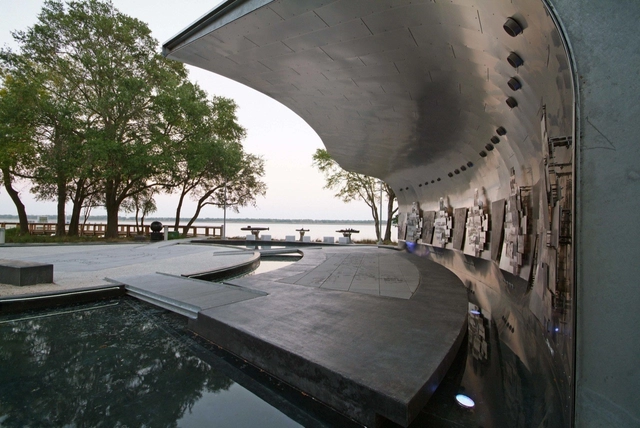
Israel’s government, with the agreement of the Russian government has proposed erecting a monument to mark the Red Army’s victory over Nazi Germany. Taking on the design challenge, TheHeder Partnership draws your eyes to the horizon as you are overcome with openness and freedom and the spirit of the moment of victory. More images and architects’ description after the break.
Commissioned by former Yugoslavian president, Josip Broz Tito in the 1960s and 70s to commemorate sites where WWII battles took place, these now forgotten structures stand empty and without the significance it once had decades ago. Designed by different sculptors and architects, the strong and powerful blending of art and architecture come together in these monuments to convey the sense of confidence and strength of the Socialist Republic. However, after the Republic gradually died down in 1992, they lost their sense of wonder and no longer attracted the millions of visitors a year. More images after the break.
As part of his series dealing with forgotten monuments from the communist era in Bulgaria, Nikola Mihov has shared with us his story and photos of the many iconic communist era monuments in Bulgaria that were dismantled after the fall of the totalitarian regime in 1989. Nevertheless, more than one hundred important monuments built between 1945 and 1989 remain standing. The majority of these sites are not recognized by the state and they remain ownerless. Their exact number is unknown and it is difficult to find information about their authors and their history. More images and his story after the break.
Australian architects David Neustein and Adi Atic shared with us their proposal for the Atlantic City Holocaust Memorial Competition. See more images and architect’s description after the break.
Architects Ariel Noyman and Ruth Kedar shared with us their proposal for the Atlantic City Holocaust Memorial Competition. More images and architect’s description after the break.
The bicentennial torch, designed by José Pareja Gómez and Jesús Hernández Martínez, is inspired by the mural depicting the social struggle of Mexican independence by Jose Clemente Orozco in which the leader of the independence, Don Miguel Hidalgo y Costilla, leading the insurrection by tightly grasping a flaming torch. The structure manifested from this image by the architect is a 45-meter tall element emphasizing the main entrance into León, Guanajuato, México.
Raphael França and Adrien Mondine have submitted their competition entry for a multicultural cemetery in Järva, Stockholm, Sweden. The challenge and aim of the competition was to develop a place for remembrance and reflection for all on a site already embedded with societal values. The chosen site has an interesting past: an artificial hill was created as a result of the dumping of construction debris from neighboring housing projects in the 70s and 80s, it was then dominated by frisbee players as the one of the most frequented sites in Sweden.
More information on the project and images after the break.
Why would this building be abandoned when at one point it was such a significant symbol for the country? Buildings such as this that have been left to stand alone are calling out for architects to intervene and come up with well thought out solutions while being sensitive to its historical significance. At one time, the Buzludzha Monument, designed by Gueorguy Stoilov, was the most celebrated monument dedicated to the sociopolitical movement of communism. Now, in the mountains of Buzludzha National Park in Central Stara Planina, Bulgaria, stands an abandoned communist concrete structure right in the middle of the country taking on a “flying saucer” in appearance. What should be done with buildings that have been abandoned all over the globe? Now is the time to think critically and discover the possibilities. More images and after the break.
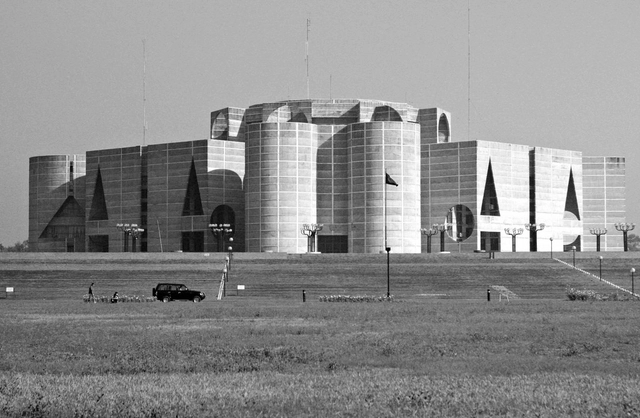
Modernist architecture is traditionally understood to be utilitarian, sleek, and most of all without context, such that it can be placed in any context and still stay true to aesthetic principles and its functional requirements. However, Louis Kahn’s National Assembly Building of Bangladesh in Dhaka is an extraordinary example of modern architecture being transcribed as a part of Bangali vernacular architecture. The National Assembly building, completed in 1982, stands as one of Kahn’s most prominent works, but also as a symbolic monument to the government of Bangladesh.
Our friends from NRJA (be sure to view previous NRJA projects on AD, especially their 2009 Building of the Year House) shared their finished competition entry for a cemetery in Järva Common, Stockholm with us. Designing a cemetery is a difficult challenge as it is a place filled with symbolic importance and infused with a commitment to offering hope. The architects decided that this new cemetery will provide a place where the identity of the site is defined not only by the environmental quality of the space and its historical importance, but also by the project’s emphasize on concentration on the memory of the deceased.
More images and more about the project after the break.

















.jpg?1441138553&format=webp&width=640&height=580)
.jpg?1441138106 "© Laurian Ghinitoiu")
.jpg?1441138131 "© Laurian Ghinitoiu")
.jpg?1441138429 "© Laurian Ghinitoiu")
.jpg?1441138529 "© Laurian Ghinitoiu")
.jpg?1441138553)