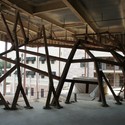
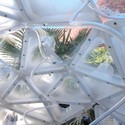
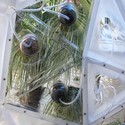
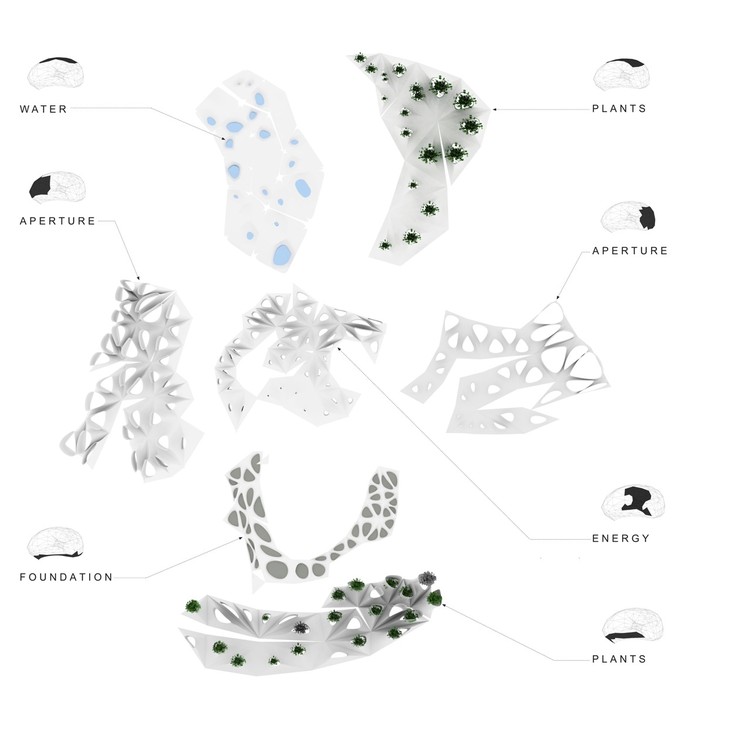
Bayou-luminescence, one of ten site-specific installations commissioned by the New Orleans chapter of the American Institute of Architects, was a collaboration between Igor Siddiqui, the principal of the Austin-based design practice ISSSStudio and Matt Hutchinson, the principal of San-Francisco-based firm PATH. The project was included as a part of DesCours, the annual architecture and art event on view at various locations in city from December 2 through 11, 2011. More images and architects’ description after the break.
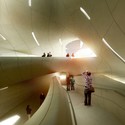
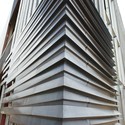
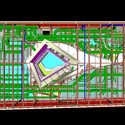
The Louisiana State Museum and Sports Hall of Fame (LSMSHOF) celebrates two seemly disconnected subjects within one contemporary venue, combining North Louisiana’s profound history with its influential world of sports. Designed by Trahan Architects, in coordination with Method Design and CASE, the new $12.6 million venue will house donated memorabilia that embodies “the contributions of the diverse cultures that have shaped the state and are crucial to understanding the unique traditions and legacy of Louisiana and the Gulf South.” A complex design, generated with the help of BIM technology, reflects the disparate subjects in one fluid structure encased within a locally inspired facade.
DesCours is a free, public, ten-night architecture and art event now in its fifth year, held December 2-December 11 in New Orleans.
This event invites internationally renowned architects and artists to create architecture installations within ‘hidden’ locations in the heart of New Orleans, including private courtyards, rooftops, abandoned buildings and walkways, all locations normally unseen, inaccessible or unused by the public.
Check out a preview we spotted on PublicInterestDesign of Tulane University’s School of Architecture URBANbuildprogram, a total collaborative effort of “individuals, organizations, and businesses committed to revitalizing New Orleans’ rich cultural and architectural heritage.” Working with Professor Byron Mouton, Make It Right and Neighborhood Housing Services of New Orleans, students have designed and built several LEED-certified homes such as URBANbuild 04 featured in the clip. This particular residence is situated in Central City of New Orleans and completely breaks with the traditional “shotgun homes” that line the streets. The young homeowner, Tami, appreciates the students’ talents and abilities to go beyond what the neighborhood, and even the city, is comfortable with to create a new urban identity. Challenged by Mouton to introduce new ideas, the students have created a beautiful residence that they can certainly be proud of and one that Tami loves View her story and a bit of the project’s journey in the video.
Tulane School of Architecture has announced their 2011-2012 school year lecture series featuring Rafael Moneo, Billie Tsien, Adam Yarinsky and others, including a string of lectures on Urban Innovations co-sponsored by The Murphy Institute. More information on the lectures after the break.
Lamar Advertising Headquarters, as designed by Eskew+Dumez+Ripple, is a reaction against the standard office environment; it is a collaborative administrative center, a proposal planned to strengthen a culture of openness. This refurbishment of a 1970’s office building reinvented a segmented office plan into a communal arena to connect colleges and contribute to the communicating whole.
More of Lamar Advertising Headquarters after the break.
Every year, the AIA stages a competition for an intervention that brings to life the historic city of New Orleans. This year the institute selected a scheme by Gernot Riether that proposed a series of glowing spherical enclosures sited within the hidden courtyards of the city’s distinctive French Quarter. They would be illuminated in the evening, dramatically modulating the host environment and bringing attention to these romantic, mysterious and usually private spaces, typically located deep in the block, away from the street.
Scheduled for demolition in Summer 2011, the Phillis Wheatley Elementary School is a treasured piece of regional modernism in New Orleans. Designed by Charles Colbert, the school has served the historic African-American neighborhood of Tremé since it opened in 1955. It is just one of over thirty public schools that were constructed at that time. These schools were designed by architects who practiced a regional modernism, incorporating innovative design for circulation, ventilation and lighting. Of the thirty schools only four are still standing, three of which are threatened with demolition (including Phillis Wheatley). DOCOMOMO Louisiana is advocating for the restoration through adaptive reuse for the Phillis Wheatley Elementary School. “A Plea For Modernism” was created by Evan Mather and is narrated by actor Wendell Pierce.
Hosted by Design By Many, the Passive House for New Orleans competition challenged designers to design a single-family dwelling that is sustainable in the broadest sense of the term: affordable to build and purchase, long-lasting, with minimal impact on the local environment, and affordable to heat and cool throughout the life of the building.
The winning proposal, designed by sustainable.TO, is based on the vernacular shotgun typology. The affordable, low-energy, single-family low cost, low energy house will help to revitalize the existing neighborhood of the Lower Ninth Ward. More images and architects’ description after the break.
The AIA New Orleans welcomed a record number of entries for the 2011 Design Awards, 100 Years of Excellence in Design. The categories included Interior Architecture, Master Planning, Divine Detail, Project, Architecture, Adaptive Reuse, and Juror Favorite. A complete list of the 2011 AIA New Orleans Design Awards and jurors comments following the break.
Thursday, May 5th the Ogden Museum of Southern Art will host the AIA New Orleans Member Preview Event for two architecture exhibitions, Elemental and New Orleans Architecture Now. Both exhibitions will open to the public on Saturday, May 7, and remain on display through Friday, May 13 during the 2011 AIA National Convention. To register and for more details of the event can be found here.
Architects’ Week is a longstanding tradition of the Tulane School of Architecture as a weeklong, design and build, group project. It is a unique occasion for students to work not only with a proven designer, but also with fellow students. The exact form that it takes varies from year to year. In 2010, A-Week groups created information kiosks for New Orleans. The year before was an exploration in rethinking the bench. This year the project brief was a bit different. The project brief, images and descriptions of each student project and the winning design after the break.
Using their award-winning campus master plan as a guide, the new international school in Baton Rouge, LA designed by Trahan Architects has just entered into the schematic design phase. The facility will be comprised of a gymnasium, stage, classrooms and an administrative suite. After interviewing Trey Trahan and being introduced to several of his projects, it is evident that the firm’s emphasis on understanding the context, in terms of both built form and culture, continually provides the backbone for their design process.
We have received an update on the design of the Baton Rouge Downtown Library by Trahan Architects, which clarifies several aspects of the circulations, the relation with the surroundings and details of the facade.
The facade looks very interesting, and on the diagrams you can see how the exterior envelope varies along the elevation to achieve the folded paper like look. A detail of the section reveals further information about this.
All the diagrams/drawings, courtesy of Trahan Architects, after the break.
Louisiana based Trahan Architects, a firm with expertise in institutional design and religious architecture (check the Holy Rosary Church Complex, remarkable project), recently unveiled conceptual design for the renovation and expansion of the River Center Branch Library.
The project stands at the intersection between civic buildings and the city’s arts and entertainment district, overlooking a new town square. This new building becomes an urban piece, exposing the interior activity to the outside with a rippled translucent skin. But also the library takes care of the exterior, with reading areas and a urban patio.
As with changes on how people consume information, the typical library approach as a storage/reading facility gets obsolete. In response to this, the project is a public place for gathering and sharing around information, with circulation patterns that place stationary structures in the center of the floors and create space for staff and patron interaction, with movable parts and multiple paths along the perimeter.
During this days, the changes of information trough technology challenge library designs, while offering an opportunity to become important public spaces among our cities. In this way, I think this concept has a good start.