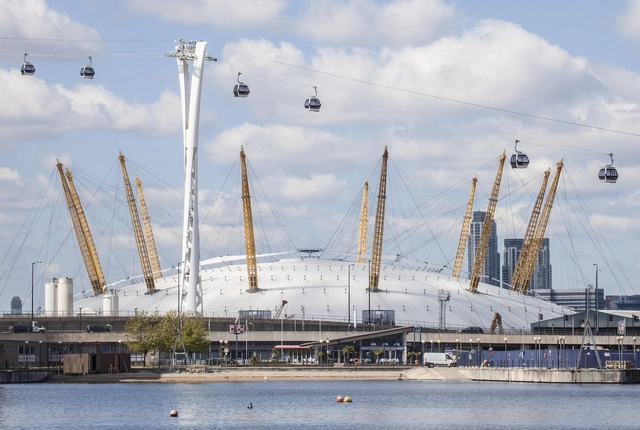
Tonight, Renzo Piano’s Shard will officially celebrate its opening complete with an amazing light show. A dozen lasers and thirty searchlights will beam streams of light across the city, creating a network between 15 other significant landmarks in London, such as the Gherkin, London Eye, Tate Modern, and Tower Bridge. (So, if you are in London, don’t miss the event at 10.15 this evening, and be sure to share some photos with us!)
Capping out at 310 meters, the Shard has become the tallest building in London, as well as the entire European Union. We have been following the history of Renzo Piano’s creation, and although laden with financial troubles, a change in developers, and criticism from Londoners, the project has finally reached completion.
More about the history of the tower after the break.
Is it the perfect blend of sculpture and engineering, or it is a twisted form of nonsense? Opinions are quite varied on the subject of Anish Kapoor and Cecil Balmond’s observation tower, ArcelorMittal Orbit, which will serve as a permanent reminder of London’s hosting of the 2012 Olympic Games. The red steel structure will rise close to 400 feet – taller than New York’s Statue of Liberty and London’s Big Ben – to be Britain’s largest piece of public art. Criticized for undertaking such a massively expensive project during the country’s recession, London Mayor Boris Johnson has claimed that the Orbit will not only enhance visitors’ experiences at the Olympic Games but will also be “the right thing for the Stratford site” beyond the summer time, calling on its potential to become ”the perfect iconic cultural legacy”.
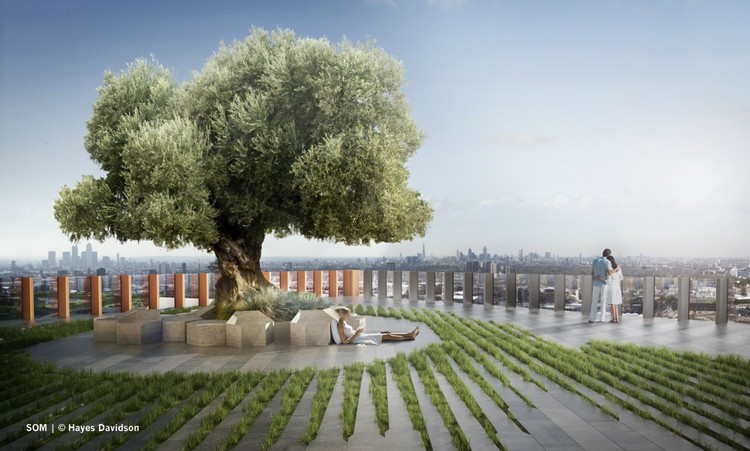
A triple height entrance lobby will welcome visitors to a world-class hotel, two restaurants, three sky gardens and a 248 unit residential tower, all with stunning views over Olympic Park. These are some of the key features offered in the newly unveiled plan for the 42-storey Manhattan Loft Gardens in London, designed by Skidmore, Owings & Merrill (SOM). It is planned to be built near the Stratford International Station – the gateway to the 2012 London Olympics. Completion is scheduled for 2014.
From next Friday 22nd will take place the AA Projects Review Exhibition. The place of the event is located in the Architectural Association’s main building at 36 Bedford Square, London WC1B3ES.
Projects Review offers an overview of the AA’s 2011/12 acadamic year. On display are hundreds of drawings, models, installations, phogographs and other materials documenting the diversity and experimental nature of the AA School.
‘At the AA architecture is pursued as a form of cultural knowledge, across year-long design projects and portfolios. We believe that truly great schools don’t just nurture and support architectural talent: they build audiences for experimentation, out of which new architectural ideas, visions and projects emerge. Please join us as part of this audience, which the AA remains committed to promoting at the cutting edge of architectural cuture, practice and learning.’
The access to this Friday event required invitation but will be free the rest of the days until 14th July.
The 244th annual Summer Exhibition at the Royal Academy of Arts, which is held until August 12, features a site specific architectural installation designed by architect and artist Chris Wilkinson, Director at Wilkinson Eyre Architects. Positioned in the center of the RA’s Annenberg Courtyard, From Landscape to Portrait is a 12 meter-long sculpture based on a series of 11 wooden artist’s frames, supported upon a timber structure clad in polished stainless steel. More images and information on the installation after the break.
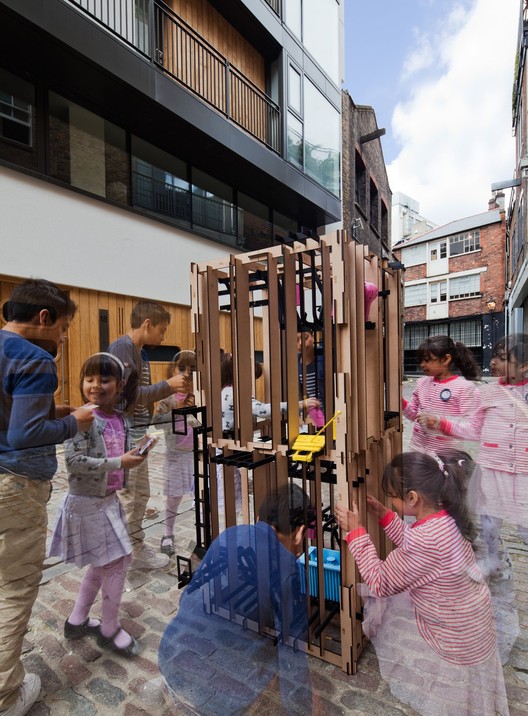
The concept for the ToyBox, a portable installation by Studio Gil , focuses on being a giant toy box for children. A 1500mmX750mm box frame supports three “landscapes” at different heights. These “landscapes” act as a surface and support frame for a series of interactions and games accessed through a screen running along the perimeter of the box. More images and architects’ description after the break.
Taking place June 19th at 7pm at RIBA in London is the Do Architects Help? event which will examine the role that the UK built environment industry plays in overseas development. This London Festival of Architecture discussion, sponsored by Dunbar & Boardman, and put on by Article 25, emphasizes that in a world that is becoming increasingly urban and populous, architects and other built environment professionals are well placed to use their specialist knowledge and skills to influence development policy and help communities better prepare for and recover from disasters. Despite this their expertise is largely lacking for mainstream international development practice. For more information on the event, please visit here.
As reported on bdonline, Zaha Hadid is currently the preferred suitor for the London’s Design Museum. The Pritzker Prize winning architect has apparently wooed the sellers with her plans to turn the 1950s building into an architecture museum. She has reportedly teamed up with a private backer and is one of eight pursuers for the Design Museum, which will be relocating into a new home in 2014.
Like no other style, Art Deco represents a built manifestation of the interwar period’s enthusiasm and splendor. In London, buildings of this era reflect the elegance, progress and assertiveness that describe the modern metropolis age. Even today, these buildings have lost none of their aura and appeal, yet they lack any proper documentation.
Together, Niels Lehmann and Christoph Rauhut have worked tirelessly for the past three years researching and photographing London’s architectural Art Deco heritage. With your help, they will feature over 230 buildings with large-scaled photographs in the soon-to-be published book “Modernism London Style.” Follow this link to become a supporter and learn more.
While many buildings try to go Green these days, few attempt to do so literally.
Last week, York Minster Abbey, one of the largest Gothic Cathedrals in Europe, was decked out with 1,500 square meters of – what else - grass.
The occasion for the makeover, the York Minster Rose Dinner to celebrate Queen Elizabeth II’s Diamond Jubilee (which we marked with a post on Britain’s Built Legacy), hosted about 900 people to raise funds for the York Minster Fund. And with £150-a-head tickets, sold months in advance, perhaps we’ll start seeing other Gothic Cathedrals turn green too (and not just with envy).