Last night, ArchDaily indulged in building our very own LEGO® Architecture Villa Savoye. As one of the most influential buildings in the International style of architecture, it is no surprise that architecture and LEGO fanatics rejoiced last month when LEGO® announcedLe Corbusier’s Villa Savoye as the newest addition to their architecture series. Now, thanks to LEGO® Architecture, five of our readers will win their very own.
We want to know what building should be the next in the LEGO® Architecture series and why. All you have to do is become a registered user at ArchDaily and leave us your answer in the comments below by Sunday, September 23rd! (More information on LEGO® Architecture’s Villa Savoye, designed by architectural artist Michael Hepp, can be found here.)
Official rules:
The five winners will be chosen at random from entries received between Monday, September 17th and Sunday, September 23rd 11:59 EST. You must leave a comment as a registered user at ArchDaily. Open to anyone in the world. One entry per person. ArchDaily will enforce verification and remove duplicated ones before choosing the winner.
Good luck!
UPDATE: And, the winners are….
Seth Ellsworth
Wonyeop Seok
Daniel Bollard
Makoto Shibuya
Mark Kitchens
Congrats! You can expect an email from us shortly.
LEGO® has just announced the newest classic building to join the collection of renowned architectural replicas in their Architecture series, the Villa Savoye, designed by Le Corbusier. Capturing the essence of the modernist villa, the small scale replica also makes sure to touch on Corbusier’s well-known ‘five points’. One of the most easily recognizable and renowned examples of the International style, the LEGO version will be available September 1 at a suggested price of $69.99.
Lying on the outskirts of Paris, France, Villa Savoye was designed as a private country house in 1931 and quickly became one of the most influential buildings and cemented Le Corbusier’s reputation as one of the most important architects of the 20th century. More images after the break.
By invitation of Director David Chipperfield, MVRDV and The Why Factorywill participate in the 2012 Venice Biennale. The main contribution consists of the collaborative project ‘Freeland’ forming part of the single exhibition in the Central Pavilion at the Giardini. Further contribution is made by Winy Maas and The Why Factory with ‘Porous City’ to the EU CITY Program, initiated by the European Forum for Architectural Policies (EFAP) representing Europe for the first time at the Venice Architecture Biennale.
More details on the two exhibitions after the break.
“Legos were the ultimate building tool, capable of making the most advanced space ships, powerful vehicles, impressive buildings, and incredible cities. As a child, everyone I knew loved Legos, and this never seemed to change. In high school, whenever a conversation with friends happened to shift upon Legos, everyone would gleefully reminisce about their days making fantastic structures out of those awesome little building blocks. No doubt Legos played a supporting role in my growth in appreciation for architecture.” - Architect Albert Lam, in a Blog post for the LPA
When you ask architects what inspired them, almost all (according to one study, 99%) can trace the calling back to the same, simple origin: playing with their LEGO bricks.
The LEGO Group, which turns 80 today, can boast that there are approximately 62 LEGO bricks for ever person on earth. However, it wasn’t until 1958, when the newly-plastic LEGO bricks incorporated the classic knob-and-tube-connecting-system, that they overtook the Froebel block (Frank Lloyd Wright’s toy of choice) to become the massively popular architectural inspiration they are today.
But while the influence of LEGO on architects may be self-evident, not many know about Architecture’s contribution to LEGO. In fact, only through the lens of Architecture, can you truly understand why LEGO merits its bold moniker as “The Toy of the Century.”
Find out Architecture & LEGOs unlikely relationship, after the break…
With a quarter million LEGO bricks and 300 hours of finger intensive labor, Warren Elsmore and his wife constructed a mini replica of the 2012 Olympic Park in London. As Gizmodo reports, the model weighs about 80kg and would cost around $300,000 to build for scratch!
Architects love LEGOs, this is a well-known fact. So what could be better than a real-life bridge made out of the colorful toys themselves?
Unfortunately, of course, the LEGOs are actually an optical illusion designed by street artist Martin Heuwold of MEGX - but that doesn’t make the project look any less awesome. The bridge, painted last fall, is part of an Urban renewal project in the city of Wuppertal meant “to reinvigorate the city and increase residents’ quality of life.” The High Line-style bridge is actually part of a larger 10-mile cycle path being built on what was once the city’s Northern Railway.
We are only 100 days away from the 2012 London Olympics, and LEGO has announced the release of their latest model in the Architecture Landmark series: The Big Ben.
The Big Ben, officially known as the Clock Tower, is one of the UK’s most recognizable buildings and a global symbol of Victorian London and the Gothic Revival style. It was designed by the unlikely team of Classical architect Charles Barry and Gothic Revival pioneer Augustus Pugin and completed in 1859.
Big Ben is the fourteenth model in the LEGO Architecture range, which uses the LEGO brick to interpret the designs of iconic architecture around the world. It is the first model to be designed by Rok Zgalin Kobe from Slovenia who joins Adam Reed-Tucker as a LEGO architect.
Sydney Opera House is not only a building with great beauty but it has also become known throughout the world as a symbol for not only a city, but a whole country.
The LEGO version of the Sydney Opera House seeks to capture the essence of this grand building in a small scale. Like the other models in the series it was created by Adam Reed-Tucker.
The set will be available in stores on March 1st at a suggested price of $39.99. More images after the break:
https://www.archdaily.com/210308/lego%25c2%25ae-architecture-series-sydney-opera-house-by-jorn-utzonAmber P
Our friends from the Iceland Design Centre Blog shared with us this interesting news. Open the Tower exhibits 676 models in a scale of 1:1000 designed by Eurohigh. The project was led by architect Winy Maas, Alexander Sverdlov and Ania Molenda of The Why Factory in collaboration with KRADS and supported by Lego and Arup.
The exhibition is the result of a 2-month-long research period on the ultimate European skyscraper, and the models are presented in a grid of 26 linear iterations. This exhibition is on display at the Tu Delft Faculty of Architecture. This work will continue until January 2012 and it will be in continous exhibition until February 2012.
Brazil will be the first South American country to host the Summer Olympics which will be held in 2016, but first the country set their sites on building the world’s tallest LEGO tower, a record previously held by Chile. The community of Sao Paulo constructed their 500,000 piece LEGO tower last weekend which rose to a height of 102 feet-three inches. School groups, families both kids and adults, joined in the team effort assembling the independent LEGO bricks that were stacked on top of each other eventually using a crane.
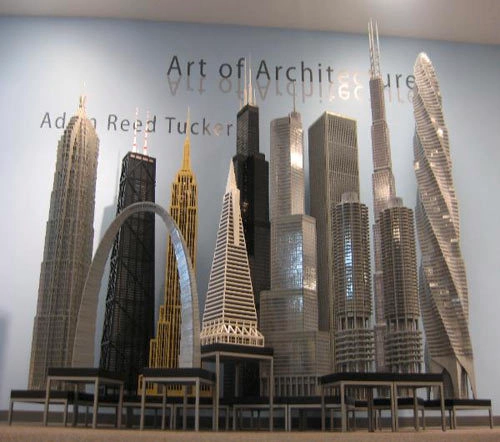
Growing up, LEGO were a staple of most children’s playtime activities to create anything from a house to an entire city for hours at a time. The blocks were so captivating that it seems that even as we outgrow our childhood years, we can never outgrow the toys. Previously, we’ve featured projects that have shown James May’s LEGO addiction…his actual house is built from LEGOs! Yet, May isn’t the only one to still show an interest in the children toys – architect Adam Reed Tuckerhas created 15 large scale buildings from around the world just using the blocks. The buildings are the focal point of the exhibition LEGO® Architecture: Towering Ambition at the National Building Museum in Washington, DC.
Last month, we featured a post about James May, a toy fanatic (and presenter of the television show James May’s Toy Stories), that built a house using LEGO bricks. The house was complete, but unfortunately, it’s now demolished after a deal to sell it didn’t quite go well.
Because the home didn’t have planning permission on its site, the builder was hoping to find a buyer to transport the house elsewhere. LEGOland theme park showed interest, but the high cost of transportation didn’t make seem like a good deal. The 3.3 million LEGO bricks used to build the home will be donated to charity once the home is teared down.
Seen at designboom. More images of James May with the completed house and demolition process after the break.