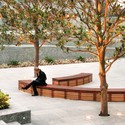
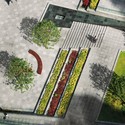
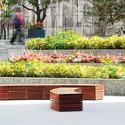
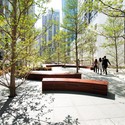
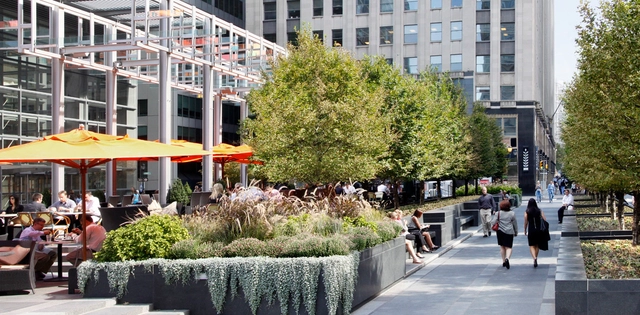
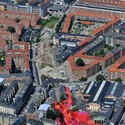
Skidmore, Owings & Merrill (SOM) and PWP Landscape Architecture shared with us their proposal for the 8 Washington development in downtown San Francisco. The plans will continue the revitalization and support enjoyment of the historically under-utilized northeast waterfront by reconnecting the City with the Bay and providing housing and community amenities which include: dynamic pedestrian corridors linking Pacific Avenue and Jackson Street with The Embarcadero; a children’s play area featuring interactive sculptural gardens; an expanded health and aquatics center; cafés, restaurants and retail; and centralized underground public parking for the Ferry Building Waterfront Area. More images and project description after the break.
The quaint and picturesque suburbs have insulated themselves against the urban environment with miles of highways, strip malls and the traffic between endless sprawl. To get to the artificial nature of surburban streets and parks you must first make an exodus out of the city, arriving in an area that is usually unwalkable: no sidewalks, large streets impossible to cross and large distances between destinations. Kaid Benfield looks at Montgomery County, Maryland’s streetscape initiative to address some of these issues in his article “Fixing Suburbs with Green Streets that Accommodate Everyone”.
Bosco Verticale, by Boeri Studio (now recognized as Barreca & La Varra and Stefano Boeri Architetti), is a high-density tower block that experiments with the integration of a lush landscape within the facade of the architecture. The Vertical Forest, currently in construction in Milan, Italy, deal with the concept of regenerating the lost forests on the ground within the inhabitable space of buildings. The towers are 80 metres and 112 metres tall. Together they will have the capacity to hold 480 big and medium sized trees, 250 small size trees, 11,000 groundcover plants and 5,000 shrubs – the equivalent of a hectare of forest. For more on this project, follow us after the break.
Karres en Brands Landschapsarchitecten + Polyform Arkitekter recently won the international competition for redesigning the Museum Garden of the Statens Museum for Kunst in Copenhagen, with their entry ‘SMK tilbage i Parken’ (‘SMK back in the park’). The project will be realized in collaboration with Svava Riesto, Oluf Jørgensen Ingeniører and Via Trafik. The design is based on the concept of connecting the museum garden with the neighbouring park Østre Anlæg, where, in the current situation, it turns its back on. By doing so, the SMK will be embedded into the park and the Museum Garden becomes the new entrance area for both the SMK and Østre Anlæg. More images and architects’ description after the break.
Located on the floodplain of Rio Tamanduateí, one of the most important rivers of the city of Sao Paulo, Brazil, Park D. Pedro II is a symbolic public space, with important historic buildings with its connection between the center of town (the historical hill) and the east zone. The transformation by Una Architects, H+F Architects, Metrópole Architects and Lume of the Park D. Pedro II, beyond its internal limits, has as premise of an urban redevelopment that could radiate qualities to the surrounding neighborhoods. Briefly, the plan provides three axes of intervention. More images and architects’ description after the break.
The ideas of the project by Imago for the Jøssingfjorden competition is to link the landscape to the new building and the building to the entire scenario of Jøssingfjorden; it’s valleys and context, both visual, historical and technological. The architecture of the proposal will express the power and intentions that people have had for generations. It will make use of the most developed technologies and formal principles as they did according to their time. More images and architects’ description after the break.
Landscape: PLANT Architect Location: Dublin, Ohio, USA Project Team: Lisa Rapoport, Chris Pommer, Mary Tremain, Lisa Moffitt, Olivia Mapue, Elise Shelley, Jane Hutton, Heather Asquith Project Year: 2009 Photographs: Stephen Evans