1. ArchDaily
  2. Interviews

Interviews: The Latest Architecture and News

Green Products Innovation Institute, Inc / Cradle to Cradle

Subscriber Access | 
Green Products Innovation Institute, Inc / Cradle to Cradle - Image 1 of 4

Yesterday, architect William McDonough and chemist Dr. Michael Braungart launched their Green Products Innovation Institute, Inc. , an addition to their Cradle to Cradle Movement® (C2C). This new non-profit organization is focused on being a valuable resource for all consumers, and ultimately, will help people achieve a higher level of environmentally safe and healthy products. The driving force behind the movement is that through the innovation of “redesigning products and ingredients to become nutrients, and enabling old products to become the raw material for new goods and services” a cycle of reusing elements will eliminate waste.

Smart Green Home 2010

Subscriber Access | 

Anand Bungalows shared with us their 1st Upcycle Container Home in Malaysia. A green design that doesn’t look like a container at all.

Emilio Ambasz Award for Green Architecture - International Prize winners

Subscriber Access | 
Emilio Ambasz Award for Green Architecture - International Prize winners - Image 1 of 4

The Emilio Ambasz Prize for Green Architecture were awarded in Israel. Among all the categories, there’s an International Prize for buildings outside Israel. You can check the International Prize winners after the break, and see all the winners right here.

Lace Hill / Forrest Fulton Architecture

Subscriber Access | 
Lace Hill / Forrest Fulton Architecture - Image 26 of 4

For Forrest Fulton Architecture‘s competition proposal, the Alabama-based firm designed a 900,000 sqf biomorphic spatial surface that connects the adjacent city and the landscape. The architecture focuses on creating an urbanistic landscape that morphs the common urban element of Yerevan, the superblock, to the site, a truncated hill along the natural amphitheater of the Yerevan. This new model of development supports a “holistic, ultra-green lifestyle” with overlapping natural and urban phenomenon.

More images and more about the project after the break.

2010 AIA/COTE Top Ten Green Projects

Subscriber Access | 
2010 AIA/COTE Top Ten Green Projects - Image 2 of 4

Earth Day today, just in time to annunce the top ten examples of sustainable architecture and green design by the AIA and its Committee on the Environment (COTE). Check them all after the break.

BC House / GLR Arquitectos

Subscriber Access | 
BC House / GLR Arquitectos - Image 17 of 4

GLR Arquitectosresidence in Nuevo Leon, Mexico sits on higher topography than its neighboring houses. This “privileged situation” provides the home with greater height, and as a result, better vistas toward the National Park of Chipinque. The home is comprised of simple, pure geometric volumes that intend to evoke an image of lightness within a language of heavy and massive volumes.

More about the project after the break.

Roadmap 2050: A Practical Guide to a Prosperous, Low-Carbon Europe.

Subscriber Access | 

AMO is a design and research studio inside OMA, a think tank operating on the boundaries of architecture: media, politics, sociology, sustainability, technology, fashion, curating, publishing and graphic design. Some of their works include the barcode flag for the EU and a study for Wired magazine.

And while OMA covers sustainable strategies on a building or master plan scale, AMO is approaching it on en European scale as one of the five consultants conducting technical, economic and policy analyses for Roadmap 2050, an initiative by the European Climate Foundation which looks to chart a policy roadmap for the next 5-10 years based on the European leaders’ commitment to an 80-95% reduction in CO2 emissions by 2050. You can download a brief of Roadmap 2050 in PDF.

Roadmap 2050: A Practical Guide to a Prosperous, Low-Carbon Europe. - Image 5 of 4
Roadmap 2050 © AMO

The goal is to achieve a 2% energy efficiency saving per year in order to meet this goal, with power and vehicle transportation being the most important areas.

Through the complete integration and synchronization of the EU’s energy infrastructure, Europe can take maximum advantage of its geographical diversity. The report’s findings show that by 2050, the simultaneous presence of various renewable energy sources within the EU can create a complementary system of energy provision ensuring energy security for future generations.

AMO’s work focuses on the production of a graphic narrative which conceptualizes and visualizes the geographic, political, and cultural implications of the integrated, decarbonized European power sector.

On their study you can find an interesting approach to a diverse european energy grid, including energy trade and the use of new non-traditional sources.

Roadmap 2050: A Practical Guide to a Prosperous, Low-Carbon Europe. - Image 1 of 4
Eneropa © AMO

The image of “Eneropa” appears as a new continent based on its energy production: Biomassburg, Geothermalia, Solaria, the Tidal States… are part of this new territory. Other branding concepts are introduced on the study, creating a tangible image of this ambitious plan, which reminds the powerful (yet simple) idea behind the barcode flag.

You can download the full study in PDF format at the Roadmap 2050 website.

More after the break:

Fincube / Studio Aisslinger

Subscriber Access | 

Fincube / Studio Aisslinger - Featured Image

Based in Germany, Studio Aisslinger‘s new housing prototype is modular, sustainable and transportable. The low energy house, named ‘Fincube’, is comprised of thin horizontal “ledges” of locally grown wood that wrap the slightly bulging form. This second facade layer provides privacy for the inhabitants and fuses the man-made structure with its natural surroundings. The home provides 47 sqm of living space with a minimal CO2 footprint, and can also be easily dismantled and rebuilt on a different site. The supporting structure is made of local larch and the interior is a combination of larch and stone-pine. Organized in a helical structure, the entrance area blends into a generous open kitchen with an adjacent living space, and around the corner rests the bedroom.

More images after the break.

Rising Currents at MoMA

Subscriber Access | 
Rising Currents at MoMA - Image 30 of 4

Organized by MoMA and PS 1 Contemporary Art Center, the Rising Currents exhibit cannot be missed by architects, ecologists, or green enthusiasts…let alone any New Yorker. The exhibit is a cohesive showcase of five projects which tackle the lingering truth that within a few years, the waterfront of the New York harbor will drastically change. Dealing with large scale issues of climate change, the architects delve into a specific scale that we can recognize and relate to. The projects are not meant to be viewed as a master plan, but rather each individual zone serves as a test site for the team to experiment. The projects demonstrate the architects’ abilities to look passed the idea of climate change as a problem, and move on to see the opportunities it presents. Barry Bergdoll, the Philip Johnson Chief Curator of Architecture and Design at MoMA, explained, “Your mission is to come up with images that are so compelling they can’t be forgotten and so realistic that they can’t be dismissed.”

More about each zone after the break.

AD Interviews: Scot Horst

Subscriber Access | 
AD Interviews: Scot Horst - Archdaily Interviews
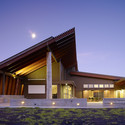
LEED Platinum: Water+Life Museum Campus / Hemet, California / Lehrer + Gangi Design + Build (image courtesy Benny Chan w/ Fotoworks)

Over the past decade, sustainable design has been transformed from a fringe movement to big business. However, given the sheer scale of the environmental damage caused by the built environment, it’s clear that far more must be done. To prevent future catastrophes, the industry must both scale up its green initiatives and increase their effectiveness.

On the quantity front, the entity most responsible for the explosion of green building is LEED. Developed in 2000 by the US Green Building Council (USGBC), the voluntary project rating system has won over the industry by providing both a convenient set of guidelines for sustainable practices and a clear marketing incentive for designers and firms to go green (or at least appear to).

Urban Farming in numbers

Subscriber Access | 

Interesting study by MVRDV, The Why Factory and Stroom Den Haag.

AD Interviews: OFIS Arhitekti

Subscriber Access | 

While in Croatia, I took some time to visit Ljubljana, Slovenia, and interview OFIS Arhitekti. The practice was founded in 1998 by partners Rok Oman and Spela Videcnik, both graduates from the Ljubljana architecture school and the Architectural Association.

Transbay Transit Terminal / Pelli Clarke Pelli Architects

Subscriber Access | 
Transbay Transit Terminal / Pelli Clarke Pelli Architects - Image 3 of 4

San Francisco’s newest transit hub will centralize all the transportation in the city by accomodating nine systems under one roof. Pelli Clarke Pelli Architects have designed a new terminal, a 1.3 mile extension of the Caltrain rail line, and the redevelopment of the surrounding area which will add 2,600 new homes, a 5.4 acre park roof and a retail street. And a loan of over $170 million given by the Transportation Infrastructure Finance and Innovation Act has given the project an extra push foward. Once completed in 2014, the terminal will include wind turbines, geothermal heating methods and a graywater recycling system. The hub will be a strong message that green technology can successfully be combined with modern transportation. “We are thrilled to be one of the first modern rail stations in the United States to achieve this historic milestone and look forward to continuing to make progress on the Transbay Project,” explained Maria Ayerdi-Kaplan, Executive Director of the Transbay Joint Powers Authority (TJPA).

More images and a video of the project after the break.

fORaLLtHEcOWs / CTRLZ architectures

Subscriber Access | 
fORaLLtHEcOWs / CTRLZ architectures - Image 4 of 4

Working with the idea of “creating a society that is based on quality not quantity, on cooperation and not competition,” CTRLZ architectures have rethought a new model for, not just a building, but rather for society. Due to the on-going “cultural revolution” we are experiencing, the way we approach solving the problems of the world have changed, and architecture along with it. Now, the architect must not merely respond to designing spaces, but to other factors, such as society, energy, the internet, and politics, as well. “We believe that architecture is not anymore about form and/or/…function, but that it is about relations. The development of network systems shows us that the power resides in links and connections.”

More about the model and more images after the break.

Edible Schoolyard / Work AC

Subscriber Access | 
Edible Schoolyard / Work AC - Image 8 of 4

Work AC, in collaboration with Edible Schoolyard NY and the Alice Waters’ Chez Panisse Foundation, is designing a new schoolyard for PS216 that will offer the young New Yorkers a different learning experience. The Edible Schoolyard is designed as a series of interlinked sustainable systems where the building will produce energy and heat, collect rainwater, process compost and sort waste with an off-grid infrastructure.

More images and more about the school after the break.

Underground Hotel / ReardonSmith Architects

Subscriber Access | 
 Underground Hotel / ReardonSmith Architects - Image 2 of 4

When asked to design a luxury hotel and spa at Hersham Golf Club in Surrey (which is within London’s Green Belt) ReardonSmith Architects responded with plans for a subterranean building. Matthew Guy, ReardonSmith’s project designer, explained “Our concept integrates hotel, spa, and golf facilities into a single architecturally exciting and organic composition below and above ground. The design fulfills the requirements of the brief for a bespoke five star hotel while returning hard standing to the Green Belt and improving the physical layout and visual attraction of the entire site. It represents a commercially viable solution to developing in the Green Belt and is, we believe, a world-first.”

More about the hotel after the break.

Green Lighthouse, Carbon Neutral Faculty building / Christensen & Co Arkitekter

Green Lighthouse, Carbon Neutral Faculty building / Christensen & Co Arkitekter - Higher Education, FacadeGreen Lighthouse, Carbon Neutral Faculty building / Christensen & Co Arkitekter - Higher Education, Facade, Handrail, Chair, TableGreen Lighthouse, Carbon Neutral Faculty building / Christensen & Co Arkitekter - Higher Education, Stairs, Handrail, ArchGreen Lighthouse, Carbon Neutral Faculty building / Christensen & Co Arkitekter - Higher Education, Facade, Beam, Handrail, StairsGreen Lighthouse, Carbon Neutral Faculty building / Christensen & Co Arkitekter - More Images+ 4

AD Round Up: Green Roof Part II

Subscriber Access | 

Sustainability Round Up to end the week. Some really interesting projects may be done using green roof. Here we show you our second part (see the first one here), of previously featured projects with green roof.