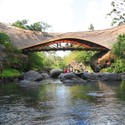
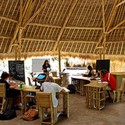
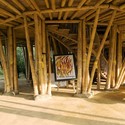
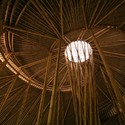
‘The Building: Problem or Solution?’ competition, managed by Faith in Place, encouraged the creative design of religious buildings through the re-use and modification of existing structures. Through the collaborative ideas of architects Onat Oktem, Ziya Imren, Zeynep Oktem and Uri Tzarmotzky, their Green Mosque won the competition’s, “Best Freestanding Religious Structure”. More on the architect’s description and images after the break.
Sustainability has become one of the main issues when designing for any architecture practice around the world, and not only thinking in technological aspects but also in the quality of the community environment. Awarded with the Young Architect Award by AIA Seattle, b9 Architects creates innovative, sustainable, modern architectural solutions utilizing open, connective spaces and maximizing access to natural light. Working through a comprehensive design process, they translate initial concepts into form through text, drawing and modeling, utilizing rhythm and pattern in order to create moments of contrast and difference. Through thoughtful site planning, energy considerations, daylighting and material choices, b9 Architects are committed to working towards achieving carbon neutrality in our built environment.
With this introduction, we would like to present an interview we made to Bradley Khouri, AIA, the Principal and founder of b9 Architects inc. Their work focuses on creating positive change in the urban environment through innovative place-specific modern architecture. Supporting sustainable, transit oriented, walkable communities, b9’s completed works include urban single- and multi-family housing projects, live-work dwellings and commercial interiors.
Short on space but still need the functionality of a kitchen? Check out this cool design we spotted over on Core77 designed by Netherlands-based design firm Studio Gorm. This super efficient and highly compact design creates a “living kitchen” which marries nature with technology. The kitchen provides a place for not only the preparation of food, but also the means to grow, store, and even compost food. Our favorite aspect is the vertical dish rack, which is positioned in such a way so excess water benefits the herds that sit in planter boxes beneath it.
Peruvian architect Carlos Bartesaghi Koc shared with us his project Systemic Agro-Tourism, for which he received an Award of Merit in the 2009 URBAN-SOS Competition. More images and architect’s description after the break.
HOK has infused green strategies into Chicago’s Greenway Self-Park facility – a not so typical place to find sustainable ideas. While the 11 story energy efficient parking garage features a naturally ventilated exterior wall, a cistern rain water collection system, a green roof, and electric car plug-in stations, we can’t get over the dozen wind turbines made by Helix Wind that attach to the external structure.
More about the self-park and more images after the break.
And while large scale initiatives have driven the green building movement here in North America and abroad, some issues have an easier time emerging as hot topics than others (think renewables). There’s no doubt that advances in those areas will, in fact, have positive impacts on the built environment, but there is an emerging group of products, technologies, materials, and design principles that seems to be taking shape in a growing number of buildings scattered across the globe.
I’m an architectural photographer based in London. For the last few years I have been working on a series of images called ecocities. I use some of the commissioned work and some of my personal work and combine this with imagery from stock libraries to produce my own version of an imagined future for London.
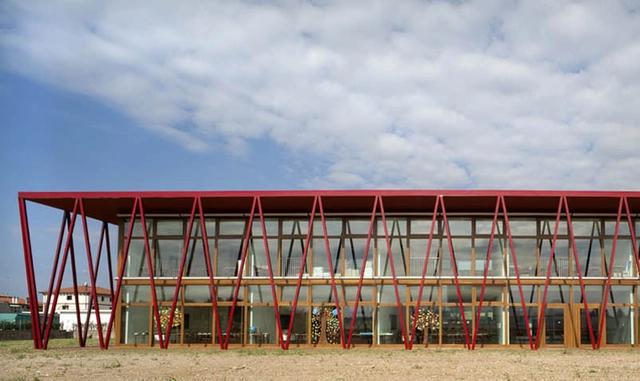
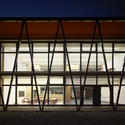
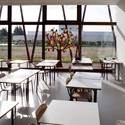
Although we’ve featured dozens of projects that incorporate vertical or roof gardens, we just couldn’t stop looking at this beautiful six story tall green wall by architect Jose Maria Chofre that we spotted at Urbanarbolismo. The articulated design, teamed with the variety of foliage, adds a great texture and personality to the building, a new children’s library in eastern Spain.
More images and more about the green wall after the break.
Antonio Pedro Coutinho shared with us the entry he designed with Estelle Dugachard, Fabiana Araújo, Nanda Eskes, Ricardo Caruana for the competition regarding the expansion of the Environment Museum in Rio de Janeiro, Brazil. The main challenge dealt in this competition was finding a way where the architecture would be inserted on the ecosystem where it was being planned; the magnificent Botanical Garden of the city of Rio de Janeiro.
When we spotted William Leddy’s (the founding principal of Leddy Maytum Stacy Architects in San Francisco) thoughts on Getting Past Green for the Architect’s Newspaper, we completely connected with his words. A few months ago, when we shared Frank Gehry’s comments about LEED, we received an overwhelming number of responses about your opinions of the rating system. Leddy exclaimed, “Let’s get past our paler notions of “green design” and stop fussing over arcane LEED points to get to the real business of fully integrating radical resource- efficiency within our concepts of design excellence. Only then can we whole-heartedly focus the transformative power of design on the greatest challenge of our generation: helping to lead our society to a prosperous, carbon-neutral future. We can afford to do nothing less.”
New Zealand architect, Tim Stephens, shared his HuntingtonUrban Farm design with us. The farm responds to the lack of support for the sustainable practice of growing and cultivating one’s own food source, an important issue Stephens sees as becoming more prevalent as our population increases. The farm provides convenient access to individualized plots of land where users can produce their own food right in the middle of the town.
We have told you in the past about Brad Pitt´s Make It Right Foundation. They have been working with a group of international architects to redevelop the Lower 9th Ward in New Orleans, after hurricane Katrina. The name of the foundation addresses the desire of Pitt, architecture enthusiast, to design these houses the best way and not just as a temporary solution, in a process that also included working not only with these renowned firms, but also very close with the community, with a focus on sustainable development.
George is also a partner at Pei Cobb Freed & Partners. Given his position as a partner on one of the most recognized firms in the US and as the voice of the architects through the AIA, George has a very good idea on the current state and future of the profession. We did our usual set of questions, but also included two things that I find very important: The importance on pushing IPD and the role of the AIA during the financial crisis (and what lessons can be learned after it). We also recommend you to read our article on his position regarding small business taxes, part of his efforts to improve the way architects practice in the US.
We published each question as a separate video so you can easily watch them. On a side note, there is some audio noise due to a bad mic placement. My fault, won´t happen again.
Not so long ago, we featured Cyril-Emmanuel Issanchou’sMaison Eco-rce, a timber residence, and today, we share his EC*-Cocoon, a low energy house. Designed for the competition BETWIN, the low energy houses are prefabricated modules that are installed upon a set of walls and plinths made from locally gathered stones.