Exhibited at the Designers’ Saturday 2012 in Langenthal, Switzerland and at the BAU 2013 in Munich, Germany, the experimental installation “Abstraction” transforms shadows and lights into predefined pixels. Created by architects Peter Thomas Hornung of Hornung and Jacobi Architecture and Axel Schenke, their patented system uses the given material properties of Corian and assigned it with so far unknown qualities. More images and architects’ description after the break.
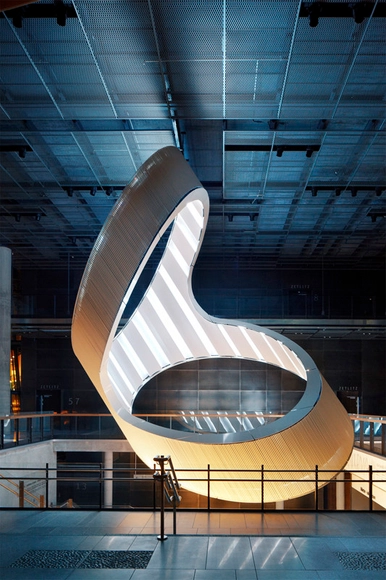
INABA has completed Skylight, a permanent installation for KORO Public Art Norway. The 6.6 m (22 ft) diameter, 11.5 m (38 ft) long structure hangs from the foyer of the New Concert Hall in Stavanger, Norway. It is visible from the adjacent public plaza, and surrounding neighborhood and harbor, serving as a light beacon for the complex.
Responding to the region’s extreme atmospheric conditions, Skylight emits a range of pure color light patterns that contrast and complement the blended luminous tones of the dawn and twilight Nordic sky. Conceived of as an inverted chandelier, Skylight’s light fixtures are mounted to face inward and illuminate the structure’s interior surface. Its programmable LED system is animated to change in brightness and hue, and produce distinct patterns during arrival, theater calls, intermission, departure, and after hours.
Video, images and more information on Skylight after the break.
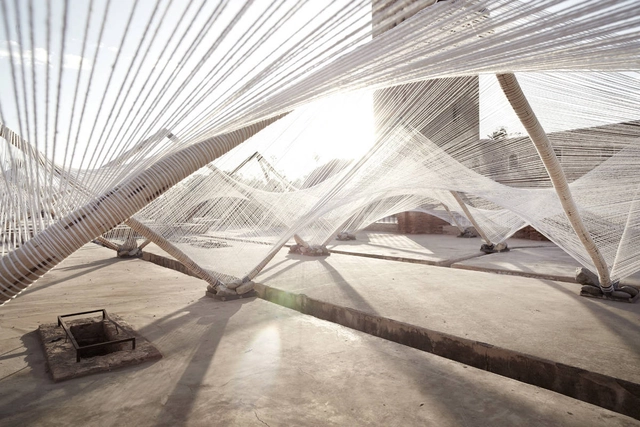
Alderbrook Station, located slightly east of Astoria along the Columbia River, is the site of the former Union Fisherman’s Cooperative Packaging Company, which once supported a thriving salmon fishing industry. The Netshed is a 3-story timber structure which was used by fishermen to repair and store their gill nets. Inspired by the natural and man-made qualities that pervade Alderbrook Station, such as the movement of tides, the light that reflects off the Columbia River, the memories and history contained within and around Alderbrook Station, and the structure of the Net Shed itself, Robert Hutchison and Sarah Biemiller’s shared with us their proposal for an installation inside the Net Shed developed out of numerous influences. More images and architects’ description after the break.
The Principles just recently completed an interactive project, titled the “Workshop”, for the clothing brand Everlane in the Meatpacking district of New York. As part of the Everlane’s “Not-a-Shop” series, which focuses on selling only online, “the space was a physical manifestation of their primarily digital presence; replacing coded interaction with physical interaction,” described The Principals co-founder Drew Seskunas.
Wave Dilfert: Wave (moves in wave-form oscillations) + Dilfert (geek-like intelligence, absorbs information like a sponge).
Wave Dilfert is a new kind of space that reads the changes in light and shadow occurring within it, catalogs and calculates them, then pulses, contracts or expands in reaction. The installation was inspired by the work of Ushahidi; a non-profit, crowdsourcing disaster relief, tech innovator. Much how Ushahidi de-mystifies the complexities of war-torn or disaster ridden locales, The Principals developed a system that could de-mystify the complexities of space through sourcing the information of its users and making it accessible through interaction.
The interactive artwork ‘Lotus Dome’, by artist and architect Daan Roosegaarde of Studio Roosegaarde, was opened in Sainte Marie Madeleine Church in Lille, France. The project, which will be on view until January 13, 2013, is a living dome made out of hundreds of ultra-light aluminium flowers that fold open in response to human behavior. When approached, the big silver dome lights up and opens its flowers. Its behavior moves from soft breathing to a more dynamic mood when more people interact. The light slowly follows people, creating an interactive play of light and shadow. More images and architect’s description after the break.
Designed by Mjölk Architekti, a high seat was installed on the main square in České Budějovice where it stayed for a month. It is situated high up so that it does not interfere with everyday life on the ground and offers sufficient privacy to its occupants. Over the month of the exhibition, this space with a floor area of 6.25 m2 hosted several inspiring personalities, the so-called “urban hunters”. They are the masters of their time and space. All the necessities needed for comfortable living are provided. More images and architects’ description after the break.
HelloWood - a creative, professional and social program with a message that mobilizes more and more young people – was organized for the 3rd year by MOMEline – designworks, together with its new partner Reflekt social architecture studio. The week-long creative camp included 200 Hungarian and international students who worked together to realize social and cultural spaces for eight north-eastern Hungarian communities. The social mission of the project was showcased at Sziget, Europe’s Best Major Festival. Cameron Sinclair, the co-founder of Architecture for Humanity, commended HelloWood’s inspirational initiative for aspiring to social change with thoughtful design for marginalized communities.
Join us after the break for details on some of the projects.
Commissioned by the Greater London Authority as part of the Wonder series to celebrate the 2012 Olympics and Paralympics, BLOOM, designed and developed by Alisa Andrasek and Jose Sanchez from The Bartlett School of Architecture at UCL, is a crowd sourced garden. Designed in neon pink, which is the official Olympics color, BLOOM is conceptualised as an urban toy, a distributed social game and collective “gardening” experience that seeks the engagement of people in order to construct fuzzy BLOOM formations. More images and architects’ description after the break.
Dover Street Market has commissioned Zaha Hadid to design this site-specific installation to showcase in their London store during the 2012 Olympic and Paralympic Games. The concept behind “Aqua” references the formal language of Hadid’s London Aquatics Centre.
Zaha Hadid: “Designing for Dover Street Market is an exciting opportunity to install a piece inspired by the fluid geometries of the London Aquatics Centre: a wave of liquid, frozen in time, right in the heart of London.”
Directed by Romain Tardy & Thomas Vaquié, Omicron installation, the piece proposed for the Centennial Hall of Wroclaw, is based around the notion of timelessness in architecture, and the idea of what future has meant throughout the 20th century. Taking the 1910’s as a starting point (the dome was erected in 1913), historical and artistic references were used to reveal the architecture of the space, its timeless and, more surprisingly, very modern dimension. More images and their description after the break.
At the seventh edition of the International Architecture Festival from June 27-July 1, eme3‘s project brings back the action to the public space. They aim to recover the format of former editions and take back the interventions and organization of activities in different locations of the city center. These locations include some lots and spaces that were abandoned and fell into degradation. Their topic, ‘Bottom Up’, has a participation of around 50 participants coming from 17 countries. More images and architects’ description after the break.
The 244th annual Summer Exhibition at the Royal Academy of Arts, which is held until August 12, features a site specific architectural installation designed by architect and artist Chris Wilkinson, Director at Wilkinson Eyre Architects. Positioned in the center of the RA’s Annenberg Courtyard, From Landscape to Portrait is a 12 meter-long sculpture based on a series of 11 wooden artist’s frames, supported upon a timber structure clad in polished stainless steel. More images and information on the installation after the break.
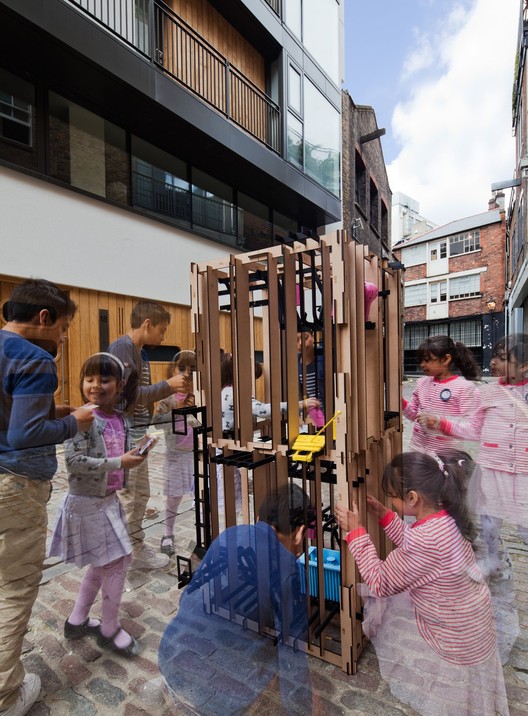
The concept for the ToyBox, a portable installation by Studio Gil , focuses on being a giant toy box for children. A 1500mmX750mm box frame supports three “landscapes” at different heights. These “landscapes” act as a surface and support frame for a series of interactions and games accessed through a screen running along the perimeter of the box. More images and architects’ description after the break.