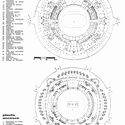
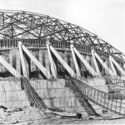
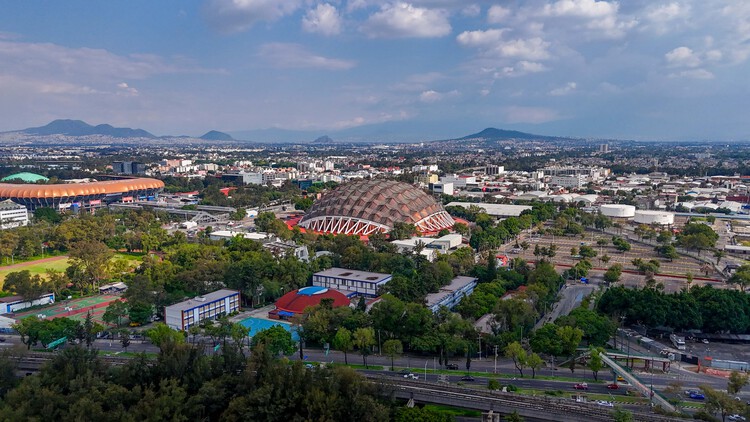
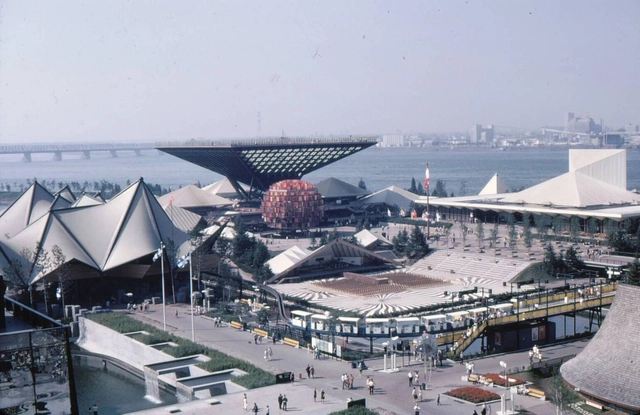
Canada's Expo 67 stands as one of the most successful world expos ever held, setting records and leaving an enduring impact on Montreal's urban landscape. As part of Canada's 100 years celebrations, the event provided an opportunity for the city to showcase its cultural and technological achievements on a global platform. With over 50 million visitors in just six months, it shattered attendance records, including an astonishing 569,500 visitors in a single day. An unprecedented feat for a world fair at the time. Now, 58 years later, and with the Osaka Expo 2025 set to showcase how to design the future society for our lives, it is worth revisiting the legacy of Expo 67 and exploring the urban transformations it brought to Montreal.
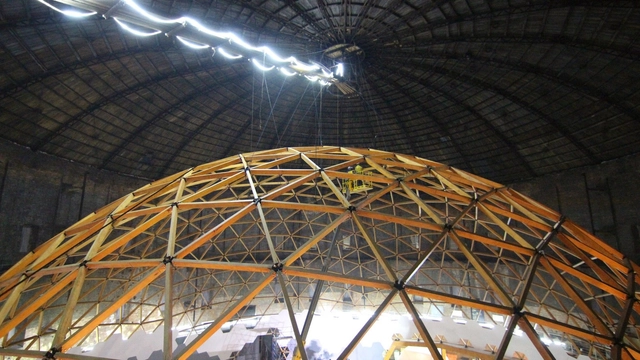
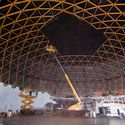
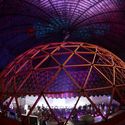
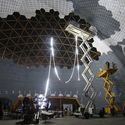
The project inscribed inside a gasholder in St. Petersburg, aims to transform an industrial area into an educational and scientific center with a large projection screen. The fun part? It is located in a large geodesic dome.
The geometric model is made up of mainly with wood and metal links for a light and resistant construction.
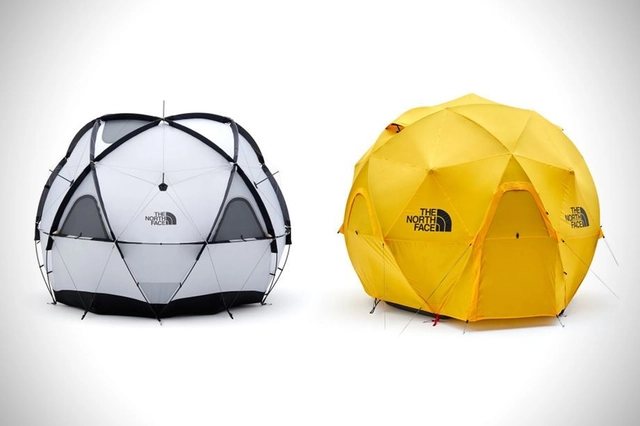
Reinterpreting the teachings of Buckminster Fuller, North Face have announced the latest tent in their collection; a geodesic dome tent. Thanks to the most spatially efficient shape in architecture, it can withstand winds of up to 60 mph as the force is spread evenly across the structure whilst even providing enough height for a six-foot person to stand comfortably inside.
The extremely efficient design has allowed the tent to weigh not much more than 11kg and comprise of 5 main poles and the equator for fast and easy assembly and storage. The outdoor gear company has also considered a water-resistant dual-layered exterior skin for their incredibly strong and sturdy tent to endure whatever mother nature has to throw at it.
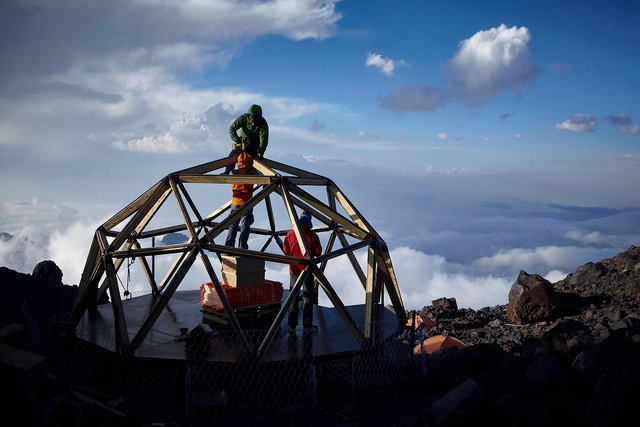
At an altitude of 3,800 meters, Ice-Age architects have designed and produced a compact and lightweight shelter as the last base before climbers venture up Mount Elbrus, the highest point in Europe. Inspired by Buckminster Fuller's 2V geodesic dome, it can sleep up to 16 people as they acclimatize to the altitude and wait for the appropriate weather for the climb.
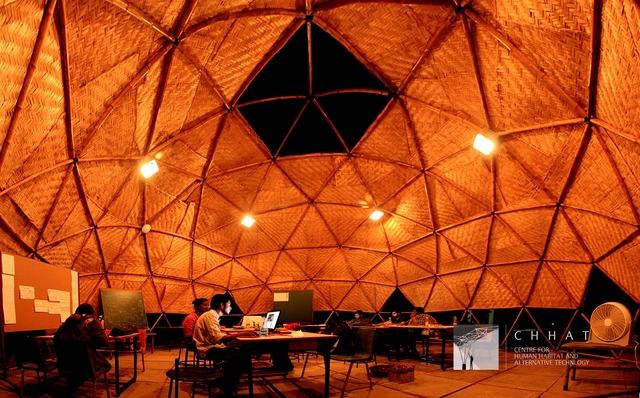
Launched in 2007, The Buckminster Fuller Challenge has quickly gained a reputation for being what Metropolis Magazine once called “Socially-Responsible Design’s Highest Award.” This year, for the first time, a Student Category was reviewed separately from the general applications, however still based upon the same criteria: comprehensiveness, feasibility, replicability, ecological responsibility, and how verifiable and anticipatory the project is. Students from the Centre for Human Habitat and Alternative Technology (CHHAT) claimed the prize with their adaptable and lightweight modular domes, made from natural, local or recycled materials.
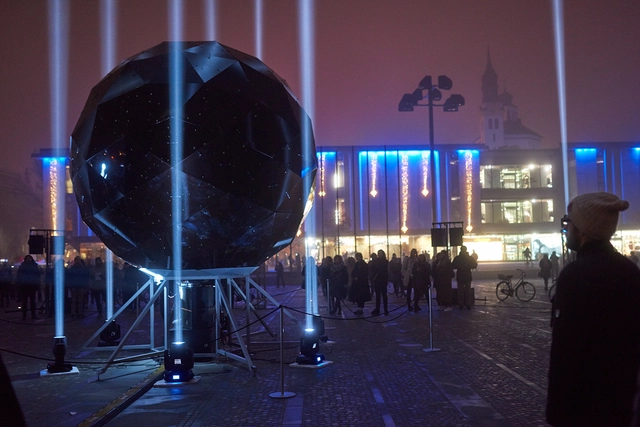
Courtesy of Martin Bricelj Baraga and the Museum of Transitory Art
Slovenian artist Martin Bricelj Baraga has created Moonolith, a monument to the moon and stars, in collaboration with the City of Ljubljana, Slovenia. Based on the modular design of Buckminster Fuller’sgeodesic dome, Moonolith “is a modern three-dimensional squaring of the circle, projected into Euclidean space.”
As a part of the artist’s Nonument series, the installation “[carries] a strong symbolic message in a physical, mental, and virtual space,” reflecting “research of the meaning and development of monuments and the phenomenology of collective memory.”
From the Cobb house to the world's first 3D printed mansion, this short animated film illustrates the history of housing from 25,000 BC to now. Published on The Atlantic, the film was authored by Jackie Lay.
"I must reorganize the environment of man by which then greater numbers of men can prosper,” says Buckminster Fuller in this rare interview on the Geodesic Life with Studs Terkel (recorded in 1965 and 1970). Animated by Jennifer Yoo and produced by Blank and Blank, this interview has been brought to life as the first of “The Experimenters” mini-series that features rare interviews with Bucky, Jane Goodall, and Richard Feynman focusing on science, technology and innovation.
On April 19, Southern Illinois University will begin to restore the world’s first geodesic dome home, built by Buckminster Fuller. Originally assembled in just seven hours from 60 wooden triangle panels, the dome was occupied by Fuller and his wife, Lady Anne, in the 1960s during his residency at SIU. After Fuller’s death, the dome was used as student housing before falling into disrepair. In 2001, the home was donated to a non-profit that had it listed on the National Register of Historic Places in 2006. It will now be restored and preserved as a museum in Carbondale.